

FTAI Aviation (NASDAQ: FTAI) has officially transitioned from a compelling aerospace story to an infrastructure powerhouse following a massive breakthrough for its newly formed FTAI Power division. In July 2026, the company announced a staggering $1.465 billion initial purchase order from a leading U.S. hyperscaler for its Mod-1 aeroderivative gas turbine generator sets. This milestone agreement validates FTAI’s ambitious pivot to supply the booming energy demands of AI data centers, leveraging its immense inventory of CFM56 aircraft engines. The five-year master agreement ensures deliveries through November 2027 and includes advance milestone payments that significantly de-risk the project’s working capital.
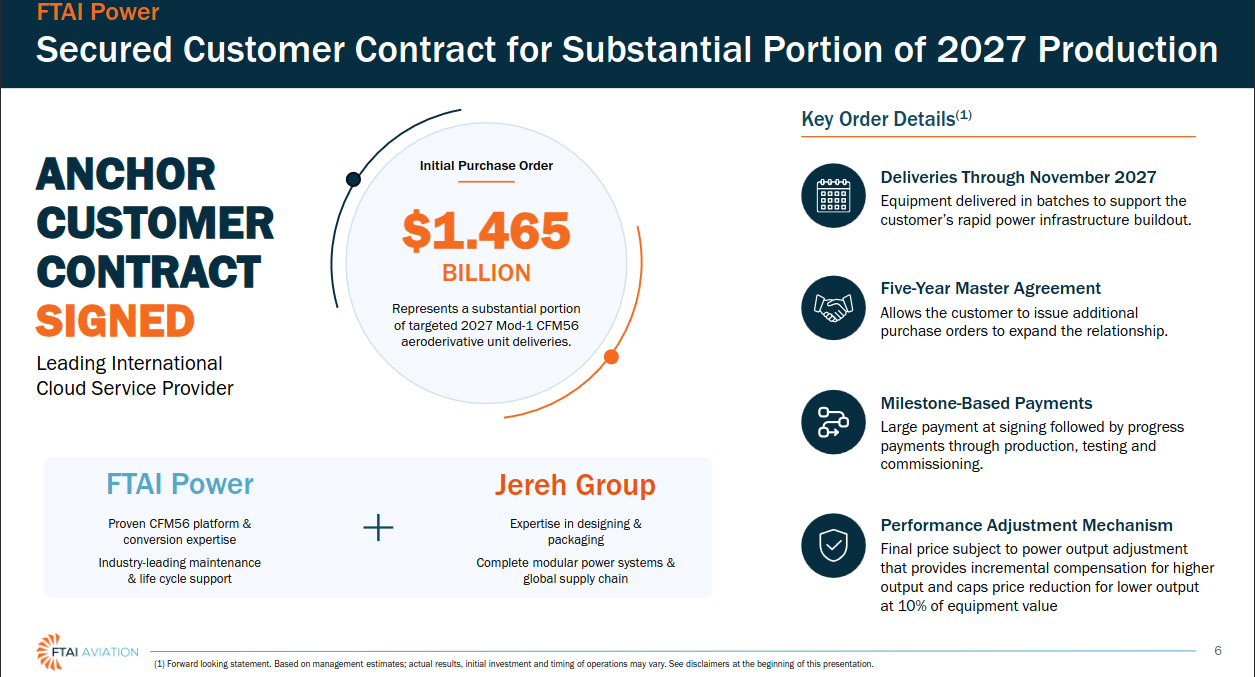
This landmark deal dramatically accelerates the timeline and scale of FTAI Power. The initial order accounts for a substantial portion of the targeted 100 Mod-1 units slated for 2027 delivery, translating to an estimated $450 million in 2027 EBITDA for the power segment alone. By repurposing legacy aerospace assets into 25-megawatt mobile turbines, FTAI is offering hyperscalers unprecedented speed-to-market—installations can take less than two weeks—along with lower maintenance costs via their engine exchange model.
If your interested in the full breakdown of FTAI’s business start here!

The “Why Now?”: Solving the Data Center Power Bottleneck
To understand the magnitude of this $1.465 billion order, one must look at the macro environment of 2026. The artificial intelligence arms race has run headfirst into a physical wall: the electrical grid. As tech giants scramble to deploy power-hungry GPU clusters, they are finding that traditional utility hookups and transmission line upgrades can take three to four years to complete.
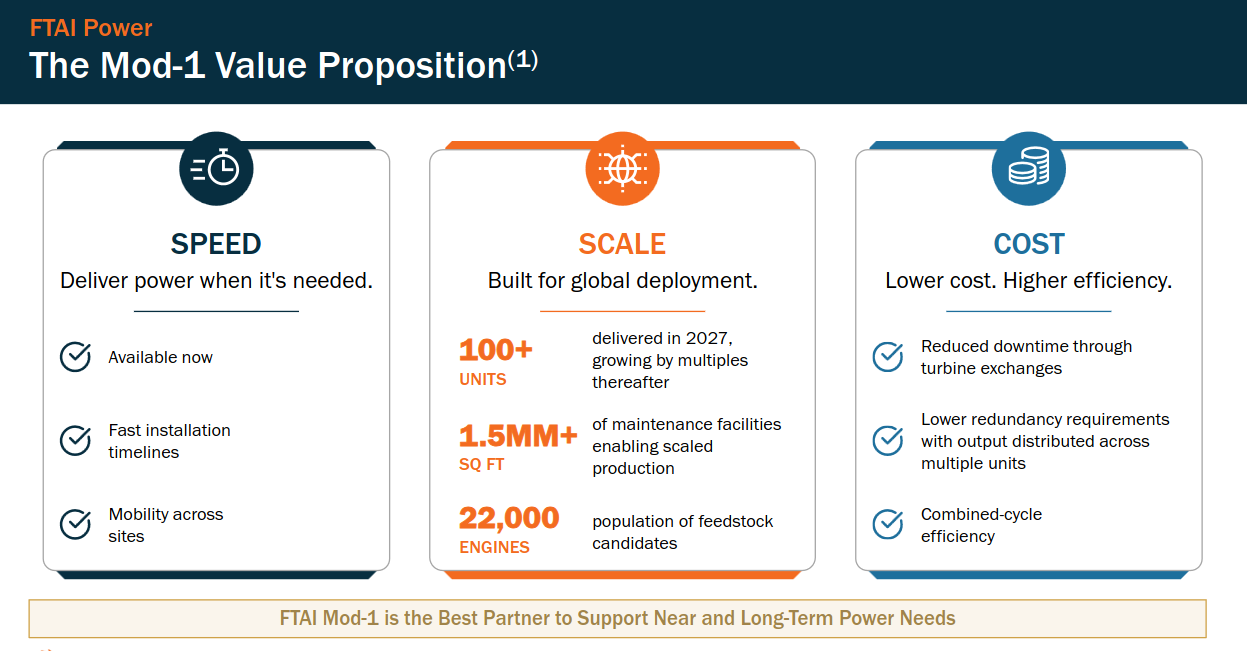
Hyperscalers cannot afford to wait years to power their billion-dollar data centers. This is exactly where FTAI Power steps in. Because the Mod-1 units are effectively jet engines repurposed into modular power plants, they provide “islanded” or supplemental power almost immediately. FTAI’s ability to promise hyperscalers power infrastructure that can be installed and generating electricity in less than two weeks is not just a convenience—it is a critical enabler of the AI revolution.
The CFM56 Moat: An Unmatched Feedstock Advantage
The secret sauce behind the Mod-1 turbine isn’t just the engineering; it’s the raw materials. FTAI is leveraging its massive inventory of CFM56 engines. The CFM56 is the most widely used engine in commercial aviation history, famously powering legacy Boeing 737 NGs and Airbus A320ceos.
As these older aircraft are retired or parted out, a massive “feedstock” of engines becomes available. Because FTAI is already a dominant player in leasing and maintaining these specific engines, they have an entrenched, low-cost supply chain that traditional power equipment manufacturers simply cannot replicate. They are taking an asset they already own, know intimately, and maintain efficiently, and pivoting it into a high-margin industrial product.
Core Aerospace Business Continues to Shine
While the power division grabbed the headlines, FTAI’s core aerospace business delivered record-breaking performance in Q2 2026.
Soaring Revenues: The Aerospace Products segment saw revenues surge 78% year-over-year.
Production Ramp-Up: Module production jumped 61% to 296 units in the second quarter.
Market Share Growth: Driven by its proprietary Maintenance, Repair, and Exchange (MRE) model, FTAI increased its market share from roughly 12% to 14%, with sights firmly set on capturing 25% of the massive commercial MRO market.
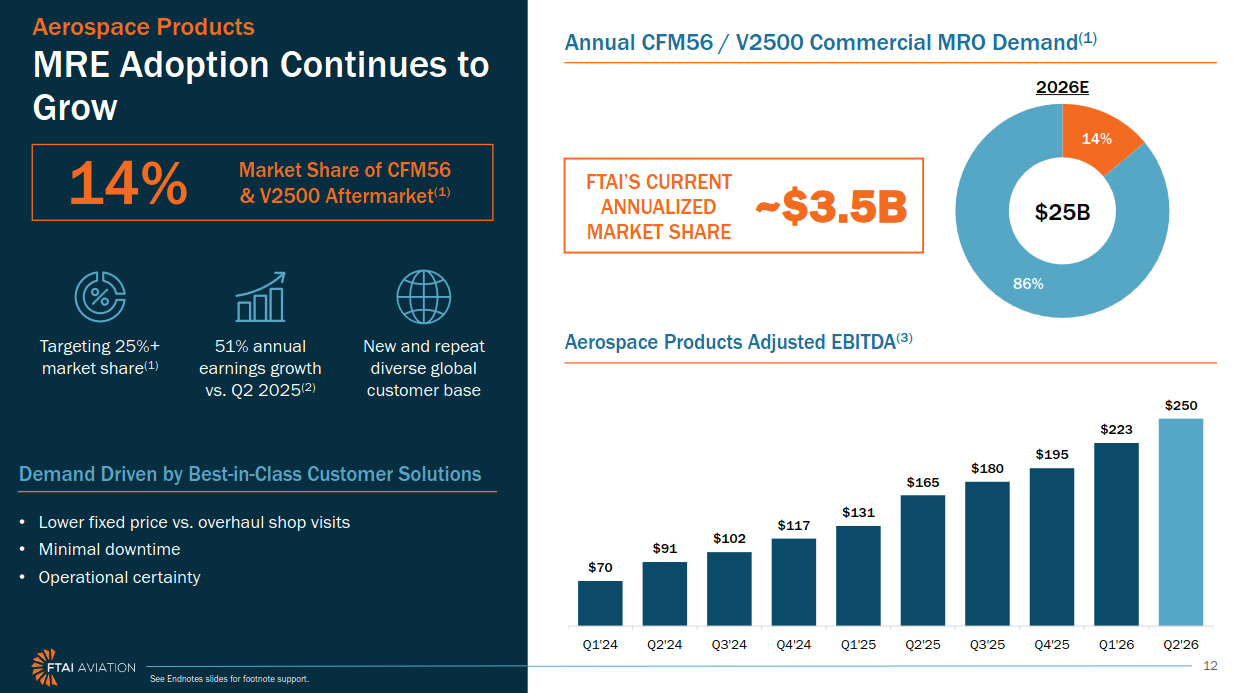
Capacity Expansion: The company has increased its module production capacity to 3,000 per year, ensuring they can support both their aviation customers and the 100 Mod-1 units needed annually for FTAI Power.
The success of the Aerospace Products division allowed management to confidently reaffirm their 2026 Adjusted EBITDA guidance of $1.05 billion for this segment and raise full-year module production estimates to 1,200 units.
Strategic Shift: Transitioning to Asset-Light
Investors should note a strategic shift in FTAI’s legacy business. The company is accelerating its transition toward an “asset-light” model, which is altering the earnings profile of its Aviation Leasing division.
Because FTAI is prioritizing highly profitable third-party module sales over replenishing its internal leasing fleet, 2026 Aviation Leasing EBITDA guidance was revised downward to $475 million. This near-term decline is a deliberate move as older Special Purpose Vehicles (SPVs) transition to harvest mode and the company launches a new 2026 SPV with a massive $6 billion target. The goal is to aggressively scale asset management toward $20 billion AUM, swapping capital-intensive leasing for lucrative management fees and third-party sales.
The Bottom Line
FTAI Aviation is firing on all cylinders. The integration of its dominant aerospace aftermarket services with a rapidly scaling power division presents a unique and compelling investment narrative. The company has introduced a highly ambitious 2027 total segment EBITDA guidance of $2.3 billion ($1.4B Aerospace, $450M Power, $450M Leasing). Furthermore, demonstrating immense confidence in their cash flow generation, the board raised the quarterly dividend to $0.50 per share in Q2—the fourth consecutive increase.
While execution risks remain as FTAI Power scales production for its new hyperscaler client, the $1.465 billion order removes significant uncertainty. For investors, FTAI is no longer just an aviation play; it is rapidly becoming a critical infrastructure partner for the AI revolution.
Management Commentary and Future Sales Guidance
During the Q2 2026 earnings call, CEO Joseph Adams provided crucial context regarding future sales and whether the company expects to sell out of its Mod-1 inventory. Management introduced a 2027 EBITDA guidance of $450 million for the power segment, but Adams clarified that this figure is highly conservative. It assumes the delivery of materially fewer than their full 100-unit annual capacity, a cautious approach meant to reflect standard startup and scaling risks.
In reality, management modeled a range of outcomes from $450 million up to $750 million in EBITDA for the segment and chose the bottom end where they currently have the highest conviction and visibility. While FTAI has not officially “sold out” its 2027 production slots just yet, Adams noted that the unit economics on the initial $1.465 billion hyperscaler contract align perfectly with their previous expectations. As FTAI signs on additional data center clients to fill out the remaining 2027 Mod-1 capacity, management fully expects to revise that $450 million figure upward.
The fundamental update is clear: FTAI is executing flawlessly on its legacy business while sitting on a billion-dollar AI catalyst. But what does this mean for the stock’s valuation today?
In the premium section below, I break down the actionable investment thesis. We’ll explore the catalyst for significant multiple expansion, walk through two proprietary DCF models with specific 5-year price targets (including an aggressive projection showing a robust 25%+ return), and uncover if this stock offers a rare combination of hyper-growth with a built-in “margin of safety.” Upgrade your subscription to unlock the models and the final verdict.