

ALERT 25 minute video including a breakdown on valuation and the base, bear, and bull case included in this business breakdown!
If you want to understand the future of banking, you don’t look to Wall Street. You look to São Paulo.
A little over a decade ago, the Brazilian banking sector was a notoriously hostile oligopoly. Five massive incumbents controlled 80% of the market, generating astronomical profits not through innovation, but through extraction. They charged some of the highest interest rates and fees in the world while subjecting their customers to hours-long lines, bureaucratic nightmares, and a profound lack of respect.
Then came a purple credit card.
When David Vélez, Cristina Junqueira, and Edward Wible launched Nubank (Nu) in 2013, they had a simple, audacious goal: fight complexity and empower people. They built a branchless, cloud-native digital bank with a fundamentally different cost structure, allowing them to offer fee-free products to the masses and actually treat customer service as a competitive advantage.
The incumbents laughed it off. They argued that a digital-only bank offering free products to emerging-market consumers could never generate meaningful returns.
They were wrong.
Today, Nubank is no longer just a scrappy disruptor; it is a $50 billion financial titan. With over 135 million customers across Brazil, Mexico, and Colombia, Nu is one of the fastest-growing and most profitable financial institutions on the planet, boasting a Return on Equity (ROE) that puts traditional US mega-banks to shame. And with a bold entry into the United States on the horizon for 2027, their ambitions have officially gone global.
But at a current valuation of roughly $14.00 a share, is the massive growth already priced in? Or is this generational compounder just getting started?
In this breakdown, we are going to look under the hood of the Nubank machine. We will explore the structural moats that allow them to serve customers for $0.80 a month, decode their multi-product profit flywheel, analyze their audacious international expansion, and run the DCF models to determine if Nu is a buy at current levels.
Let’s dive in.
Table of Contents
Beyond Brazil: Nubank’s Global Expansion and Future Growth Strategy
25 minute video detailing Nu and walk-through the DCF’s
By the Numbers: Nubank’s Financials and Key Performance Indicators (KPIs)
Check the Scorecards Want to see how our research grades out? View our 1-page fundamental breakdowns—scoring every company on Growth Potential, Profitability, Balance Sheet, Return on Capital, Shareholder Yield, Management, Moat, and Execution Certainty

Deep dives are only half the equation. Join me as we put this research into practice and build a high-conviction allocation strategy from the ground up in the CompoundingAlpha Tracking Portfolio.

To understand the Nubank of today—a fintech behemoth boasting over 100 million customers—we must look back at its origins. The story of Nubank is one of challenging a deeply entrenched, highly concentrated banking oligopoly in Brazil, armed with little more than a vision for better, fairer financial services and a relentlessly customer-centric approach.
Here is a look at the key milestones in Nubank’s journey from a bold startup to a dominant financial force in Latin America.
2013: The Seed is Planted
The Catalyst: David Vélez, a Colombian venture capitalist working for Sequoia Capital in Brazil, experiences firsthand the excruciating, bureaucratic, and hostile process of opening a bank account in the country. He realizes the Brazilian banking sector—dominated by five major banks controlling 80% of the market—is ripe for disruption. These incumbents charged some of the highest interest rates and fees in the world while providing famously poor customer service.
Founding: Vélez teams up with Cristina Junqueira (a Brazilian engineer with deep experience in traditional banking and credit cards) and Edward Wible (an American computer scientist). Together, they found Nubank in São Paulo, Brazil.
The Mission: Their goal is simple but audacious: to fight complexity and empower people by returning control over their finances. They aim to build a financial institution that is transparent, fully digital, and completely free of the notorious abusive fees common in Brazil.
Initial Funding: Sequoia Capital and Kaszek Ventures provide the crucial $2 million in seed funding to get the operation off the ground.
2014: The Purple Card Arrives
The Launch: Nubank launches its first product: a no-fee, international Mastercard credit card, managed entirely through a mobile app. The iconic purple card (the “roxinho”) is born.
The Strategy: To manage risk and build exclusivity, the card is initially offered on an invitation-only basis. The waitlist quickly balloons, driven by intense word-of-mouth marketing and dissatisfaction with traditional banks. The app offers unprecedented features for the Brazilian market, such as real-time tracking of purchases, category tagging, and the ability to easily block/unblock the card.
2015-2016: Scaling and Gaining Traction
Explosive Growth: Despite the severe economic recession in Brazil during this period, Nubank experiences phenomenal growth. The demand for a fee-free, user-friendly credit card outstrips expectations.
Series B and C: The company secures significant funding rounds from prominent investors like Tiger Global Management, Founders Fund, and DST Global, validating its business model and fueling further expansion.
2017: Expanding the Ecosystem
NuConta (now Nu Account): Nubank takes a major step toward becoming a full-service financial platform by launching its digital savings account, the NuConta. This account offers transfers (TEDs) free of charge and automatically yields interest on deposits at a rate higher than traditional savings accounts, further attracting customers away from incumbent banks.
Rewards Program: The company introduces Nubank Rewards, a proprietary loyalty program where points never expire and can be used to erase purchases from the credit card bill.
2018: Becoming a Unicorn
Unicorn Status: Following a Series E funding round led by Tencent, Nubank achieves a valuation of over $1 billion, becoming one of the first tech unicorns in Brazil.
Debit and Cash Withdrawals: The functionality of the NuConta is expanded to include a debit card option and the ability to make cash withdrawals, bridging the gap between digital and physical banking.
2019: Crossing Borders and Broadening Horizons
International Expansion begins: Nubank takes its first steps outside Brazil, announcing its expansion into Mexico (under the brand “Nu”) and Argentina (an operation that was later paused to focus on other markets).
Lending: The company begins offering personal loans to its Brazilian customer base, leveraging its vast trove of data to underwrite credit more effectively than traditional banks.
PJ Account (SME): Recognizing the struggles of small businesses, Nubank launches a digital account specifically for small and medium-sized enterprises (SMEs).
2020: Accelerating Through the Pandemic
Acquisitions: Nubank makes its first strategic acquisitions, buying Plataformatec (a software engineering firm) and Cognitect (the company behind the Clojure programming language, which Nubank heavily uses), bolstering its technical capabilities.
Life Insurance: The company enters the insurance market with the launch of Nubank Vida, offering affordable and easily accessible life insurance directly through the app.
Expansion to Colombia: Nubank announces its expansion into Colombia, David Vélez’s home country.
2021: The Big Debut
Easynvest Acquisition: Nubank acquires Easynvest, a leading digital investment platform in Brazil. This move rapidly accelerates Nubank’s entry into the investment market, allowing it to offer a wide range of investment products to its massive user base (later rebranded as NuInvest).
Going Public (IPO): In a historic milestone, Nubank (Nu Holdings Ltd.) goes public on the New York Stock Exchange (NYSE) under the ticker symbol “NU”, and simultaneously lists Brazilian Depositary Receipts (BDRs) on the B3 exchange in São Paulo. The IPO raises over $2.6 billion, valuing the company at over $40 billion and making it, briefly, the most valuable financial institution in Latin America.
2022-2023: Profitability and Consolidation
The Pivot to Profitability: After years of focusing primarily on aggressive customer acquisition and top-line growth, Nubank proves its business model by achieving consistent, record-breaking profitability. This demonstrates the immense operating leverage of its low-cost, digital-only model.
Crypto Launch: Nubank introduces Nubank Cripto, allowing users to easily buy, sell, and hold cryptocurrencies like Bitcoin and Ethereum directly within the main app.
Mexican and Colombian Growth: The operations in Mexico and Colombia begin to show significant traction, proving that the Nubank playbook can be successfully replicated outside of Brazil. In Mexico, Nu quickly becomes one of the largest issuers of new credit cards.
2024: The 100 Million Milestone
A Historic Landmark: In May 2024, Nubank reaches a staggering milestone: 100 million customers globally (across Brazil, Mexico, and Colombia). This makes it the first digital bank outside of Asia to reach this scale.
Expanding the Product Suite: Nubank continues to aggressively launch new products, including high-yield savings accounts in Mexico (Cajitas), expanding credit offerings, and further integrating NuInvest into the core app to create a comprehensive financial hub.
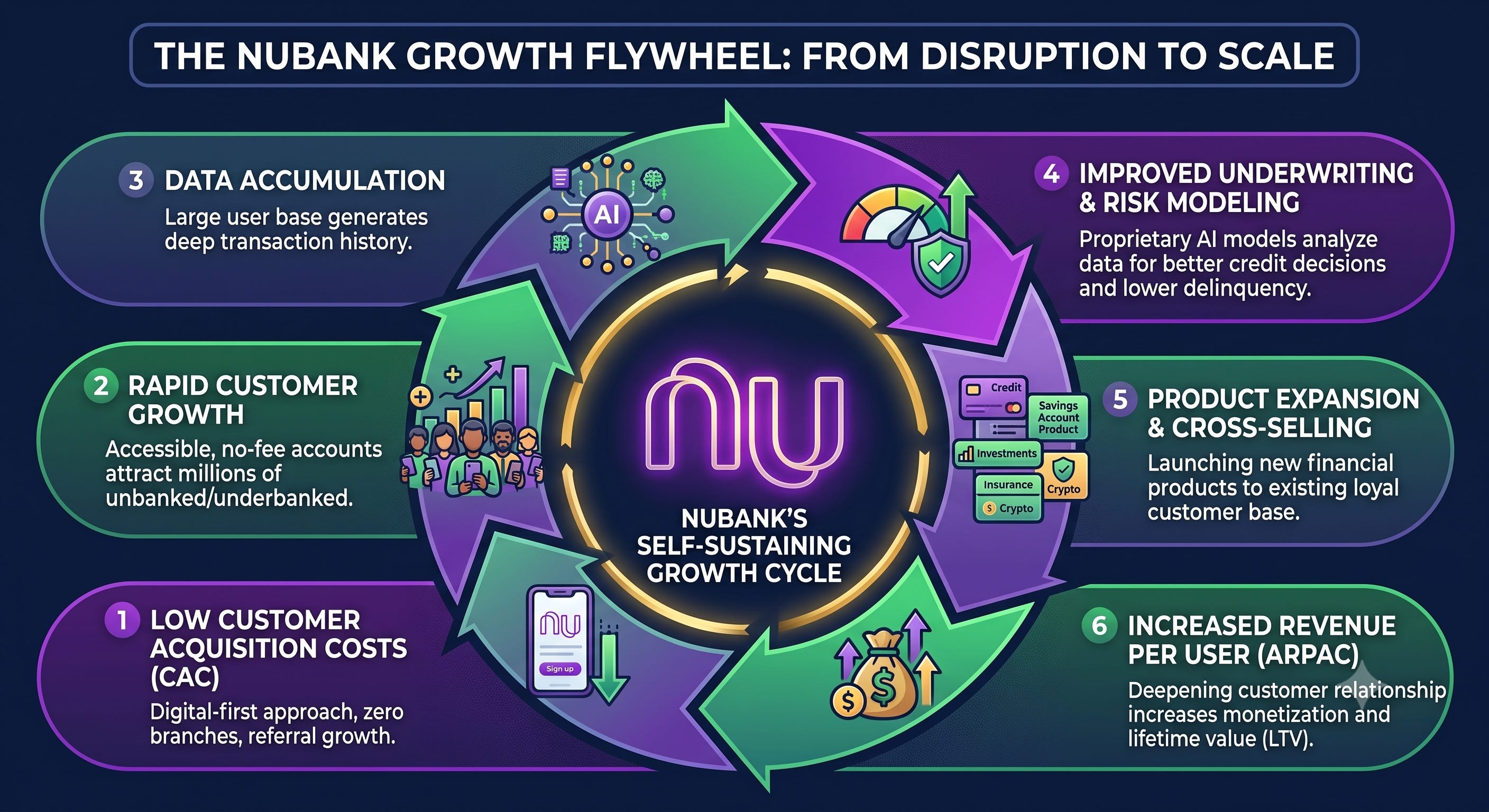
If Nubank’s history is a story of disruption, its product ecosystem is a masterclass in unit economics and cross-selling. Traditional banks operate on a high-friction, high-cost model: heavy physical branch networks, bloated legacy technology, and aggressive fees used to offset overhead.
Nubank flipped this equation. By operating an entirely cloud-native, branchless infrastructure, their average monthly cost to serve a customer sits astonishingly low—around $0.80. This structural cost advantage allowed them to launch free core products to acquire users massively, and then build a highly profitable ecosystem around them. Today, with over 130 million customers globally and an Average Revenue Per Active Customer (ARPAC) steadily climbing past $15, the “Nu” ecosystem is a multi-headed profit engine.
Here is a breakdown of Nubank’s core product segments and how each one actually makes money.
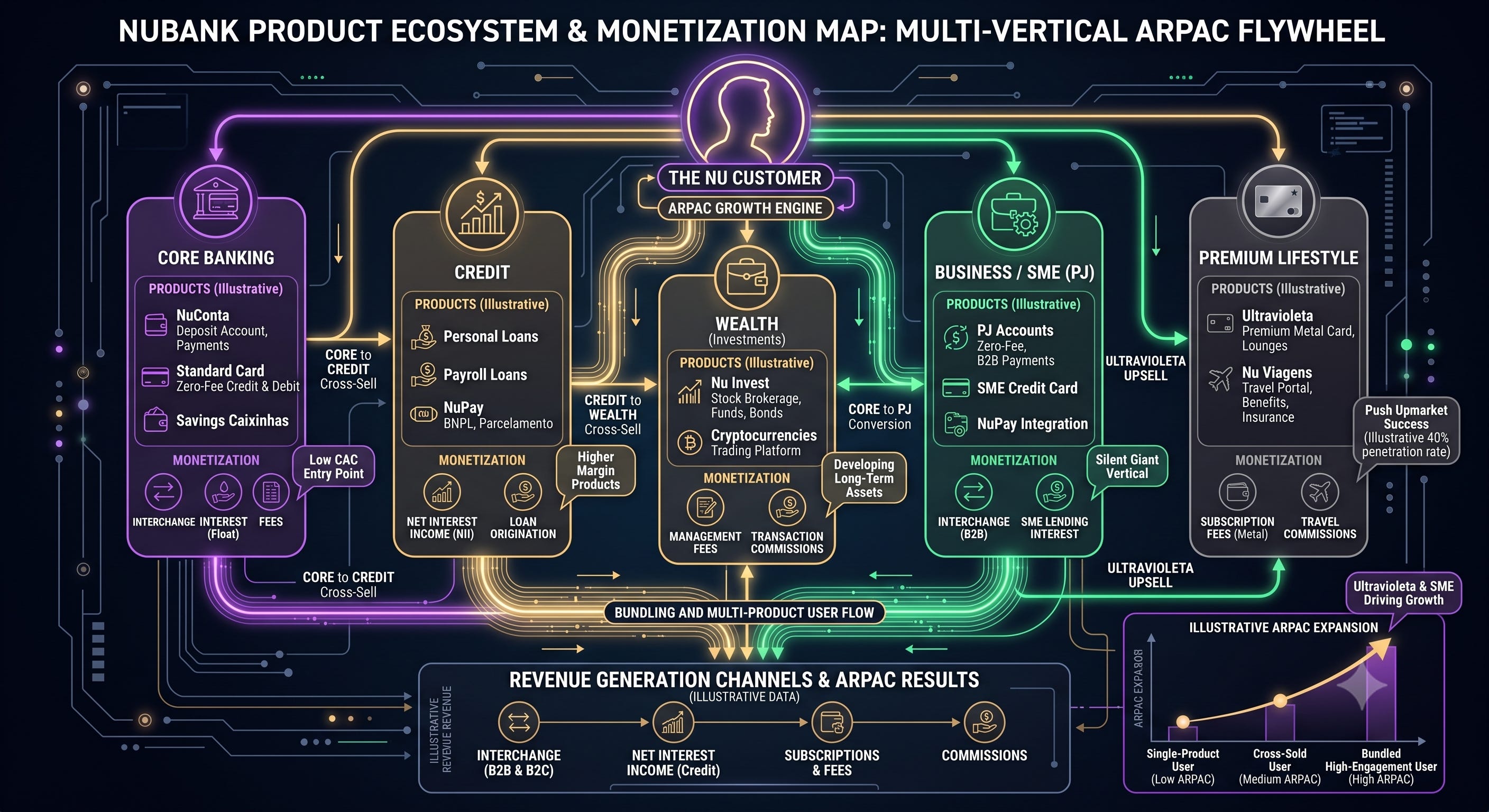
1. Spending: Payments & Credit Cards
The iconic purple card was the wedge that got Nubank into millions of wallets. Today, this segment spans the mass market to the affluent.
The Products: The classic “Roxinho” (a no-fee Mastercard credit and debit card) and the Nubank Ultravioleta (a premium, metal black card aimed at high-income customers offering 1% cashback and exclusive perks).
The Business Model:
Interchange Fees: Every time a customer swipes a Nu card, the merchant’s payment processor pays a small percentage fee to Nubank. Because of their massive transaction volume, these micro-pennies add up to billions.
Interest on Revolving Credit: If a customer doesn’t pay their credit card bill in full, Nubank earns interest on the remaining balance.
Subscription Fees: The Ultravioleta premium tier charges a monthly subscription fee (which can be waived if the user hits certain spending or investing thresholds), driving predictable recurring revenue.
2. Saving & Daily Banking: The Nu Account
To become a primary bank, you need to hold the customer’s paycheck. The Nu Account (formerly NuConta) is the hub of the ecosystem.
The Products: A completely free digital checking/savings account. It includes features like “Caixinhas” (Moneyboxes) and “Turbo Moneyboxes,” which allow users to segment their money for specific savings goals while earning market-rate yields.
The Business Model:
Net Interest Margin (NIM): This is foundational to any bank. By 2025/2026, Nubank held over $41 billion in customer deposits. Nubank takes these deposits, parks them in high-yield, safe government bonds or uses them to fund their lending operations, and pockets the difference (the spread) between what they earn and the yield they pay out to users.
3. Borrowing: The Profit Engine (Lending)
Lending is where Nubank’s proprietary tech and AI infrastructure truly shine.
The Products: Personal unsecured loans, Pix financing (a Brazilian Buy-Now-Pay-Later equivalent using the instant payment network), and highly lucrative payroll loans (consignado—where payments are deducted directly from a worker’s paycheck).
The Business Model:
Net Interest Income (NII): Nubank charges interest on these loans. What sets Nubank apart is its underwriting advantage. Powered by advanced AI models (like their proprietary nuFormer), they use thousands of data points from a user’s daily banking behavior to assess risk far more accurately than legacy credit bureaus. This allows them to price loans perfectly—approving more people while keeping their Non-Performing Loan (NPL) rates remarkably controlled relative to the mass-market demographic they serve.
4. Investing & Wealth Management: NuInvest & Nu Cripto
As Nubank’s customer base matured and accumulated wealth, the bank built the infrastructure to keep those assets in-house.
The Products: A full-suite brokerage offering stocks, ETFs, mutual funds, and fixed-income products. Alongside this, Nubank Cripto allows users to easily buy, sell, and hold cryptocurrencies like Bitcoin and Ethereum directly in the main app.
The Business Model:
Brokerage & Management Fees: While basic stock trading is often fee-free to drive engagement, Nubank earns management fees on proprietary mutual funds and distribution fees for third-party investment products.
Crypto Spreads: For cryptocurrency, Nubank takes a small transactional spread/fee on every buy and sell order executed on the platform.
5. The B2B Ecosystem: Nu PJ (SMEs)
Recognizing that many of their retail customers were also gig workers or small business owners frustrated by corporate banking fees, Nubank expanded into the B2B space.
The Products: Nu PJ offers digital corporate accounts, business credit cards, payment links, and tailored credit lines for micro and small enterprises (SMEs).
The Business Model:
The mechanics mirror the consumer side (interchange fees on corporate cards, credit interest, and deposit spreads), but business accounts typically process significantly higher transaction volumes. By early 2025, this segment exploded to over 4 million business customers, becoming a massive, distinct growth vertical.
6. Insurance & Services: The Marketplace
Nubank leverages its massive distribution (over 130 million highly engaged app users) to sell adjacent financial products without taking on heavy risk.
The Products: Nubank Vida (life insurance), auto insurance, cellular protection, and loan protection.
The Business Model:
Brokerage/Commission: Nubank operates largely as a distributor here. They partner with massive global underwriters (like Chubb) to create bespoke, affordable insurance products. Nubank sells the policy through its seamless app interface and takes a healthy commission/brokerage fee, while the partner handles the underwriting risk and claims. It is a highly capital-efficient, high-margin revenue stream.
The Takeaway: Nubank’s business model is a textbook “flywheel.” They acquire customers cheaply through incredibly intuitive, fee-free core products. Once a customer is in the ecosystem, Nubank’s AI-driven interface gently nudges them toward higher-margin products (loans, investments, insurance). Because their cost-to-serve remains flat ($0.80), every additional product a user adopts flows almost entirely to the bottom line, driving their record-breaking ~33% Return on Equity (ROE).
The Moats: Nubank’s Unfair Competitive Advantages
Many fintechs build beautiful apps, but very few achieve the massive scale and profitability of Nubank. To understand why, you have to look past the intuitive UI and examine what the company has built over the last decade. Nubank didn’t just digitize banking; they fundamentally re-engineered the unit economics.
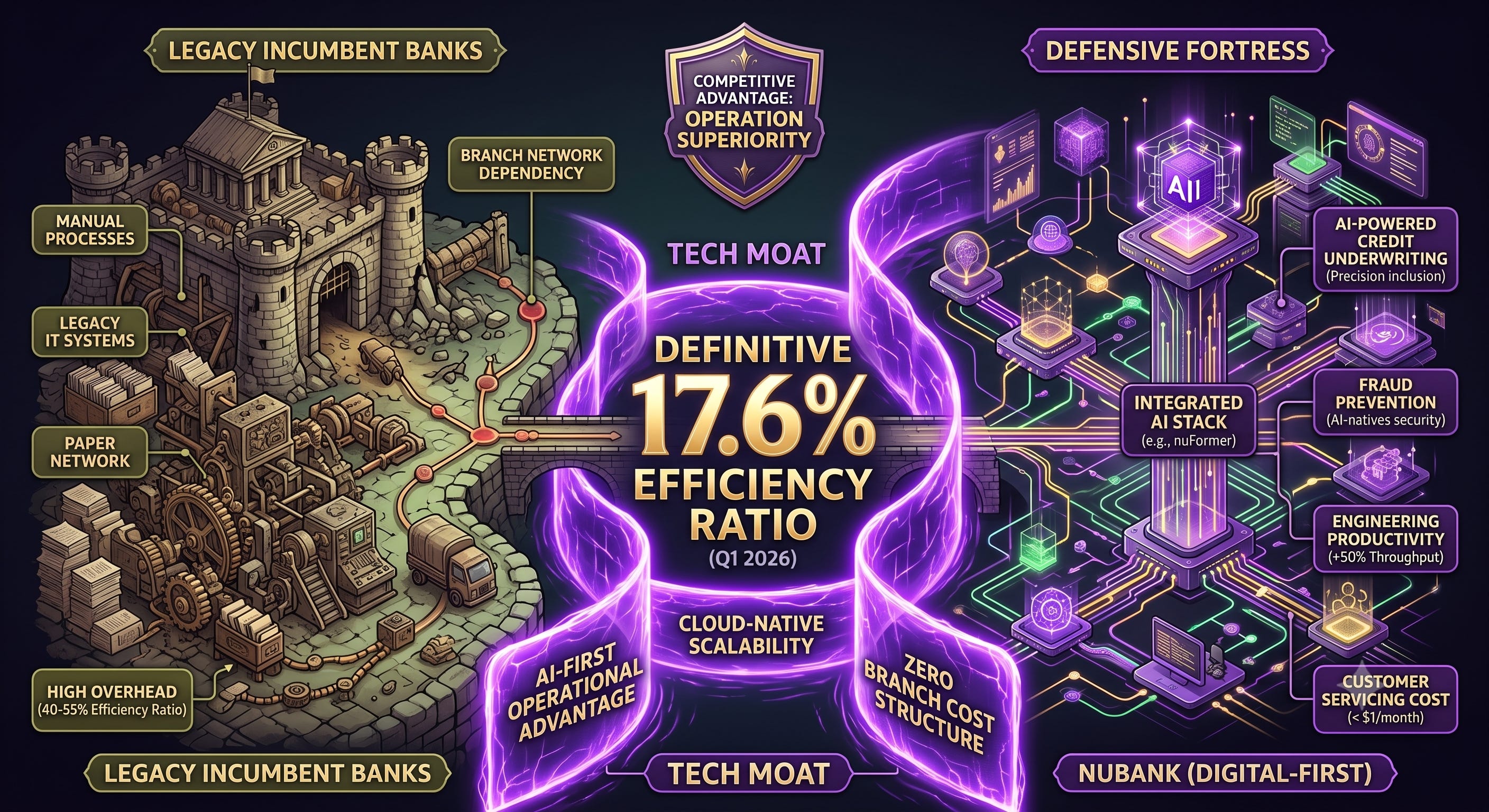
Here are the four core competitive advantages that make Nubank a nightmare for legacy incumbents.
1. The Structural Cost Advantage (The $0.80 Secret)
This is the bedrock of Nubank’s entire business model. Traditional banks in Latin America are burdened by massive legacy costs: thousands of physical branches, tens of thousands of tellers, and bloated administrative overhead. These incumbents have to charge high fees just to break even on a low-income customer.
Nubank, born in the cloud with zero physical branches, operates on a fundamentally different cost curve. Their monthly active cost to serve a customer hovers around $0.80.
The Moat: Because their operating expenses (Opex) are a fraction of traditional banks, Nubank can profitably serve the mass market with fee-free products—a segment the incumbents either ignore or exploit. When Nubank layers high-margin products (like loans or insurance) on top of this rock-bottom cost structure, the operating leverage is staggering.
2. Cult-Like Brand & Zero-CAC Growth
In the banking sector, customer acquisition is notoriously expensive. Banks normally pay hundreds of dollars in marketing, sign-up bonuses, and affiliate fees to acquire a single funded account.
Nubank flipped this script by treating customer service as a marketing channel. By offering 24/7 human-in-the-loop support (the “Xpeers”) and a product that actually solved customer pain points, they achieved a Net Promoter Score (NPS) consistently above 80—unheard of in financial services.
The Moat: Over 80% of Nubank’s customers are acquired organically through word-of-mouth or uncompensated referrals. Their Customer Acquisition Cost (CAC) is effectively negligible (historically between $5 and $7, primarily just the cost of printing and mailing the physical card). This allows them to invest capital into product engineering rather than endless marketing funnels.
3. Data-Driven Underwriting (The AI Credit Engine)
Lending in emerging markets is incredibly difficult. Traditional credit bureaus are often outdated, incomplete, or highly fragmented, leading legacy banks to charge exorbitant interest rates to cover their massive default risks.
Because Nubank acts as the primary daily financial hub for millions of users, they possess a proprietary data advantage. They see where a user shops, how often they top up their phone, their PIX transfer habits, and their exact income cadence.
The Moat: Nubank feeds billions of these proprietary data points into advanced, in-house AI models (like their nuFormer architecture). This allows them to underwrite credit risk with far greater precision than competitors relying on standard FICO-style scores. They can approve more customers and perfectly price the risk, keeping their Non-Performing Loan (NPL) ratios well within profitable margins even during macro-economic downturns.
4. Modern, Agile Tech Stack
Most traditional banks run on core banking software built decades ago (often relying on ancient languages like COBOL). These monolithic architectures make it incredibly slow, risky, and expensive to roll out new features.
Nubank was built from day one on modern, scalable microservices (heavily utilizing the functional programming language Clojure).
The Moat: This technological agility allows Nubank to ship new products, run A/B tests, and adapt to regulatory changes (like the launch of Brazil’s PIX system) in weeks, rather than years. They don’t have to spend 70% of their IT budget just “keeping the lights on” like incumbents do; they can direct it entirely toward innovation and scaling into new markets like Mexico and Colombia.
The Bottom Line: Nubank’s moats are deeply intertwined. Their modern tech stack enables the low cost-to-serve. The low cost-to-serve allows for fee-free products. The fee-free products and great UX drive organic, zero-CAC growth. The massive user base generates the proprietary data. And that data feeds the highly profitable lending engine. It is a compounding advantage that legacy banks, shackled by their physical footprints and legacy tech, are structurally incapable of replicating.
The Architects of Disruption: Nubank’s Executive Leadership
A company’s trajectory is rarely just a product of market timing; it is shaped by the people steering the ship. Nubank’s leadership team reflects a blend of entrepreneurial visionaries, seasoned financial veterans, and top-tier tech talent drawn from global giants like Google, Visa, and Shopify.
As Nubank has transitioned from a scrappy Brazilian startup to a profitable global decacorn serving over 135 million customers, its management structure has evolved. Here is a look at the key figures driving the company forward as of 2026.
The Founders
David Vélez – Founder & Chief Executive Officer (CEO)
The driving force behind Nubank. A Colombian-born engineer and former venture capitalist (Sequoia Capital, General Atlantic), Vélez experienced the bureaucratic nightmare of traditional Brazilian banking firsthand. That frustration sparked the vision for Nubank. As CEO, Vélez sets the overarching long-term strategy, prioritizing geographic expansion, preserving the company’s famously customer-centric culture, and steering the broader corporate vision rather than day-to-day operations.
Cristina Junqueira – Co-Founder & Chief Growth Officer (CGO)
A vital piece of the founding puzzle, Junqueira brought deep, inside knowledge of the traditional Brazilian banking system (having worked in consumer credit and marketing at Itaú Unibanco). She is widely recognized as one of the most powerful women in global fintech. Currently, as CGO, she oversees global growth strategies across Latin America and is actively spearheading the development of Nubank’s highly anticipated future banking operations in the United States, which she is slated to lead as CEO.
Edward Wible – Co-Founder & Systems Architect
The technical bedrock of Nubank. Wible, an American computer scientist (Princeton/INSEAD), served as the Chief Technology Officer for nearly a decade, architecting the scalable, modern tech stack that allowed Nubank to handle millions of transactions at a fraction of incumbent costs. After guiding the tech organization through their 2021 IPO, Wible stepped back from executive management to focus entirely on hands-on software engineering, functional programming, and systems architecture within the company.
The C-Suite & Key Operators
Youssef Lahrech – President & Chief Operating Officer (COO)
Lahrech is the engine room of Nubank. Appointed President in 2022 (while retaining his COO duties), he essentially runs the day-to-day operations of the entire company, allowing David Vélez to focus on the macro vision. Lahrech oversees the performance, budget, and operations of global products and corporate functions.
Rob Livingston – Chief Financial Officer (CFO)
Appointed in July 2026, Livingston is a massive acquisition for Nubank’s executive team. He brings over 30 years of global financial experience, joining from Visa where he served as CFO for North America (their largest market). He replaces Guilherme Lago (who transitioned to a Special Advisor role after successfully guiding Nu through its IPO and hyper-growth phase). Livingston is tasked with optimizing capital allocation, liquidity planning, and managing investor relations as the company scales globally.
Eric Young – Chief Technology Officer (CTO)
Taking over the CTO role in August 2025, Young brings elite Silicon Valley pedigree to Nubank. He previously served as Senior VP of Engineering at Snap Inc. and spent seven years as VP of Engineering at Google (overseeing infrastructure for Search, Ads, and Cloud), plus 15 years at Amazon. He is tasked with scaling Nubank’s technical infrastructure for international expansion and embedding AI technologies deeply into the core product stack.
Livia Martines Chanes – Chief Executive Officer, Latin America
Chanes joined Nubank in 2020 as VP of Products and quickly rose through the ranks. After a successful stint as CEO of Brazil, she was elevated in July 2026 to oversee all of Nubank’s operations across the broader Latin American region, playing a critical role in standardizing the playbook across Brazil, Mexico, and Colombia.
Carl Rivera – Chief Product Officer (CPO)
Joining in May 2026, Rivera took over the product reins from Jag Duggal. Rivera brings a massive e-commerce and product design background, having spent seven years at Shopify in senior leadership roles (including Chief Design Officer and VP of Product for Merchant Services). His appointment signals Nubank’s continued focus on seamless user experiences and expanding their B2B (SME) and marketplace offerings.
Roberto de Oliveira Campos Neto – Executive Vice-Chairman & Global Head of Public Policy
A monumental hire in July 2025. Campos Neto previously served as the President of the Central Bank of Brazil (2019-2024), where he was internationally lauded for modernizing the Brazilian economy—most notably by launching the revolutionary instant payment system, Pix. His deep regulatory knowledge and relationships make him an invaluable asset as Nubank navigates complex financial regulations across new global markets.
Beyond Brazil: Nubank’s Global Expansion and Future Growth Strategy
With over 135 million customers and a dominant, highly profitable stronghold in Brazil, the question for Nubank is no longer if their model works, but how far it can scale. Management has made it clear that their ambitions extend far beyond their home country.
Nubank’s future growth strategy relies on a multi-pronged approach: replicating their Brazilian playbook in new Latin American markets, moving upmarket to capture high-net-worth individuals, dominating the SME space, and executing a highly anticipated, audacious entry into the United States.
1. Scaling the LatAm Strongholds: Mexico & Colombia
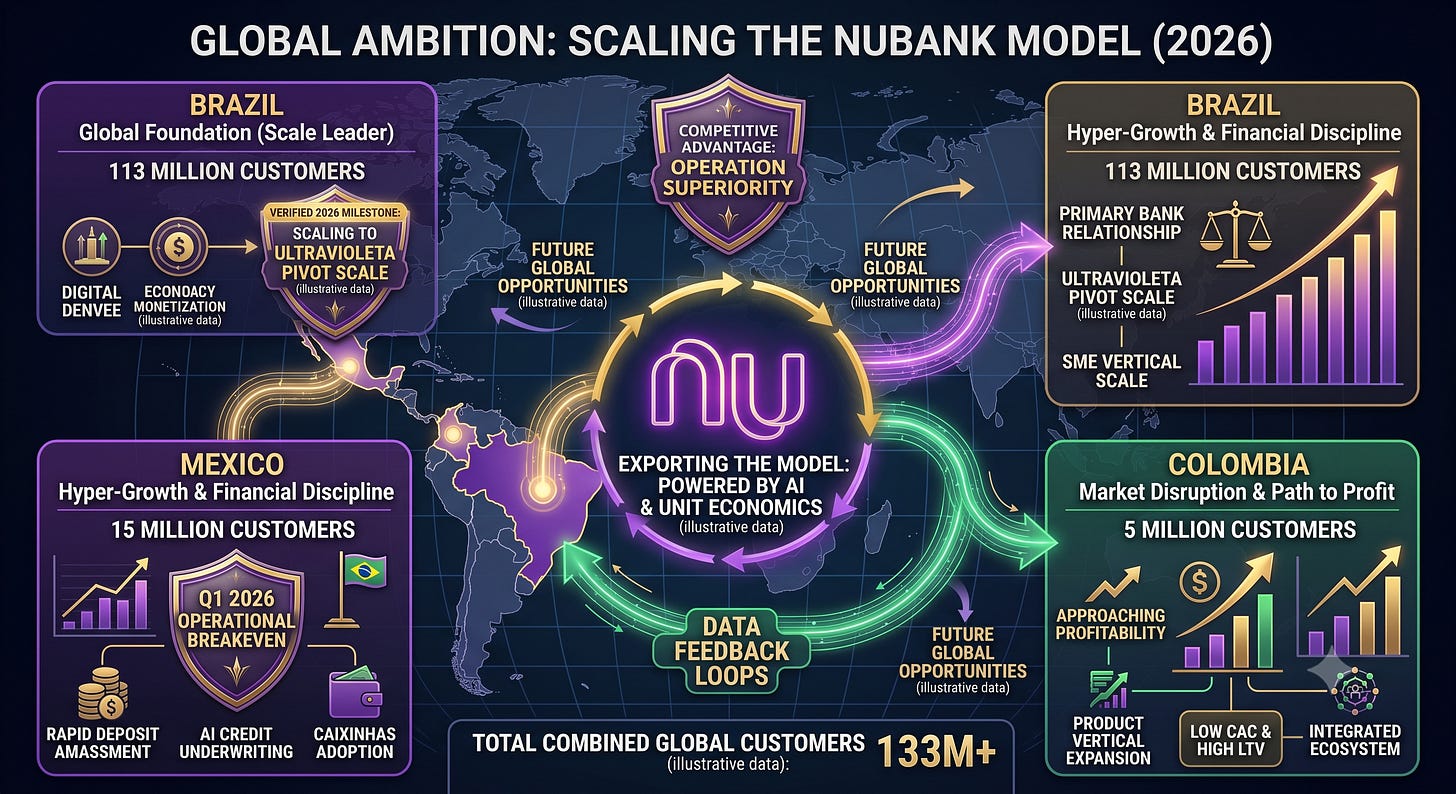
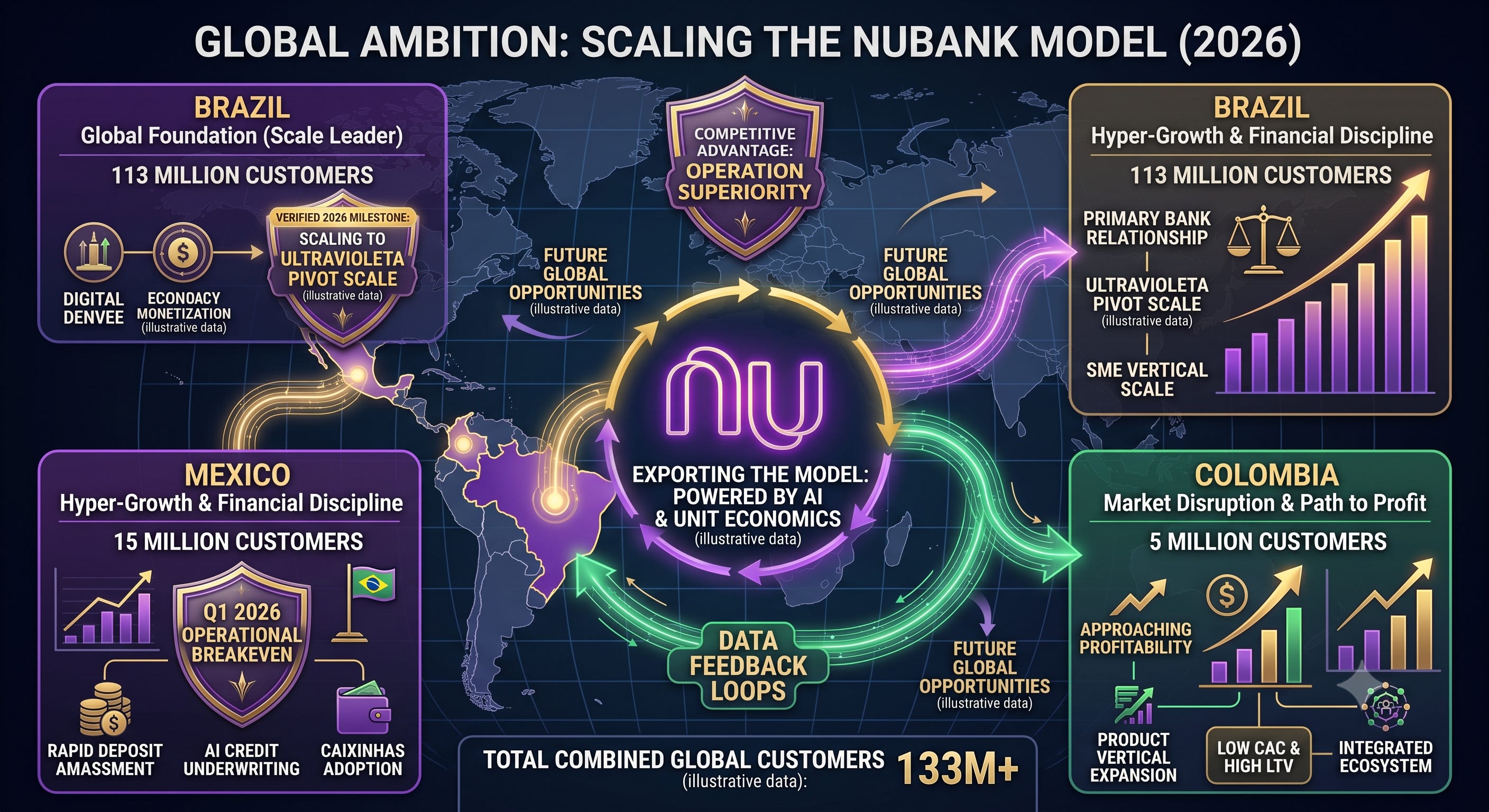
While Brazil remains the growth engine (approaching 113 million customers as of mid-2026), Nubank is proving that its model is highly exportable. They aren’t just planting flags in new countries; they are rapidly capturing market share by targeting the same exact pain points—high fees, terrible customer service, and oligopolistic banking structures.
Mexico (Nu México)
Mexico is Nubank’s most crucial growth vector. In a country where legacy banks historically ignored the unbanked, Nu has scaled at a pace that took traditional institutions decades.
The Scale: As of July 2026, Nu Mexico surpassed 15 million customers, capturing roughly 15% of the country’s adult population. They are adding 12,000 new customers per day.
Profitability Milestone: In Q1 2026, the Mexican operation achieved a massive milestone: operational breakeven.
Regulatory Moat: In July 2026, Nu received official authorization from the CNBV to begin operations as a full-fledged bank in Mexico. This allows them to rapidly expand beyond basic credit into payroll loans, deep retail deposits (already surpassing $5.9 billion), and investments.
Colombia (Nu Colombia)
Colombia is following the exact same hyper-growth trajectory. Despite a highly concentrated legacy banking sector and strict “usury rate” caps, Nu is winning on user experience and zero fees.
The Scale: In May 2026, Nu Colombia officially crossed 5 million customers, meaning they now serve over 15% of the adult population.
Product Expansion: Following the launch of Cajitas (savings boxes) and checking accounts, they rapidly amassed over 10 trillion pesos in deposits, proving they are becoming the primary banking relationship for Colombians, not just a secondary credit card.
2. The Push Upmarket: Capturing the Affluent Client (Brazil)
Nubank initially built its empire on the underbanked, but you can’t build a highly profitable banking giant without capturing the affluent class. The legacy bear case against Nu was always: “Sure, they have tens of millions of users, but can they monetize the wealthy?”
The answer in 2025 and 2026 has been a resounding yes. Nubank is successfully pulling high-income clients away from traditional incumbents like Itaú and BTG Pactual through its Nubank Ultravioleta segment.
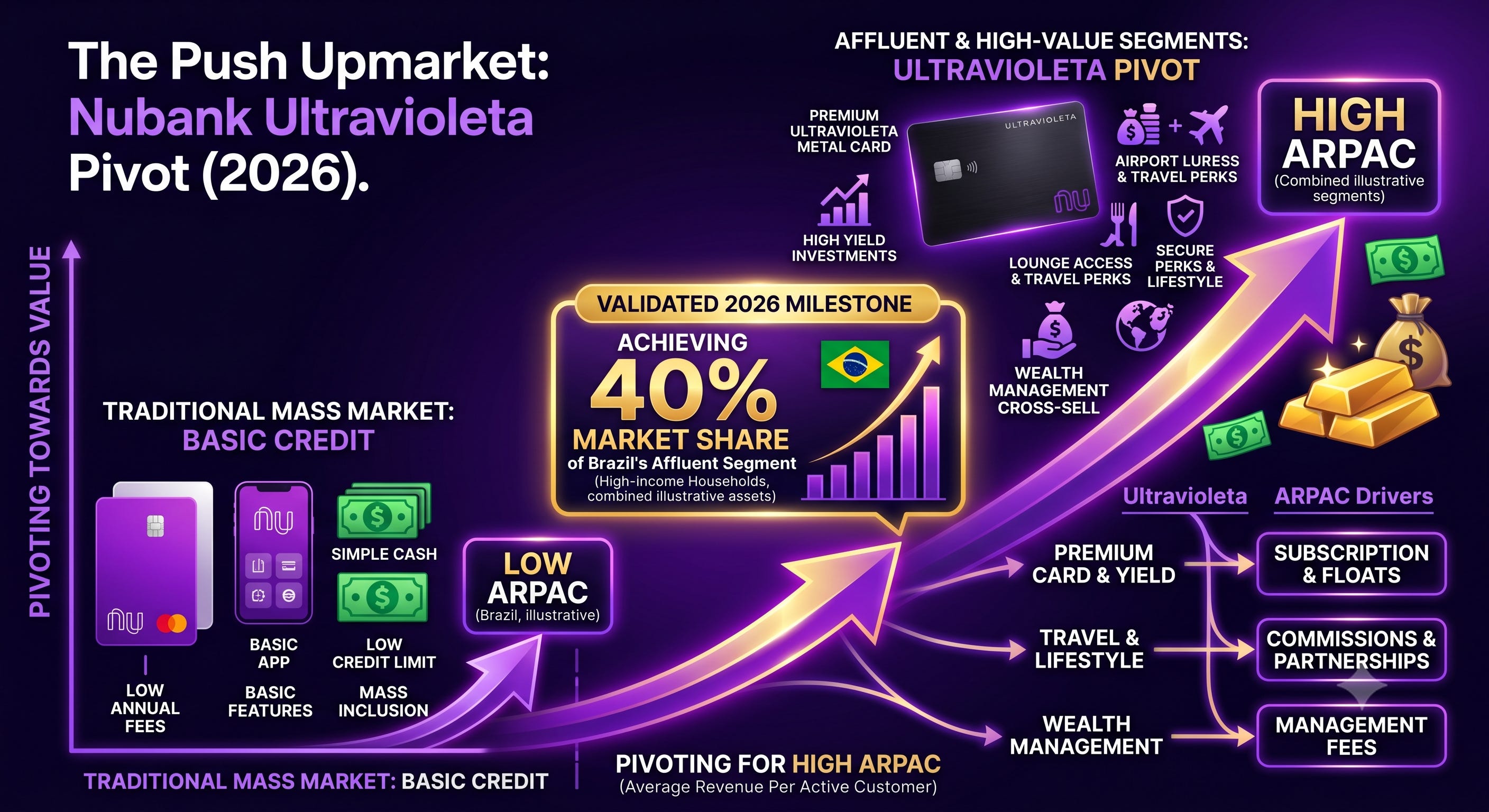
The Ultravioleta Value Prop: They’ve expanded benefits to include zero IOF (tax) on international transactions, 4 free annual Priority Pass lounge visits, and the Nu Viagens travel portal, offering aggressive 5% cashback or points. They also integrated NuInvest seamlessly, bringing proprietary funds and crypto custody directly into the main app.
The Result: The upmarket push is working. By continuously bundling high-yield investments, exclusive credit limits, and premium travel perks, Nu is driving up its Average Revenue Per Active Customer (ARPAC) month over month. They have successfully captured approximately 40% of the affluent Brazilian demographic, proving they can cross-sell wealth management products to the group that controls the majority of the country’s wealth.
3. B2B and SMEs: The Silent Giant
While consumer banking gets the headlines, Nubank’s SME (Small and Medium-sized Enterprise) business, known as Nu PJ (Pessoa Jurídica), is quietly becoming a massive revenue driver.
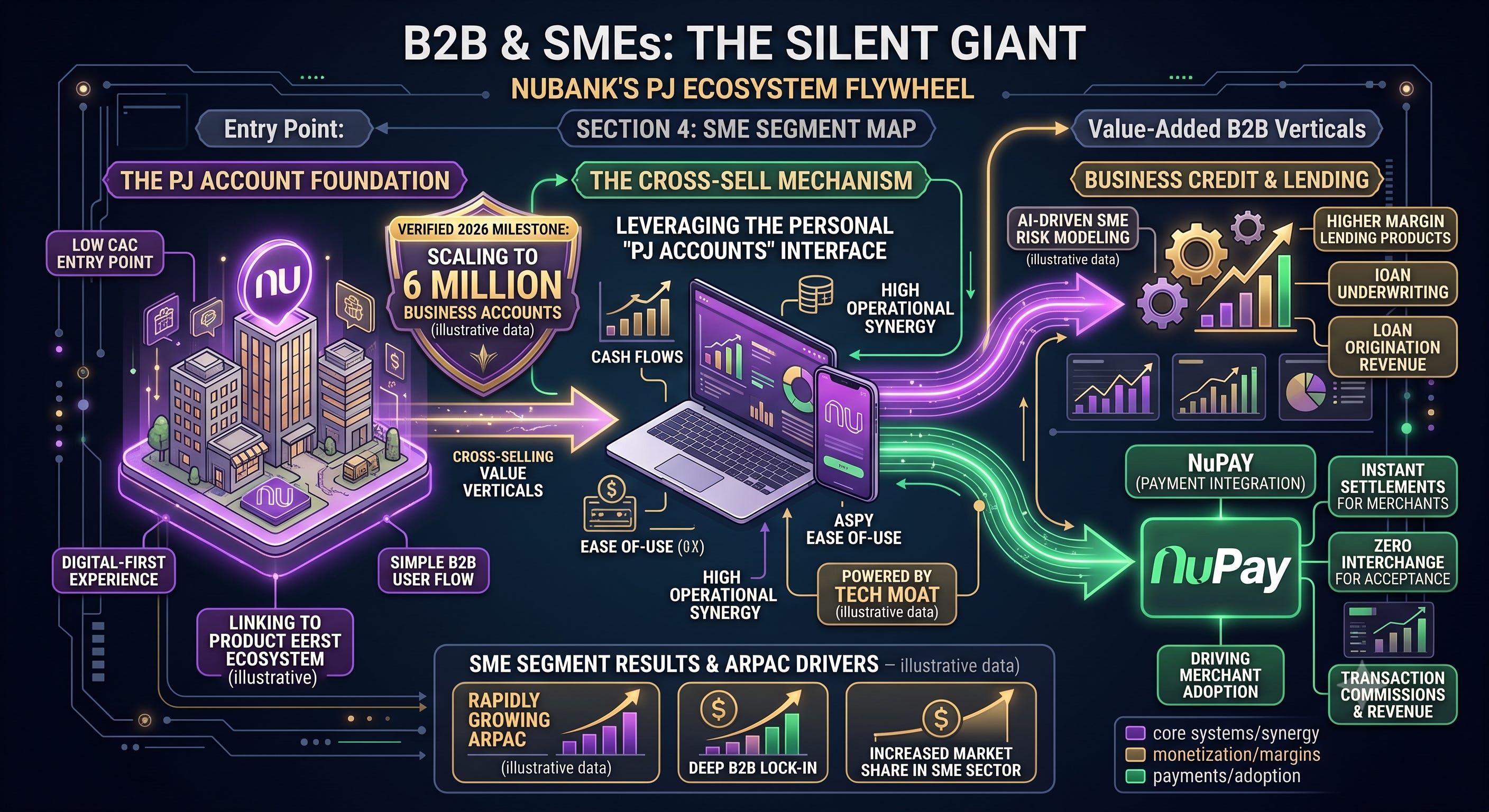
Small businesses in Latin America have historically faced brutal fees and a complete lack of credit access. Nu took their frictionless consumer interface and applied it to entrepreneurs—freelancers, gig workers, and small shop owners.
Massive Scale: As of May 2026, Nubank reached 6 million business accounts.
The Moat: They are now the largest financial institution in Brazil by the number of business accounts. By locking entrepreneurs into the Nu ecosystem with corporate credit cards, seamless payment links, and low-cost credit lines, they generate high-margin revenue through interchange fees and working capital loans. This segment has rapidly become one of the most profitable verticals for the company globally.
4. The Bold Frontier: The United States Expansion (2026–2027)
For years, analysts wondered if a Latin American neobank could successfully penetrate the mature, highly saturated US financial market. In early 2026, Nu officially made its move.
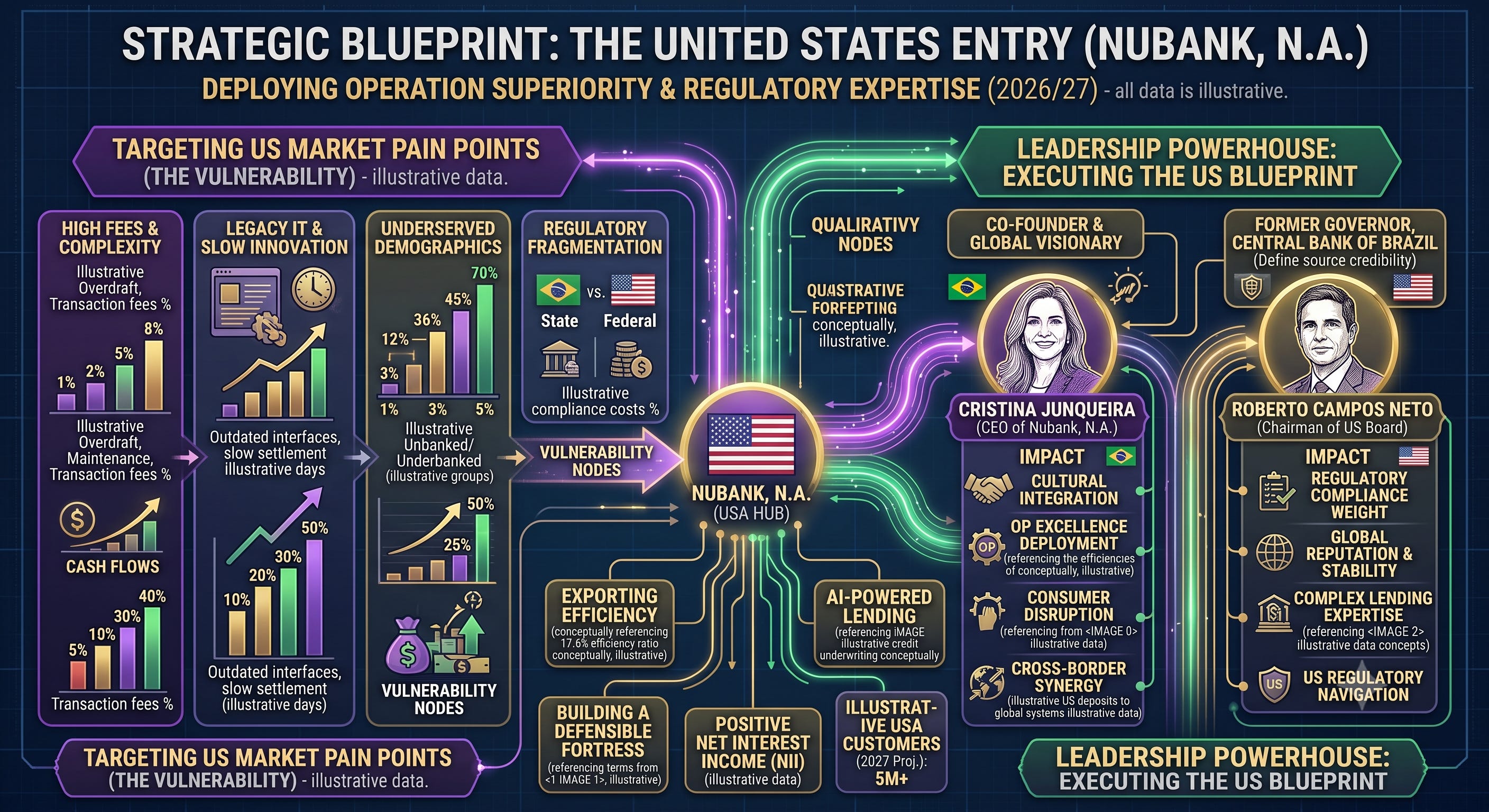
On January 29, 2026, Nu Holdings announced it had received conditional approval from the Office of the Comptroller of the Currency (OCC) for the formation of a de novo national bank—Nubank, N.A. This isn’t a light partnership model; Nu intends to operate as a fully federally regulated US bank offering high-yield deposits, credit, and digital asset custody.
Leadership Commitment: To prove their dedication to this massive undertaking, Co-Founder and Chief Growth Officer Cristina Junqueira relocated full-time to the US to serve as the CEO of the new subsidiary. Furthermore, the US board is chaired by Roberto Campos Neto (former President of Brazil’s Central Bank) and includes heavy-hitters like Brian Brooks (former US Acting Comptroller of the Currency).
The US Strategy: Why enter the US when Latin America still has room to run? First, Nu plans to aggressively attack international transaction fees and money transfers—an acute pain point for the massive US Hispanic and immigrant populations. Second, while the US has neobanks, none have achieved the scale, profitability, or complete product suite of Nubank. Nu believes its proprietary $0.80 cost-to-serve tech stack will allow them to offer better yields and lower loan rates than traditional American banks burdened by physical branches.
The Timeline: Nu has 18 months from their January 2026 approval to fully capitalize and open the bank, putting them on a collision course to shake up the US digital banking landscape by mid-2027.
Investor’s Takeaway: Nubank is transitioning from a regional disruptor to a global financial powerhouse. With operational breakeven achieved in Mexico, massive affluent market penetration in Brazil, a booming SME division, and the groundwork laid for a US invasion, Nu Bank is on track to become one of the most valuable financial institutions in the world.
The Bear Case: Nubank’s Competition and Key Risks
Every great growth story has a flip side. While Nubank has executed flawlessly over the past decade, their transition from a regional challenger to a global financial powerhouse introduces a new set of complex challenges. They are no longer flying under the radar, and their valuation leaves very little room for error.
To present a balanced thesis, we have to look at the macro headwinds, the regulatory threats, and the formidable competitors trying to slow their momentum.
1. The Competitive Landscape: The Empire Strikes Back
Nubank’s early success was largely due to the complacency of traditional banks. That window has closed. The competition is now fierce and well-capitalized.
The Legacy Incumbents (Itaú, Bradesco, Santander): The Brazilian oligopoly is awake. Banks like Itaú have heavily invested in their digital transformations, modernizing their tech stacks and closing physical branches to lower costs. While they can’t match Nu’s $0.80 cost-to-serve, they possess massive balance sheets, deep corporate relationships, and a historical stranglehold on the ultra-wealthy demographic that Nu is currently trying to disrupt.
The Ecosystem Rival (Mercado Pago): This is arguably Nubank’s biggest threat in Latin America. Mercado Libre (the “Amazon of LatAm”) has built a formidable fintech arm in Mercado Pago. Because Mercado Pago is attached to a massive e-commerce engine, they have a closed-loop ecosystem. They capture the merchant, the payment processing, and the consumer financing all at once. In markets like Mexico, Mercado Pago is fighting Nu tooth-and-nail for deposits and credit card issuance.
The Saturated US Market: As Nu plots its US expansion for 2027, they are entering a brutal arena. The US is fundamentally different from Brazil; it is heavily overbanked. Nu will have to battle established neobanks (Chime, SoFi, Cash App) and deeply entrenched legacy giants (JPMorgan Chase, Bank of America) in a market where Customer Acquisition Cost (CAC) is exponentially higher than the $5 they are used to paying in LatAm.
2. Credit Risk and the NPL Tightrope
Nubank makes a significant portion of its revenue through high-yield personal loans and credit card revolving balances. Their target demographic historically leans toward the mass market and unbanked—groups highly vulnerable to economic shocks.
Non-Performing Loans (NPLs): Nubank relies on its proprietary AI models to price risk accurately. However, bears argue that this algorithm is carrying a massive, rapidly growing loan book. If Latin America experiences a severe, prolonged spike in unemployment or inflation, default rates (NPLs) could surge, eating directly into the company’s profitability. Nu must constantly prove that its underwriting is superior, not just that it is willing to lend to riskier profiles.
3. Macroeconomic and FX Volatility
Nubank operates entirely in emerging markets (Brazil, Mexico, Colombia), which are notoriously volatile, but it reports its earnings to Wall Street in US Dollars.
Currency Devaluation: If the Brazilian Real (BRL) or Mexican Peso (MXN) depreciates heavily against the US Dollar, Nubank’s reported revenue and profits shrink instantly in the eyes of international investors, even if the underlying business is performing perfectly in local currency.
Interest Rate Fluctuations: Latin American central banks frequently use aggressive interest rate hikes to combat inflation. While higher rates can increase Nu’s Net Interest Margin (NIM) on cash deposits, they also increase the cost of funding and squeeze the consumer, making loan defaults more likely.
4. Regulatory Crosshairs
Financial services is a highly regulated industry, and Nubank’s sheer size now makes it a systemic player in Brazil.
Interchange Fee Caps: A significant chunk of Nu’s revenue comes from interchange fees (the toll merchants pay when a card is swiped). Regulators in LatAm frequently discuss capping these fees to help small businesses. Any aggressive legislative cap on credit card interchange fees would immediately impact Nubank’s top line.
The US OCC: Navigating the US Office of the Comptroller of the Currency (OCC) to launch a de novo national bank is incredibly expensive and compliance-heavy. Any regulatory missteps or delays in the US launch could drag down the stock’s premium valuation.
The Bottom Line: Nubank has structural advantages that make it a generational company, but the easy market share has been captured. The next phase of growth requires winning a grueling war of attrition against modernized legacy banks, navigating fragile emerging market economies, and executing an unprecedented, high-stakes invasion into the United States.
Check Out the video detailing Nu and walkthrough the DCF’s
By the Numbers: Nubank’s Financials and Key Performance Indicators (KPIs)
The true test of any disruptive business model is whether it can transition from hyper-growth to sustainable profitability. For years, skeptics argued that a neobank offering fee-free products to emerging market consumers would never generate meaningful returns.
Nubank’s recent financial results have completely dismantled that bear case. By early 2026, they are not just profitable; they are generating some of the highest returns on equity (ROE) in the global financial sector.

1. The Headline Financials (Q1 2026)
Nubank has proven that its low-cost digital model scales beautifully, creating massive operating leverage. As they cross the 135-million customer mark, the revenue growth is staggering.
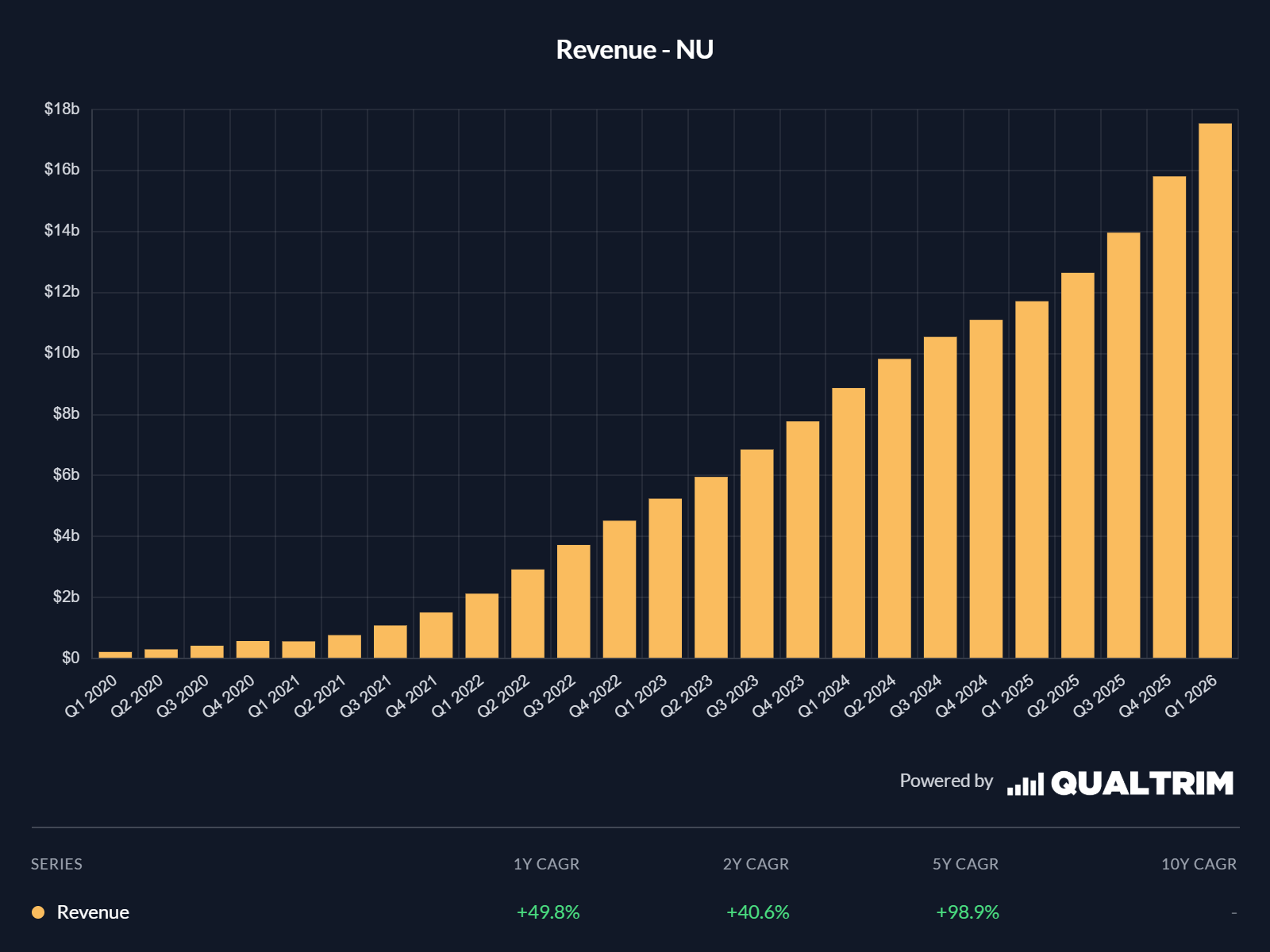
Quarterly Revenue: $5.0 Billion. In Q1 2026, Nu surpassed the $5 billion quarterly revenue mark for the first time in company history, driven by strong monetization across credit, float, and fee businesses.
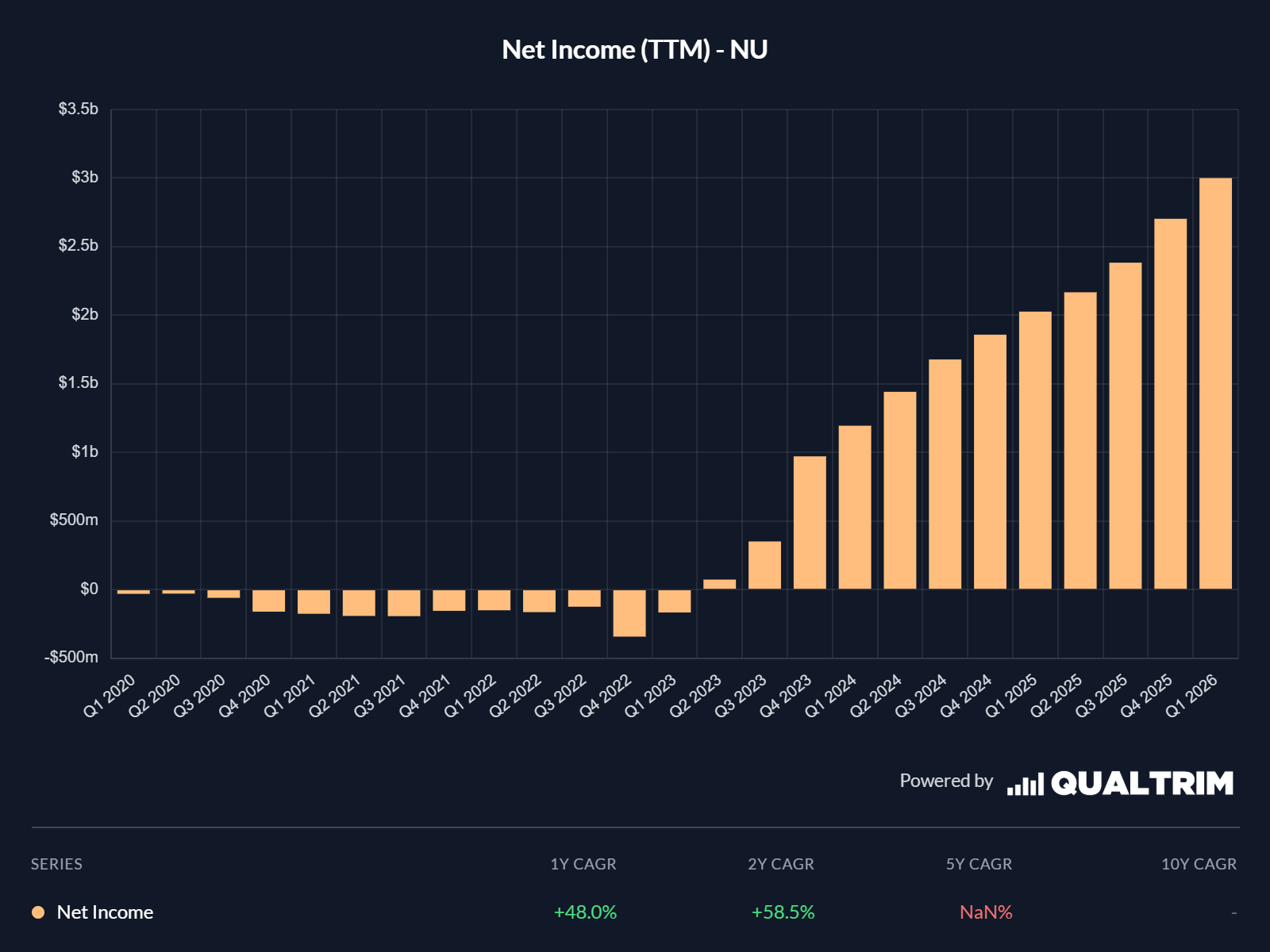
Net Income: $871 Million. This represents a massive 41% year-over-year increase. It proves that the “growth at all costs” era is over; Nu is now a cash-generating machine.
Return on Equity (ROE): 29% (Ann.). This is perhaps the most important metric for bank investors. A 29% ROE is practically unheard of for a retail bank of this size (traditional US banks like JPMorgan or Bank of America typically hover between 10% and 15%). It highlights the sheer efficiency of Nu’s capital allocation. (Note: Nu hit an all-time high ROE of 33% at the close of 2025).
2. The Core KPIs: The Unit Economics Engine
To understand how Nubank generates those massive headline numbers, we have to look at the underlying unit economics that drive the business.
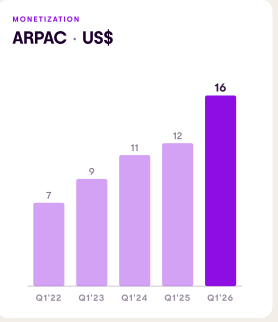
ARPAC (Average Revenue Per Active Customer): $16.00 / month. ARPAC is the holy grail for Nubank. They acquire a customer practically for free, offer them a basic product, and slowly cross-sell them into loans, investments, and insurance. As of Q1 2026, ARPAC reached approximately $16, continuing a multi-year upward trajectory. For their mature, affluent cohorts, this number is significantly higher, proving they can monetize their base just as effectively as legacy banks.
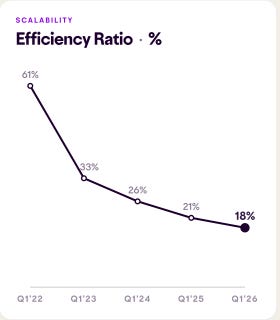
Efficiency Ratio: 17.6%. In banking, the efficiency ratio measures how much it costs to generate a dollar of revenue (lower is better). Most traditional legacy banks have an efficiency ratio between 45% and 60% due to branches, tellers, and legacy tech. Nubank’s staggering 17.6% efficiency ratio is the direct result of their cloud-native infrastructure and $0.80 cost-to-serve.
Activity Rate: 83%. This proves that Nubank isn’t just a secondary app sitting on a user’s phone. 83% of their 135+ million users are actively using the platform every single month, cementing Nu as the primary financial hub for millions of Latin Americans.
3. Lending Profitability: Margins & Asset Quality
As a bank, Nubank’s primary profit engine is taking in deposits and lending them out at a higher rate. This requires walking a tightrope between growth and risk management.
Net Interest Margin (NIM): 21.1%. This represents the spread between what Nu earns on loans/investments and what it pays out on deposits. A 21% NIM is exceptionally high, reflecting the high-yield nature of consumer credit in Latin America.
Risk-Adjusted NIM: 9.5%. Because lending in emerging markets carries higher default risks, this is the true measure of profitability after accounting for credit loss allowances. Despite the volatile macro environment, Nu maintains a highly profitable spread.
Asset Quality (NPLs):
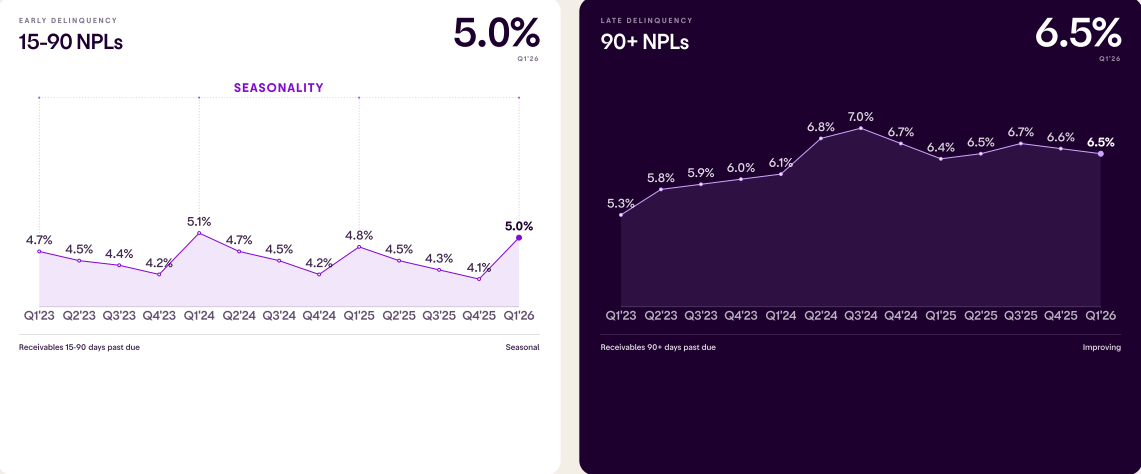
15-90 Days NPL (Early Delinquency): 5.0%. This metric experienced a slight uptick in Q1 2026, but management attributes this strictly to historical first-quarter seasonality.
90+ Days NPL (Default): 6.5%. Crucially, the long-term default rate actually declined sequentially, staying well below their 7.0% peak from 2024. This validates their proprietary AI underwriting models; they are pricing risk accurately even as the credit portfolio rapidly expands.
4. Balance Sheet Strength
A bank is only as strong as its funding base. Nubank has successfully transitioned from relying on wholesale funding to being fueled by sticky, low-cost consumer deposits.
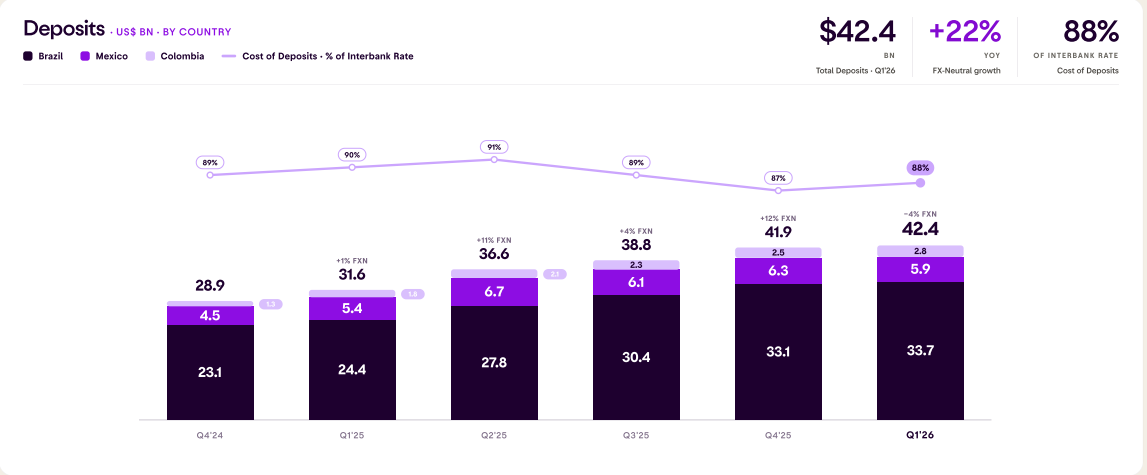
Total Deposits: $42.4 Billion. Up 22% year-over-year. By becoming the primary checking account for millions, they have secured a massive, stable pool of capital.
Total Credit Portfolio: $37.2 Billion. This is split across credit cards ($24.3 billion), highly lucrative unsecured personal lending (nearly $10 billion), and a growing secured lending segment ($3 billion).
Loan-to-Deposit Ratio (LDR): 58.3%. This metric shows they are lending out about 58 cents for every dollar deposited. This is up from 49% in 2025, demonstrating that they are safely deploying their massive deposit base to drive NII (Net Interest Income) growth, while still retaining plenty of liquidity.
The Bottom Line: Nubank’s financial statements tell the story of a company that has definitively won its home market. They have combined tech-company growth rates with elite banking profitability. As they pour these profits into their US, Mexican, and Colombian expansions, their rock-bottom efficiency ratio provides a massive competitive cushion against legacy incumbents.
Valuation Scenarios and Final Investment Thesis
To truly understand whether Nubank (NU) is a buy at current levels, we must look beyond the narrative and run the numbers. Given their rapid transition from a hyper-growth startup to a highly profitable financial institution, modeling their future earnings requires balancing their massive total addressable market against execution and macro risks.
Below are three Discounted Cash Flow (DCF) scenarios—Bull, Base, and Bear—based on a current share price of $14.00, a Trailing Twelve Month (TTM) EPS of $0.65, and a desired annual return of 15%.
The Base Case: Steady Growth and Expected Friction
This is the most realistic scenario. It assumes continued strong growth in Latin America, but acknowledges that scaling into the US will be expensive and that legacy banks in Brazil will put up a fight for affluent customers.
Growth Assumptions: Growth is slightly tempered compared to historical rates, starting at 22% in Year 1, dipping to 17% in Year 2 (perhaps reflecting initial US expansion costs), and settling at 15% by Year 5.
Exit Multiple: A more conservative, yet still growth-oriented, multiple of 18x.
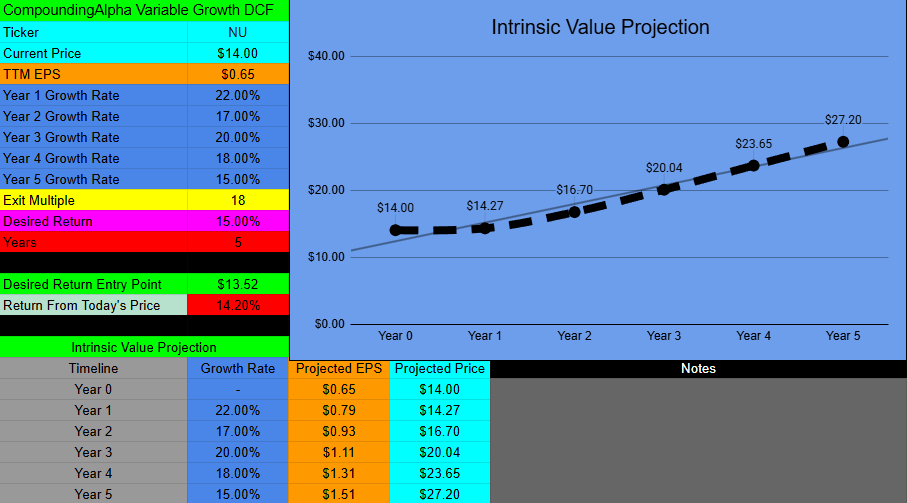
The Verdict: The projected EPS in Year 5 reaches $1.51, driving a projected share price of $27.20.
Actionable Takeaway: The “Desired Return Entry Point” here is $13.52. At a current price of $14.00, the stock is trading almost exactly at fair value for an investor seeking a 15% annual return. It suggests that much of their expected near-term success is already priced in, but it remains a solid hold for long-term compounders.
The Bear Case: Macro Headwinds and Stalled Expansion
In the bear case, we assume significant friction. Perhaps the US expansion proves too costly and complex, or severe currency devaluation in Brazil and Mexico eats into reported dollar earnings. Furthermore, we assume credit defaults rise, squeezing their Net Interest Margins.
Growth Assumptions: Growth slows considerably, starting at 18% in Year 1 and steadily declining to just 10% by Year 5 as market saturation hits.
Exit Multiple: We assign a traditional banking multiple of 13x, removing the “tech premium” entirely as growth stalls.
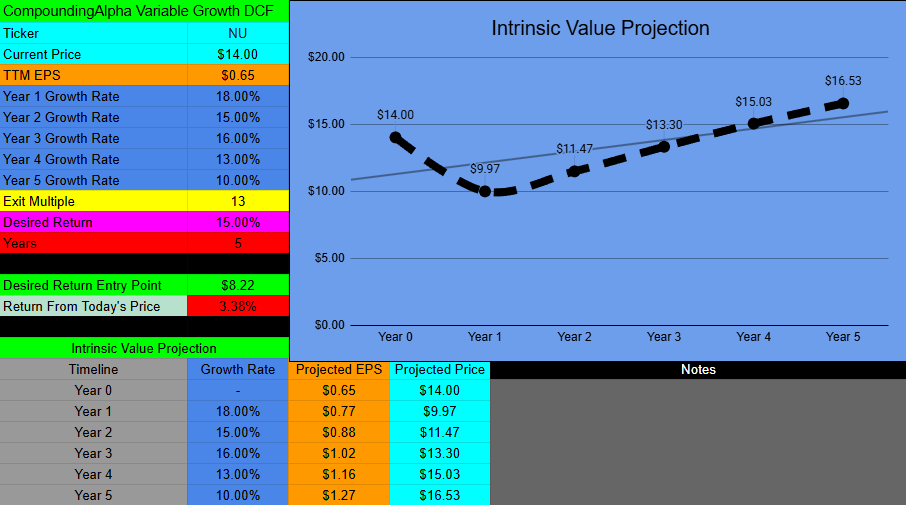
The Verdict: The projected EPS in Year 5 only reaches $1.27. Because of the compressed multiple, the projected share price only reaches $16.53 by Year 5 (and actually dips below the current price in the near term).
Actionable Takeaway: The “Desired Return Entry Point” plummets to $8.22. At $14.00, the stock is significantly overvalued under these conditions. If you believe Latin America is heading for a deep recession or that the US expansion will fail, Nu is a clear avoid at current prices.
The Bull Case: Flawless Execution
In this scenario, Nubank executes perfectly. Mexico and Colombia continue their hyper-growth trajectories and maintain profitability, the push upmarket in Brazil captures even more of the affluent segment, and the early stages of the US expansion show incredible promise without dragging down overall margins.
Growth Assumptions: Earnings grow rapidly, starting at 25% in Year 1 and stabilizing at a very strong 16% by Year 5.
Exit Multiple: We assign a premium multiple of 25x, reflecting their status as a high-margin, global fintech leader.
The Verdict: Under these assumptions, the projected EPS in Year 5 reaches $1.63, driving a projected share price of $40.70.
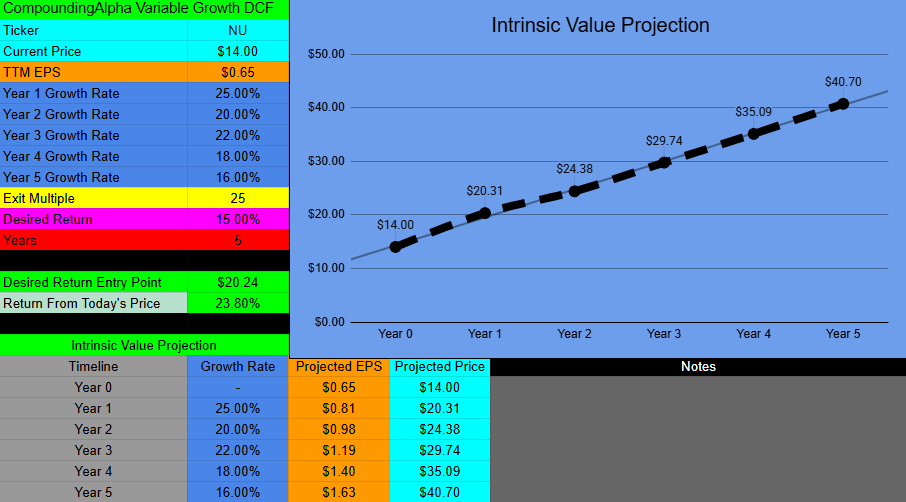
Actionable Takeaway: The “Desired Return Entry Point” for this scenario is $20.24. Since the stock is currently trading at $14.00, it suggests a significant margin of safety and a highly attractive entry point for growth investors who believe management will execute their global vision flawlessly.
The Final Verdict: Is Nubank a Buy?
Nubank is no longer a speculative venture; it is a $5 billion-a-quarter revenue machine generating an elite ~30% Return on Equity. They have structurally broken the banking model in Latin America with their $0.80 cost-to-serve, and they are now applying that exact playbook to Mexico and Colombia with astounding success.
However, at $14.00 a share, you are paying for that success. As our Base Case illustrates, the stock is currently priced almost perfectly for a 15% annual return, leaving little room for error.
The Investment Thesis:
If you are a value investor looking for a deep discount, Nubank is not for you; the current price offers very little margin of safety against macroeconomic shocks.
But if you are a long-term growth investor looking for a generational compounder, Nu remains deeply compelling. The market is currently pricing them as a dominant Latin American bank. If the executive team can successfully execute the US expansion and replicate even a fraction of their Brazilian success stateside, the Bull Case takes over, and Nu will transition from a regional giant into one of the most valuable financial institutions on the planet. For investors willing to hold through the inevitable volatility of emerging markets, Nubank offers a compelling case to buy a potentially generational asset on the precipice of a major expansion at a fair price.
Check the Scorecards Want to see how our research grades out? View our 1-page fundamental breakdowns—scoring every company on Growth Potential, Profitability, Balance Sheet, Return on Capital, Shareholder Yield, Management, Moat, and Execution Certainty
Deep dives are only half the equation. Join me as we put this research into practice and build a high-conviction allocation strategy from the ground up in the CompoundingAlpha Tracking Portfolio.
damn, devil in the details. This must have taken a while!
Solid work on this one.
I trade momentum, so I come at names like this from the other side. The fundamental story picks the watchlist. The chart picks the timing.
135M users is a story worth keeping on the list for the day the chart agrees with it.