

In our previous discussion on economic moats, we explored how businesses protect their profits from competitors. A moat is the defensive fortress. But what goes on inside the castle walls? How do we measure the strength and efficiency of the business itself?
Identifying “quality” is the holy grail of long-term investing. The market often swings between pricing assets based on macroeconomic fears or speculative hype, but over a multi-decade horizon, your returns will inexorably track the fundamental performance of the underlying business. As Warren Buffett noted, time is the friend of the wonderful company and the enemy of the mediocre one.
But “quality” is a nebulous term. Ask ten portfolio managers to define it, and you will get ten different answers, ranging from “consistent dividend growth” to “high ESG scores.” For the serious investor looking to build a resilient, compounding portfolio, we need a more rigorous framework.
This framework must be twofold: Quantitative (the numbers that prove the business is exceptional) and Qualitative (the human and strategic elements that ensure those numbers are sustainable).
Part 1: The Quantitative Signatures of Quality
Numbers don’t lie, but they can mislead if you look at the wrong ones. A quality business isn’t necessarily one growing its revenue the fastest. Growth without profitability destroys value. Instead, we look for metrics that indicate efficiency, pricing power, and the ability to generate cash.
1. Return on Invested Capital (ROIC)
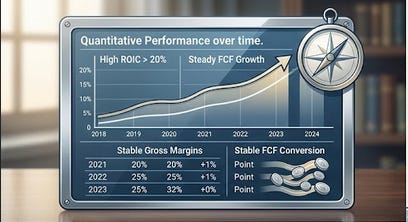
If you can only look at one metric to judge a business, make it ROIC. It answers the fundamental question: For every dollar this business reinvests into its operations, how much profit does it generate?
The Formula: Net Operating Profit After Tax (NOPAT) / Invested Capital (Debt + Equity - Cash).
Why it matters: A high ROIC (consistently above 15-20%) indicates that the company has a distinct advantage. It can take capital and compound it at a high rate. Conversely, a business with an ROIC lower than its cost of capital (WACC) is actually destroying value every time it grows.
The Moat Connection: High ROIC is the numerical proof that a moat exists. If a company had no moat, competitors would enter the market, drive down prices, and push the ROIC back down to the industry average.
2. Gross Margins and Pricing Power
Gross margin (Revenue - Cost of Goods Sold) tells you how much it costs the company to deliver its core product or service before operating expenses.
The Benchmark: We look for consistently high and stable gross margins (often 40%+, though this varies heavily by industry).
Pricing Power: High gross margins are the clearest indicator of pricing power. If a company can raise prices during inflationary periods without losing customers (or suffering a drop in volume), they have pricing power. As seen recently in the consumer goods sector, companies that cannot pass on raw material costs suffer immediate margin compression. A quality company dictates its price to the market; a commodity company accepts the market price.
3. High Free Cash Flow (FCF) Conversion
Net income is an accounting construct; free cash flow is reality. FCF is the cash left over after the business has paid its operating expenses and capital expenditures (the money needed to maintain or expand its assets).
FCF Conversion: We want to see a high percentage of Net Income converting into Free Cash Flow (ideally 80-100%+).
Why it matters: Quality companies are “capital light.” They don’t need to constantly pour billions of dollars into new factories or heavy machinery just to maintain their current earnings. This excess cash flow can then be used to pay dividends, repurchase shares, or acquire other businesses—all of which drive shareholder return.
4. A Clean Balance Sheet
A quality business does not rely on excessive leverage to generate returns.
The Metric: Look at Net Debt to EBITDA. I generally want to see this ratio under 2.5x, though lower is always better. Often times I am looking for companies that have more cash on hand than debt. In times of economic stress or rising interest rates, debt becomes an existential threat to mediocre companies. For a high-quality business, a pristine balance sheet allows them to play offense during recessions, buying distressed assets or gobbling up market share while competitors are busy surviving.
Part 2: The Qualitative Drivers of Quality
If the quantitative metrics tell us what the business is doing, the qualitative factors tell us why it can keep doing it.
1. The Durable Competitive Advantage (The Moat)
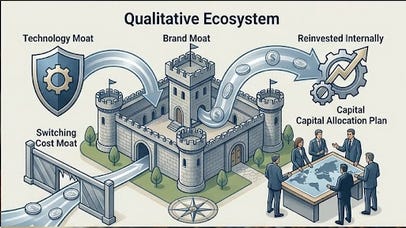
As covered in our previous module, a quality business must have a mechanism to keep competitors at bay. Whether it is network effects, switching costs, intangible assets (brands/patents), or cost advantages, the moat is the prerequisite for long-term quantitative success. A high ROIC without a moat is just an invitation for competition.
2. Visionary and Aligned Management
Management is the steward of your capital. A quality business requires leadership that excels at capital allocation.
The Key Question: What does the CEO do with the free cash flow?
The Red Flags: Empire-building through overpriced, debt-fueled acquisitions; excessive stock-based compensation that dilutes shareholders; or chasing short-term earnings targets at the expense of long-term R&D.
The Green Flags: A history of opportunistic share buybacks (buying when the stock is cheap, not just to offset dilution), prudent reinvestment into core business lines, and significant insider ownership (they eat their own cooking).
3. Mission-Critical Products or Services
A high-quality business provides a product that its customers simply cannot live without.
The Test: What happens if this company disappears tomorrow? If the answer is “we buy a slightly cheaper alternative,” the quality is low. If the answer is “our entire IT infrastructure grinds to a halt” or “we cannot process payments,” the quality is high. Mission-critical products lead to high switching costs and extreme customer loyalty.
4. Secular Tailwinds
Even the best management team will struggle in a dying industry. We want to find quality businesses operating in spaces benefiting from long-term, structural growth trends (secular tailwinds) rather than short-term economic cycles.
Wait! ...
If you only read this far, you know how to spot a “good” business. But if you want to find a generational wealth compounder, the foundation isn’t enough. You need the engine.
In the rest of this article, we unlock the advanced frameworks that separate standard portfolios from market-beating ones. Upgrade to a paid subscription to access the rest of this module, including:
The Reinvestment Runway: The critical mathematical formula that turns a good ROIC into explosive intrinsic growth.
The Microsoft Blueprint: A full, granular teardown of how MSFT combines these metrics to dominate the market.
Spotting Value Traps: Don’t get fooled. We break down the “Melting Ice Cube” and the “Debt-Fueled Mirage” (featuring a detailed autopsy of the IBM trap).
The Premium Quality Checklist: The exact, step-by-step framework to run your stocks through before putting a single dollar at risk.
Avoiding just one value trap using this framework will pay for your subscription for the next decade. Join us below.
