

The New Paradigm vs. Historical Gravity
For decades, semiconductor memory was the ultimate widow-maker trade—a brutal, highly cyclical commodity market where explosive boom years were inevitably followed by devastating, margin-crushing busts. But in 2026, the artificial intelligence revolution has rewritten the laws of semiconductor economics. Micron Technology (NASDAQ: MU) has transformed from a cyclical volume producer into the absolute chokepoint of the global AI rollout. High-Bandwidth Memory (HBM) is no longer just a standard component; it is the vital oxygen that $30,000 AI GPUs need to function.
With shares trading near all-time highs and the company generating unprecedented free cash flow, investors face a critical juncture. Is this truly a “new paradigm” where structural AI demand permanently overrides historical memory cycles? Or are we simply at the euphoric peak of the greatest boom before an inevitable $75 billion CapEx-driven bust?
In this comprehensive deep dive, we will unpack Micron’s technological moat, analyze the macro power-grid constraints defining the market, and run proprietary variable-growth DCF models to determine exactly how much of this supercycle is already baked into the stock price.
Table of Contents
The Manufacturing Moat: EUV Lithography and Advanced Packaging
Financial Performance and Balance Sheet Strength (Premium Breakdown)
Check the Scorecards Want to see how our research grades out? View our 1-page fundamental breakdowns—scoring every company on Growth Potential, Profitability, Balance Sheet, Return on Capital, Shareholder Yield, Management, Moat, and Execution Certainty

Company History and Timeline
Micron Technology is one of the last remaining titans of American semiconductor manufacturing. Surviving decades of notoriously brutal boom-and-bust memory cycles, Micron has consolidated its position through organic technological leaps and strategic acquisitions to become a linchpin in the global AI supply chain.
Key Milestones:
1978: Founded as a four-person semiconductor design company in the basement of a Boise, Idaho, dental office.
1980–1984: Broke ground on its first fabrication plant in Boise and introduced the world’s smallest 256K DRAM chip, establishing early tech leadership.
1998: Acquired Texas Instruments’ worldwide memory operations, catapulting Micron into the ranks of the largest global memory producers.
2013: Acquired Elpida Memory, significantly expanding its DRAM market share and mobile footprint.
2015: Partnered with Intel to unveil 3D NAND and 3D XPoint technologies.
2021–2022: Achieved critical inflection points by being the first to ship 1-alpha (1α) DRAM, 1-beta (1β) DRAM, and the world’s first 232-layer NAND, effectively closing the technological gap with South Korean rivals.
2023–2024: Shipped the industry’s first 24GB 8-high HBM3E memory, establishing a beachhead in the generative AI hardware market.
2025–2026 (Present): Crossed the $1 trillion market cap threshold alongside its peers. Began shipping the revolutionary 1-gamma (1γ) DRAM node and next-generation HBM4 memory for leading AI accelerators (e.g., NVIDIA’s Vera Rubin platform).
Macro Industry Overview: The Memory Market Dynamics
Before analyzing Micron’s specific product stack, it is crucial to understand the unique economic that control the global semiconductor memory market.
The Notorious “Boom and Bust” Cyclicality
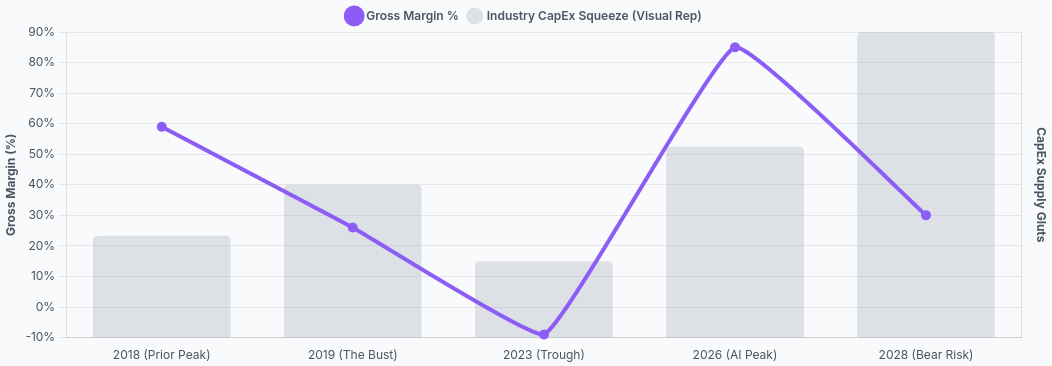
Historically, memory (DRAM and NAND) has been a brutal, highly cyclical commodity business. Because fabricating memory requires massive, multi-billion-dollar upfront capital expenditures (CapEx) and years to build a fab, supply is highly inelastic.
This creates severe cycles:
The Boom: When macro demand surges (e.g., the work-from-home PC boom of 2020), supply cannot react quickly enough. Average Selling Prices (ASPs) skyrocket, and memory makers print free cash flow.
The Bust: Lured by high margins, manufacturers aggressively expand capacity. By the time these new mega-fabs come online, demand has often normalized. The market floods with excess supply, ASPs crash below the cost of production, and companies bleed cash.
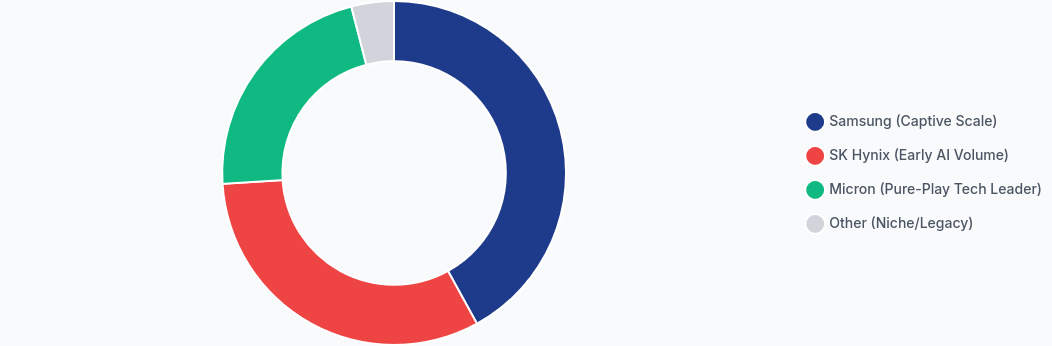
Fortunately, the industry has consolidated heavily since the 1990s. Moving from over twenty manufacturers down to a disciplined oligopoly of three primary DRAM players (Samsung, SK Hynix, and Micron) has somewhat smoothed these wild swings, encouraging more rational capacity management.
The Secular Uptrend: Insatiable Global Demand
While cyclicality drives short-term volatility, the baseline for memory strictly goes up. We are living in an era of exponential data creation, and every byte of that data must be processed (DRAM) and stored (NAND). The global demand for memory is ever-increasing, driven by overlapping megatrends:
The AI Supercycle: Large Language Models (LLMs) and generative AI require massive datasets to be held in active memory during training and inference, fundamentally rewriting the demand curve.
Cloud Computing & Hyperscalers: The continuous migration of global enterprise data to the cloud requires constant upgrades to server density and speed.
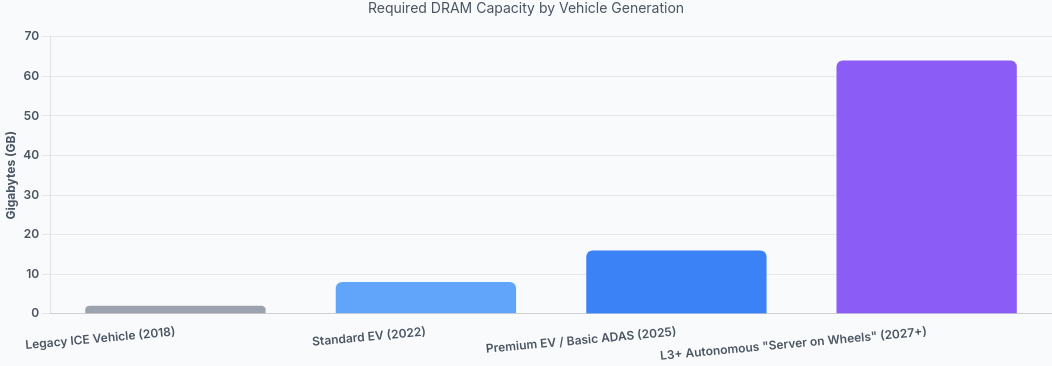
Edge Computing & Automotive: Modern electric and autonomous vehicles are essentially “servers on wheels,” requiring gigabytes of ultra-reliable, temperature-resistant memory to process real-time sensor data.
The Device Upgrade Cycle: “AI PCs” and next-generation smartphones now require drastically higher base-level memory to run on-device AI applications locally.
Memory is the foundational bedrock of the digital economy; without it, the entire technology ecosystem grinds to a halt.
The “Second-Level” Macro Constraint: The 2026 Power Wall
Most analysts stop at “AI needs memory.” But the true structural driver of the 2026 supercycle is a secondary macro constraint: the data center power grid. By 2025 and into 2026, the primary bottleneck for AI expansion decisively shifted from chip manufacturing capacity (like TSMC’s CoWoS packaging) to the availability of electricity.
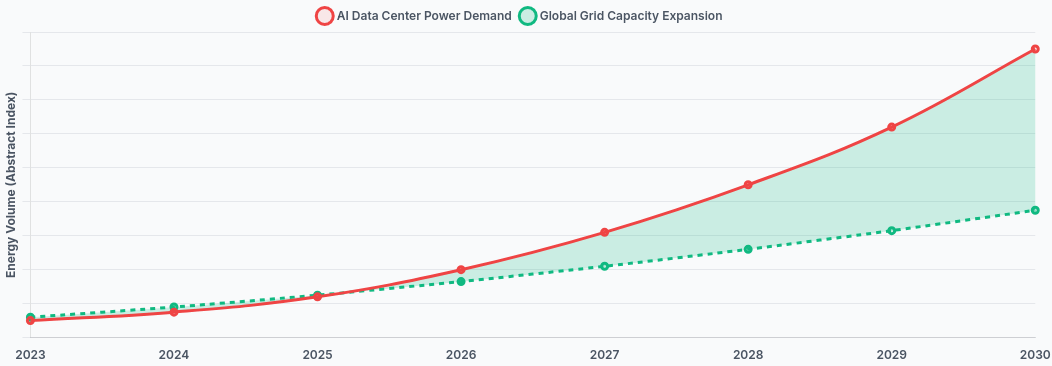
Hyperscalers currently possess stockpiles of AI hardware they cannot deploy because regional energy grids and cooling systems are maxed out. This “Power Wall” changes the buying calculus entirely. Because physical megawatt limits are now the hardest ceiling on AI scale, hyperscalers are forced to prioritize total cost of ownership (TCO) and performance-per-watt above all else. They can no longer afford to run standard, commodity DRAM that eats into their power budget. This macro grid limitation forces operators to buy the absolute most power-efficient premium memory available (where Micron currently leads), effectively destroying the “commodity” nature of high-end memory.
Product Breakdown
Micron operates fundamentally in two massive segments—DRAM (Dynamic Random Access Memory) and NAND (Flash Storage)—but the AI revolution has highly specialized its product stack.

High-Bandwidth Memory (HBM) – The AI Crown Jewel
HBM is fundamentally different from traditional memory. It involves stacking DRAM dies vertically and connecting them with micro-bumps and through-silicon vias (TSVs). This advanced architecture is critical to the broader AI investment thesis for two primary reasons:
Solving the “Memory Wall”: Modern AI GPUs process calculations at such extreme speeds that traditional planar DRAM cannot feed them data fast enough. This creates a bottleneck—the “Memory Wall”—where expensive compute clusters sit idle, starved for data. HBM solves this by acting as a massive, ultra-wide data highway placed directly adjacent to the processor, allowing the GPU to run at maximum utilization.
The Ultimate AI Chokepoint (The AI Trade Link): Because top-tier AI accelerators physically cannot function efficiently without HBM, advanced memory is no longer a mere commodity; it is the critical chokepoint of the entire AI supercycle. The broader AI investment trade is inextricably linked to memory bandwidth. By controlling HBM supply, Micron and its peers effectively control the deployment pace of global AI infrastructure.
Current High-End HBM Stack:
HBM3E: Micron’s 12-high, 36GB HBM3E modules deliver industry-leading pin speeds greater than 9.2 Gbps and bandwidth over 1.2 TB/s. These are critical components in top-tier AI accelerators (like NVIDIA’s H200 and B200).
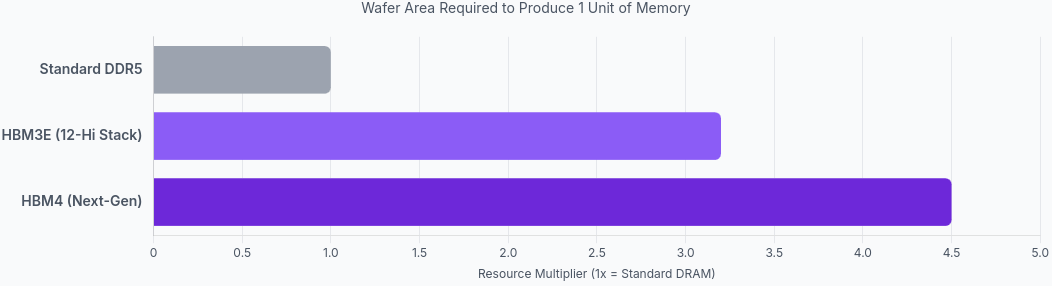
HBM4: Currently in high-volume production (ramping twice as fast as HBM3E) for next-generation platforms like NVIDIA’s Vera Rubin. HBM4 requires significantly more cleanroom space and wafer capacity, inherently constricting overall market supply.
Standard DRAM, Edge AI, and Emerging Architectures (CXL)
While HBM captures the AI headlines, standard and mobile DRAM still drive massive volume, and the architecture of how this memory is deployed is shifting rapidly.
Server DRAM and Compute Express Link (CXL): Beyond their standard 256GB DDR5 RDIMMs, Micron is pioneering memory modules for the CXL standard. Historically, memory was physically trapped inside individual servers. If one server ran out of memory while another had excess, the data center couldn’t share it (known as “stranded memory”). CXL acts as a universal interconnect, allowing hyperscalers to create massive “pools” of shared Micron DRAM that any server can access instantly. This dramatically lowers the Total Cost of Ownership (TCO) for cloud providers and opens a massive new Total Addressable Market (TAM) for Micron.

Automotive Memory (The Server on Wheels): Modern electric and autonomous vehicles require gigabytes of high-bandwidth memory to process real-time sensor and LiDAR data. However, automotive memory must pass rigorous safety certifications (ASIL) and survive extreme temperature fluctuations and physical vibrations. Micron’s highly specialized, ultra-reliable LPDDR5X automotive-grade memory dominates this high-margin niche, positioning them perfectly as cars transition into software-defined “servers on wheels.”
Mobile & “AI PCs” (LPCAMM2): Micron provides ultra-low power DRAM essential for pushing AI processing to the “edge” (i.e., running AI directly on your laptop or smartphone rather than in the cloud). Their new LPCAMM2 modules offer the modularity and upgradeability of standard PC memory but with the extreme power efficiency of mobile memory.
NAND & Enterprise SSDs (Storage)
G9 TLC NAND: The industry’s fastest NAND, powering the next generation of solid-state drives.
High-Capacity SSDs: Micron’s 245TB QLC SSD is completely displacing traditional Hard Disk Drives (HDDs) in AI data centers, reducing physical rack footprints by up to 82% and cutting power consumption in half.
The Manufacturing Moat: EUV Lithography and Advanced Packaging
It is impossible to separate Micron’s premium product stack from the physical manufacturing processes required to build it. Memory manufacturing has reached atomic-level physical limits, turning fabrication capabilities into the ultimate competitive moat.
EUV Lithography (The 1-gamma Node): Micron’s transition to the 1-gamma node relies heavily on Extreme Ultraviolet (EUV) lithography. EUV utilizes light wavelengths incredibly close to the X-ray spectrum, allowing Micron to print microscopic circuits with unprecedented precision. This drastically increases die density, maximizing the amount of memory that can be extracted from a single silicon wafer. Mastering EUV deployment at high volume is extraordinarily difficult and capital-intensive, requiring specialized optics and massive, hyper-sterile cleanrooms.
Advanced Packaging and The TSV Bottleneck: Building HBM is not just a standard memory manufacturing process; it is an advanced packaging nightmare. To stack 8 or 12 DRAM dies vertically, Micron must physically punch thousands of microscopic holes through the silicon—known as Through-Silicon Vias (TSVs)—and connect them perfectly with solder micro-bumps.
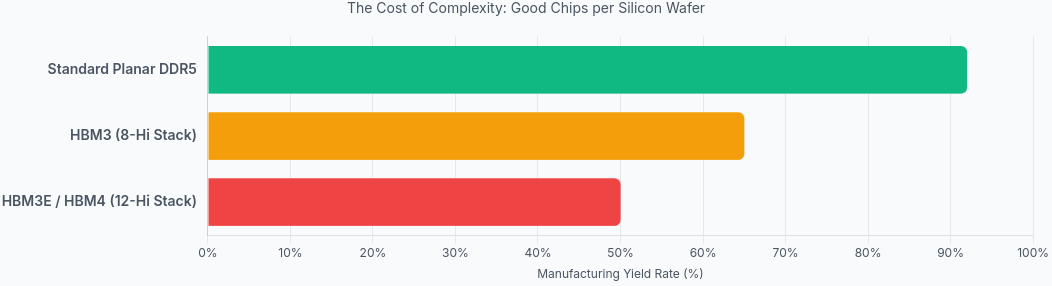
The Yield Rate Advantage: Because the physical complexity of TSV stacking is so high, a single microscopic flaw can ruin an entire stacked chip. This inherently lowers manufacturing “yield rates” across the industry compared to standard planar DRAM. Micron’s ability to maintain higher yield rates in its advanced packaging facilities is a critical driver of its outsized gross margins. This complexity also guarantees that even if well-funded competitors build new fabs, they cannot simply flip a switch and flood the market with high-yield HBM.
Competition and Differentiation
The memory market is a consolidated oligopoly dominated by three players. While Micron holds strong technological leadership today, it is essential to understand why it historically operates with a significantly lower overall market share than its South Korean rivals, Samsung Electronics and SK Hynix.
The Heavyweights: Samsung and SK Hynix (and Why They Lead in Volume)
Samsung Electronics (The Volume King): Samsung is the undisputed market share leader in both DRAM and NAND, but this dominance is largely structural. As a South Korean “chaebol,” Samsung is a vertically integrated titan. Because they manufacture hundreds of millions of Android smartphones, tablets, and consumer electronics annually, they have a massive, captive internal market for their own memory chips. Furthermore, with deep pockets and historical national backing, Samsung has traditionally utilized brute-force CapEx spending to flood the market with wafer capacity, prioritizing sheer scale and market dominance over absolute margin efficiency.
SK Hynix (The Early AI Pioneer): SK Hynix historically captured the #2 spot through aggressive consolidation (including acquiring Intel’s Solidigm NAND business) and highly prescient early bets. While Micron leads the current efficiency race, SK Hynix was the original pioneer of HBM in partnership with AMD and NVIDIA. Their early dominance in TSV (through-silicon via) stacking gave them a massive head start in AI memory volume, allowing them to capture the lion’s share of the early HBM2 and HBM3 waves before Micron fully entered the chat.
What Differentiates Micron? (The Pure-Play Strategy)
As a US-based, pure-play memory producer without a captive smartphone division to guarantee volume, Micron operates at a structural scale disadvantage against the Koreans. Consequently, CEO Sanjay Mehrotra has engineered a strategic pivot: conceding low-end commodity market share to relentlessly optimize for high-margin, cutting-edge nodes.
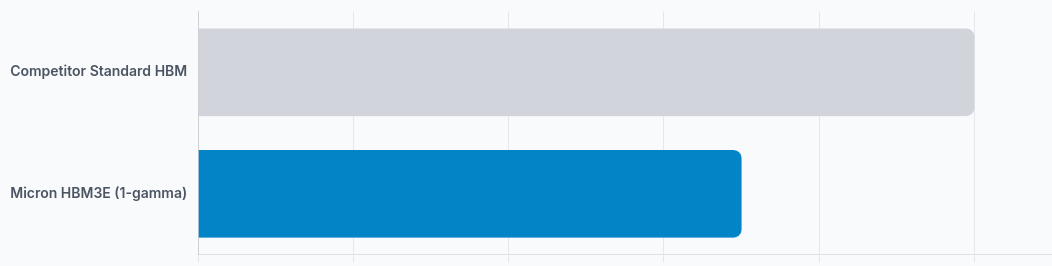
Power Efficiency as a Margin Driver: Micron’s HBM3E boasts approximately 30% lower power consumption than competitive offerings from SK Hynix and Samsung. As we established, power grids are the primary constraint in 2026 data centers. By saving megawatts at the rack level, hyperscalers can install additional compute nodes without upgrading their physical grid infrastructure. Because this solves a multi-million dollar infrastructure headache, Micron is able to command a measurable pricing premium (estimated at 15-20% over standard HBM). This premium drops straight to the bottom line, directly driving their record-breaking 80%+ gross margins.
U.S. Geopolitical Positioning: As the only U.S.-based memory manufacturer, Micron enjoys a significant structural advantage. In a geopolitical environment defined by U.S.-China decoupling and Taiwan supply chain risks, Micron is the primary beneficiary of the CHIPS Act and defense/enterprise contracts prioritizing domestic supply chains.
Customer Diversification (The NVIDIA Hedge): Major buyers like NVIDIA actively rely on Micron to prevent SK Hynix or Samsung from gaining monopolistic pricing leverage. This ensures Micron’s capacity remains fully allocated.
Process Node Leadership: Historically a follower, Micron leapfrogged Samsung in recent years. Their transition to the 1-gamma node utilizing extreme ultraviolet (EUV) lithography has yielded superior die densities and better manufacturing yields.
Strategic Customer Agreements (SCAs): To insulate itself from the notorious boom-and-bust cyclicality of the memory market, Micron recently signed 16 multi-year, take-or-pay SCAs extending through 2030. These cover roughly 20% of their DRAM and 33% of their NAND volume, securing $22 billion in cash deposits and locking in floor prices.
Management Team and Notable Figures
Micron’s recent operational excellence can be heavily attributed to its veteran leadership team, which has historically prioritized disciplined execution over market-share price wars.
Sanjay Mehrotra (President & CEO): Mehrotra has led Micron since 2017. He is a semiconductor industry legend who co-founded SanDisk in 1988 and served as its CEO until its sale to Western Digital in 2016. Holding over 70 patents in nonvolatile memory design, his engineering background allows him to deeply understand node transitions. His tenure has been marked by successfully closing the technology gap with Korean rivals.
Mark Murphy (EVP & CFO): Joining Micron in 2022, Murphy has been instrumental in managing the company’s balance sheet through the severe 2023 memory downturn and positioning the company for the current AI supercycle.
Scott DeBoer (EVP & Chief Technology and Products Officer): The architect behind Micron’s leap to 1-beta and 1-gamma DRAM, and 232-layer NAND.
Notable Board Members: The board includes heavyweights like Robert Swan, former CEO of Intel, providing deep strategic insight into the broader CPU/accelerator ecosystem.
Future Guidance and Capital Allocation
Micron is currently experiencing a historic profit surge. Fiscal Q3 2026 guidance demonstrated explosive momentum, with quarterly revenues hitting record highs and gross margins expanding rapidly (driven by HBM pricing power and structural supply shortages).
Management’s strategy for allocating this capital reflects a balance between aggressive reinvestment and rewarding shareholders:
A. Reinvestment (CapEx & R&D)
The HBM Wafer Penalty: HBM requires roughly 3x the wafer capacity of traditional DRAM to produce the same bit output. Because HBM is fully sold out into 2027, Micron is structurally forced to increase Capital Expenditures (CapEx) to meet demand without cannibalizing traditional server/mobile DRAM supply.
U.S. Mega-Fabs: Micron is pouring billions into new infrastructure. They recently broke ground on a massive, highly subsidized fab in Clay, New York (a project that could total $100 billion over the next two decades), alongside major expansions at their Boise, Idaho headquarters.
Strategic Agreements: Micron is locking in revenue through long-term Strategic Customer Agreements (SCAs), moving away from spot-market pricing to ensure stable ROI on their massive CapEx deployments.
B. Returning Capital to Shareholders
Despite heavy CapEx requirements, the sheer volume of free cash flow generated in 2025/2026 has allowed Micron to aggressively return capital:
Dividends: Management recently signaled profound confidence in the sustainability of this cycle by approving a 30% increase in the quarterly dividend.
Share Buybacks: After pausing buybacks during the memory downturn, Micron has actively resumed repurchasing shares to offset dilution from stock-based compensation and return excess cash.
C. Future Outlook
Management’s forward guidance rests on the thesis that AI computation is becoming increasingly “memory-bound.” Advanced reasoning models and multimodal AI require longer context windows and exponentially more high-speed memory. With HBM supply constraints expected to persist well beyond 2026, and traditional server/PC upgrade cycles kicking in, Micron’s management projects continued margin expansion and sustained free cash flow generation through the end of the decade.
Key Catalysts and Hidden Risks (The Bull vs. Bear Debate)
Before we can accurately model Micron’s true intrinsic value, we have to look past the headline numbers and weigh the specific asymmetric catalysts against the industry’s historical realities.
The Bull Case Catalysts
The “HBM Squeeze” Extends: HBM production requires complex cleanrooms and high wafer utilization. If competitors (like Samsung) stumble on their HBM4 yields, Micron’s pricing power could expand even further, creating a longer runway for 80%+ gross margins.
Edge AI & The PC/Smartphone Upgrade Cycle: The market is currently pricing Micron almost exclusively as an AI data center play. However, the impending roll-out of “AI PCs” and next-gen smartphones requires dramatically higher base-level DRAM content (e.g., jumping from 8GB to 16GB as a standard). This mass-market volume shock is not yet fully priced into the street’s consensus estimates.
The Bear Case Risks (What Could Derail the Story?)
The “Commodity Gravity” Threat: Historically, memory is intensely cyclical. Bears argue that the current massive CapEx build-outs by Micron, SK Hynix, and Samsung will inevitably lead to a massive supply glut by 2028 when the new mega-fabs come online, crashing ASPs and margins.
Geopolitical Supply Chain Vulnerabilities: While Micron is expanding its US footprint, it remains highly reliant on its manufacturing hubs in Taiwan and its testing facilities in China. Any escalation in trade restrictions or geopolitical tension in the Taiwan Strait presents an existential tail-risk to operations.
🛑 The Paywall: What is Micron Actually Worth Today?
We’ve established the qualitative narrative: Micron holds the physical chokepoint to the AI revolution, but faces a historical $75 billion CapEx threat by 2028. The narrative is flawless—but what does the math say?
Are you buying a generational AI compounder, or stepping in front of a cyclical freight train at peak valuations?
In the premium section below, we strip away the narrative and run the hard numbers. Upgrading your subscription unlocks:
The Q3 ‘26 Financial Deep Dive: Breaking down the incredible $41B revenue surge and 85% gross margins.
Proprietary DCF Models: My custom Variable Growth Base, Bull, and Bear case models mapped out over the next 5 years.
The Final Verdict: My official 12-month Price Target, exact entry points, and portfolio weighting recommendation.
Upgrade now to read the conclusion of this report and access my entire library of institutional-grade equity research.
