

Introduction: The “Hidden” Moat in the Trash Business
When investors search for “compounding machines,” they often flock to high-flying tech sectors, overlooking the lucrative infrastructure hidden in plain sight at the end of every driveway. Casella Waste Systems (CWST) has transformed from a single-truck operation in 1975 into a regional powerhouse that is currently redefining the economics of environmental services. By pivoting from a traditional “hauler and bury” model to a sophisticated “resource management” strategy, Casella has built a formidable competitive moat centered on asset scarcity. In a region where new landfill permits are nearly impossible to obtain, Casella’s existing footprint has become “irreplaceable real estate.” As the company enters the “Coletta Era”—a transition from founder-led grit to institutionalized, data-driven growth—this deep dive explores whether Casella can maintain its escape velocity amidst a tightening regulatory landscape and a massive Mid-Atlantic expansion.
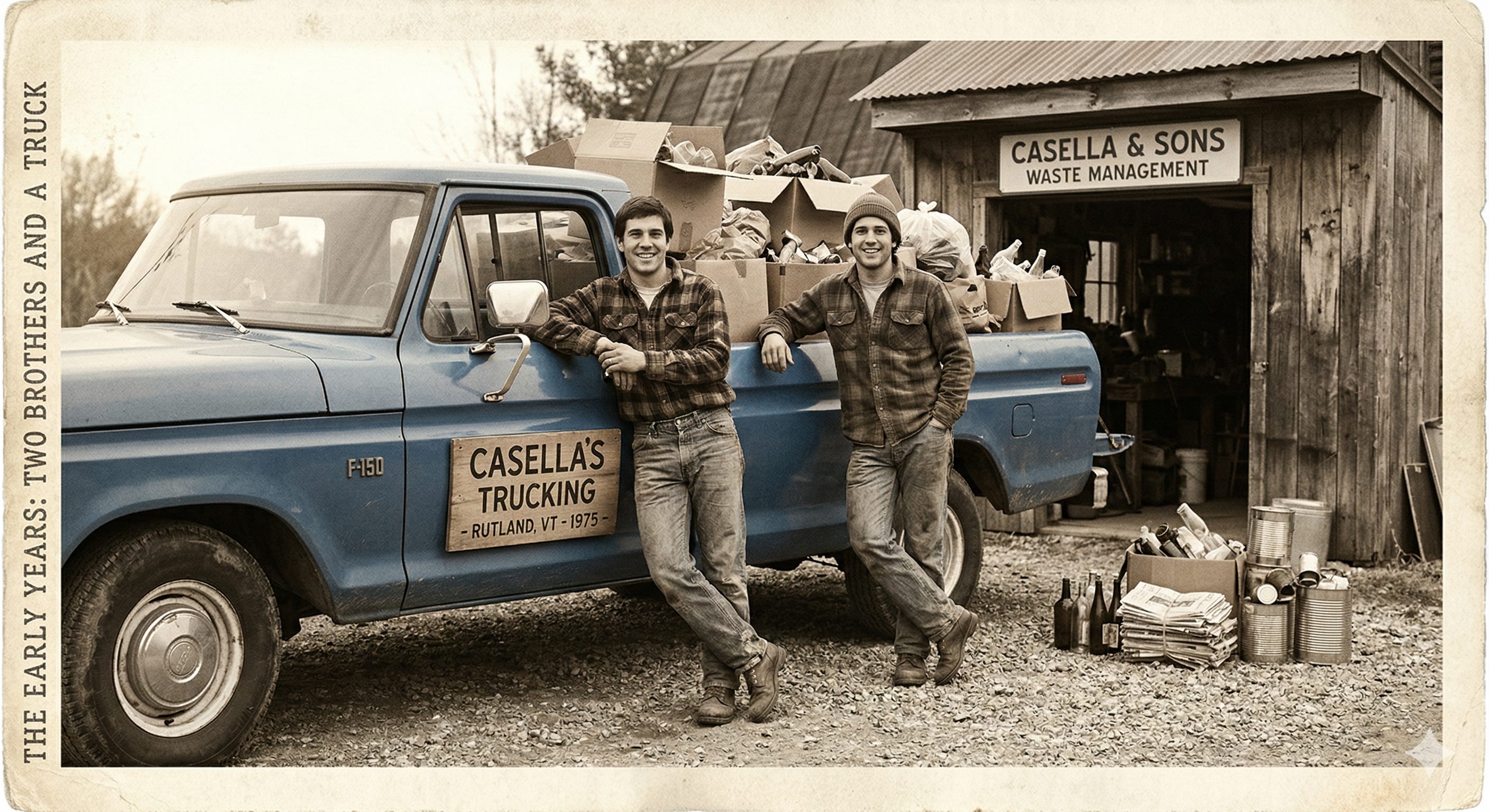
The Early Years (1975–1989): Two Brothers and a Truck
The company’s DNA was formed by “frugality and foresight.” While other haulers were just burying trash, the Casellas were looking at the value within it.
1975: Doug Casella founds the company with a single pickup truck in Rutland, Vermont, using money saved from childhood jobs. He is soon joined by his brother, John (long time CEO).
1977: Long before “sustainability” was a corporate buzzword, the brothers build Vermont’s first recycling facility.
1980s: The company scales across Vermont, establishing a network of transfer stations. They pioneer the “resource management” model by selling cardboard and other commodities back to New England paper mills.
Rapid Expansion & Public Listing (1990–1999)
This decade marked Casella’s transition from a local hauler to a regional infrastructure player.
Early 1990s: Expansion into New York and New Hampshire. They begin acquiring landfills to achieve vertical integration (owning the trucks and the destination for the waste).
1997: Casella goes public on the NASDAQ (CWST). The timing was legendary: trading began the day after a major market “mini-crash,” yet the IPO was one of the most successful in the industry at the time.
1999: A pivotal year. Casella acquires KTI, an integrated waste processor. This nearly doubled their size and extended their footprint across the eastern U.S., significantly increasing their recycling expertise.
The 2000s: The “SEED” Framework & Modernization
With the basic infrastructure in place, the 2000s were about professionalizing the “Green” aspect of the business.
2002: Implementation of the SEED™ (Sustainable Environmental and Economic Development) program. This was a strategic shift to align landfill development with community interests by adding gas-to-energy and resource transformation projects.
2004: Ned Coletta (the current CEO) joins the company.
2008–2009: The Great Recession hits volumes. Casella begins a period of “tightening,” focusing on debt reduction and the core Northeast footprint rather than national expansion.
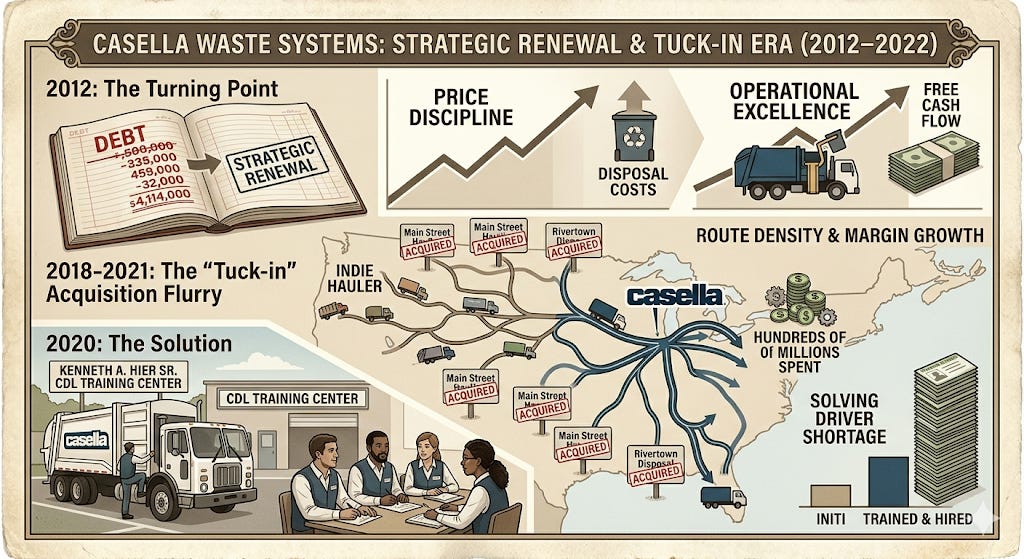
The Strategic Renewal & “Tuck-in” Era (2012–2022)
After a period of heavy debt in the early 2010s, the company executed a massive turnaround strategy.
2012: Launch of the Strategic Renewal Program. Focus shifts to:
Price discipline (raising rates to match rising disposal costs).
Operational excellence (fleet automation).
Free cash flow generation.
2018–2021: A flurry of “tuck-in” acquisitions. Casella spends hundreds of millions to buy out smaller, independent local haulers, increasing “route density” (more stops per mile, which is the key to waste industry margins).
2020: Opens the Kenneth A. Hier Sr. CDL Training Center to combat the industry-wide driver shortage.
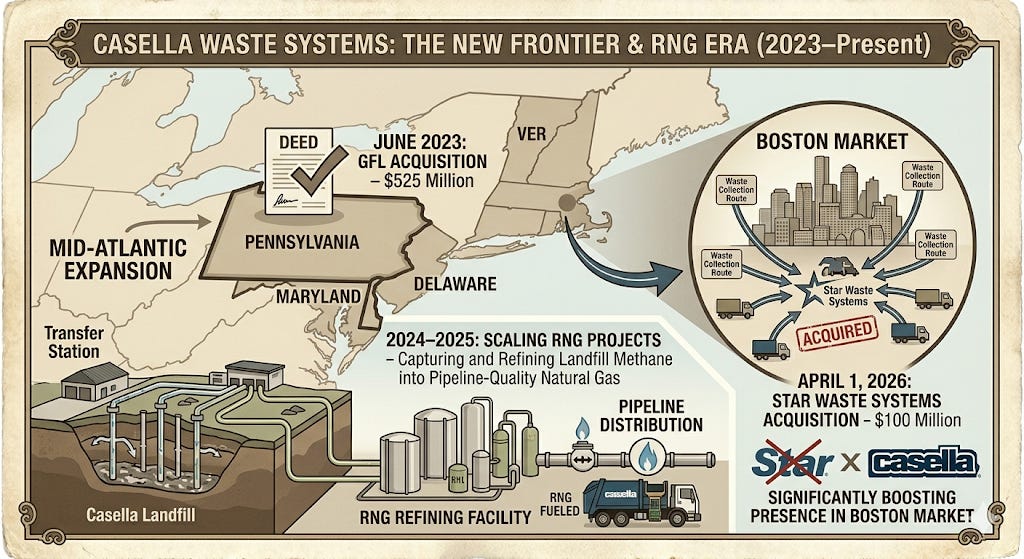
The New Frontier: Mid-Atlantic & RNG (2023–Present)
Casella is currently in its most aggressive growth phase since the late ‘90s.
2023: Casella makes a major leap by acquiring GFL Environmental’s assets in Pennsylvania, Delaware, and Maryland for $525 million. This moves them firmly into the Mid-Atlantic market.
2024–2025: Focus shifts toward Renewable Natural Gas (RNG). They begin scaling projects that capture methane from their landfills and refine it into pipeline-quality natural gas.
April 1, 2026: Casella completes the $100 million acquisition of Star Waste Systems, significantly boosting its presence in the lucrative Boston market.
The “New Guard”: Ned Coletta (CEO)
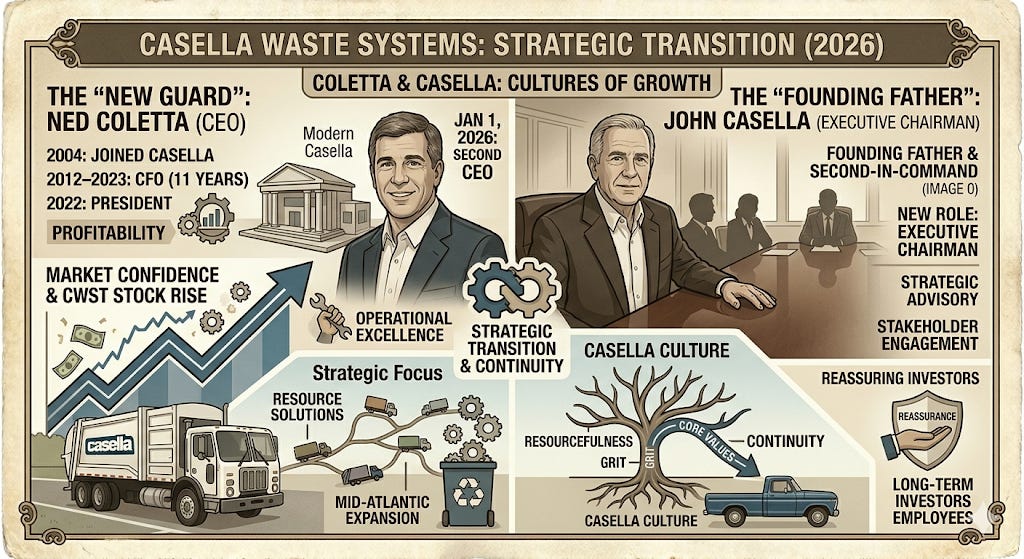
As of January 1, 2026, Edmond “Ned” Coletta officially became the second CEO in the company’s 50-year history.
The “Financial Architect” Pedigree: Coletta isn’t an outsider. He joined Casella in 2004 and served as CFO for 11 years (2012–2023) before being promoted to President in 2022.
Market Confidence: Because he was the CFO during the “Strategic Renewal” era (the period when CWST’s stock price began its massive multi-year climb), the market views him as the architect of the company’s modern profitability.
Strategic Focus: Coletta has stated his tenure will focus on “executing against the long-term strategy”—specifically scaling Resource Solutions (recycling/sustainability services) and continuing the Mid-Atlantic expansion.
The “Founding Father”: John Casella (Executive Chairman)
John Casella didn’t leave the building; he moved into the Executive Chairman role.
Strategic Advisory: In this new capacity, John focuses on high-level strategic development, stakeholder engagement, and maintaining the “Casella culture.”
Continuity: His presence on the board is intended to reassure long-term investors and employees that the company’s core values—often described as “resourcefulness and grit”—remain intact.
2026 Leadership Shake-up: The “Coletta Era” Begins
Since taking the helm just a few months ago, Coletta has already begun reshaping the executive suite to align with a more aggressive, technology-forward growth phase:
New Chief Revenue Officer (March 2026)
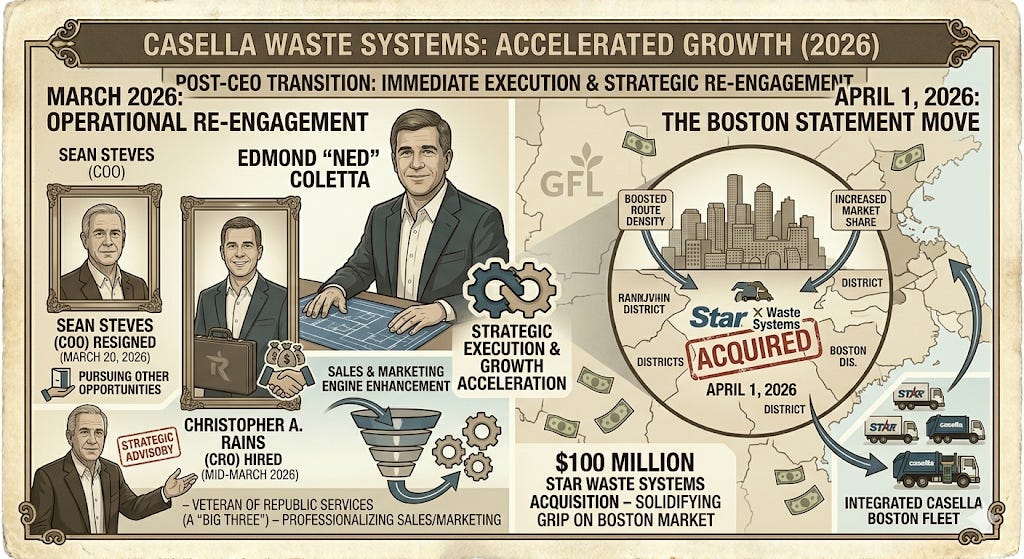
In mid-March, Casella hired Christopher A. Rains as Senior Vice President and Chief Revenue Officer.
Why this matters: Rains is a veteran of Republic Services (one of the “Big Three” in waste). Bringing in a heavyweight from a national competitor suggests Casella is looking to professionalize its sales and marketing engines to compete at a higher level.
Operations Transition (March 2026)
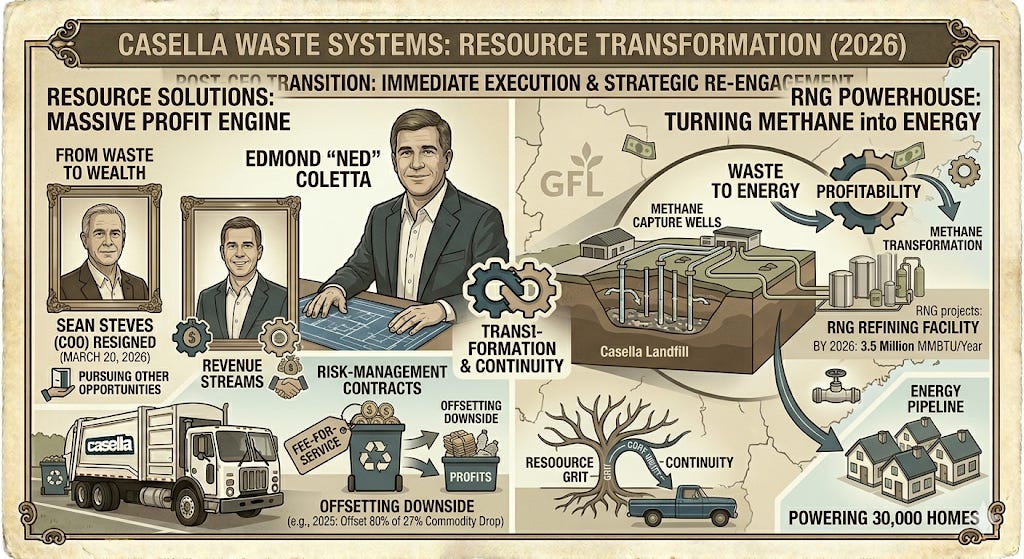
Sean Steves, the COO of Solid Waste Operations, resigned effective March 20, 2026, to pursue other opportunities.
The context: While the company stated there was no disagreement, a change in the COO role right after a CEO transition is a standard signal that Coletta is looking to build his own operational leadership team.
Immediate M&A Execution
To prove the transition wouldn’t slow growth, Coletta’s team finalized the Star Waste Systems acquisition on April 1, 2026. This $100 million deal is a clear “statement move” to solidify their grip on the Boston market under new leadership.
Ned Coletta (CEO): The Growth-Incentive Model
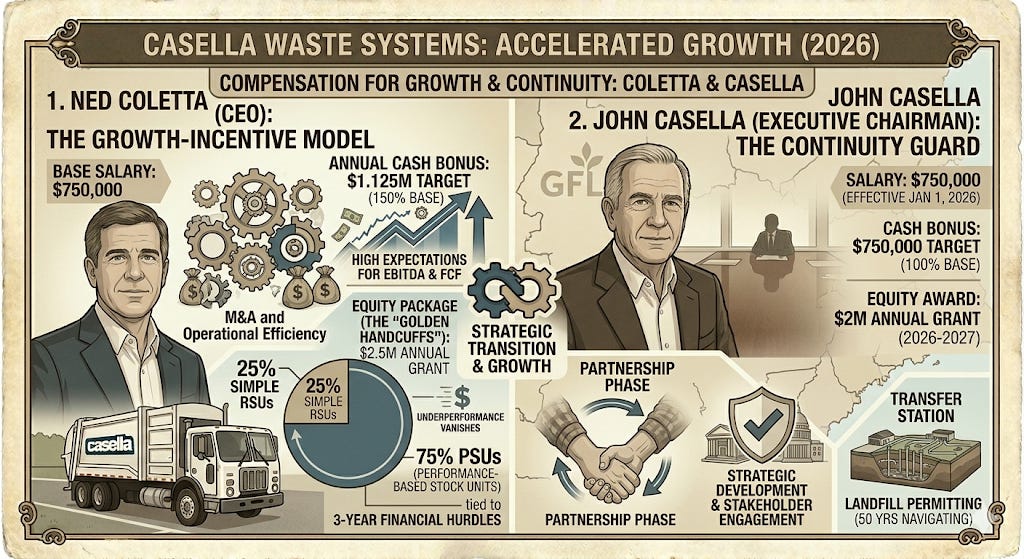
Ned Coletta’s compensation package is built to reward performance over presence. His contract reflects a CEO who is expected to hit the gas on M&A and operational efficiency.
Base Salary: $750,000.
Annual Cash Bonus: Target is 150% of his base salary ($1.125M target). This is a significant jump from his previous bonus structure as President/CFO, signaling high expectations for hitting immediate EBITDA and free cash flow targets.
Equity Package (The “Golden Handcuffs”): For 2026, he was awarded an annual equity grant of $2.5 million.
The Mix: Only 25% is in simple Restricted Stock Units (RSUs).
The Hook: 75% is in Performance-Based Stock Units (PSUs). This means the bulk of his wealth creation is tied to specific three-year financial hurdles set by the board. If the company underperforms, this money effectively vanishes.
John Casella (Executive Chairman): The Continuity Guard
The board has kept John Casella in a high-impact, high-pay role to ensure the transition doesn’t rattle institutional investors who have followed him for decades.
Salary: $750,000 (Effective Jan 1, 2026). Interestingly, his base salary matches Coletta’s, which reinforces the “partnership” nature of this phase.
Cash Bonus: Target is 100% of his base salary.
Equity Award: He is scheduled to receive $2 million in annual equity awards for both 2026 and 2027.
The Role: He remains a full-time employee focused on “strategic development and stakeholder engagement.” This is crucial for a company like Casella that relies heavily on local government relationships for landfill permitting—territory John has navigated for 50 years.
The Revenue Explosion (2020–2026)
Casella has effectively doubled its revenue in a remarkably short window.
The Numbers: In 2025, revenue jumped 18% to reach $1.84 billion. For 2026, the company has issued guidance projecting revenue will just under $2 billion.
The Five-Year Streak: 2025 marked the fifth consecutive year of double-digit growth in Revenue, Adjusted EBITDA, and Free Cash Flow.
Acquisition Cadence: Over the last five years, they have acquired over $800 million in annualized revenue. In 2025 alone, they closed nine deals ($115M in revenue), followed immediately by the Mountain State Waste acquisition on January 1, 2026, which added another $30M and opened the West Virginia market.
Geographic Evolution: The Mid-Atlantic Pivot
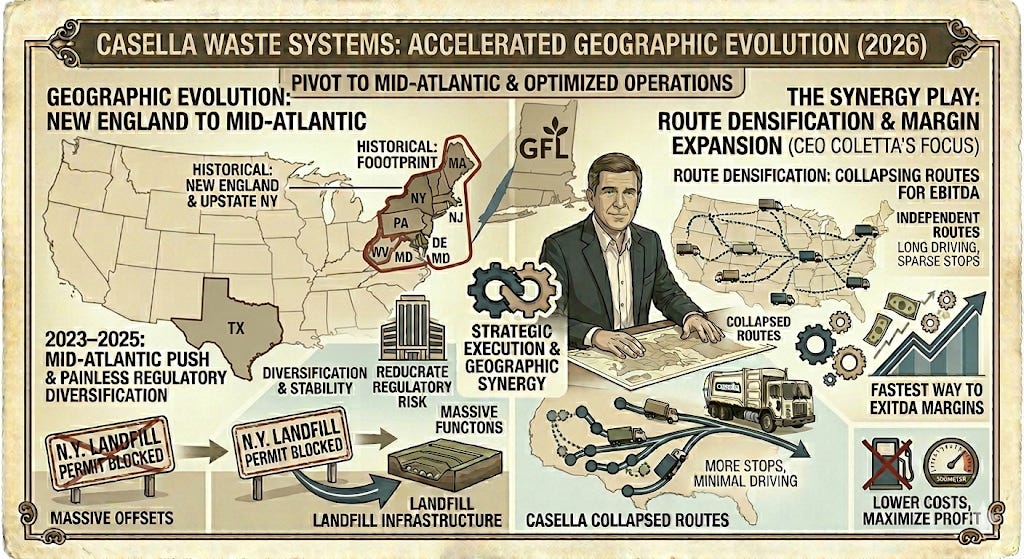
Historically, Casella was a “New England & Upstate New York” company. That changed with the 2023–2025 Mid-Atlantic push.
The Impact: By acquiring assets in PA, DE, MD, and now WV, Casella is diversifying its regulatory risk. If a landfill permit gets blocked in New York, they now have massive infrastructure elsewhere to offset the volume.
The Synergy Play: CEO Ned Coletta is currently focused on “route densification” in these new markets. The goal is to “collapse” routes—ensuring that their trucks spend less time driving and more time picking up, which is the fastest way to expand EBITDA margins.'
The Shift to “Resource Transformation”
Growth isn’t just about more trash; it’s about what they do with it. The Resource Solutions segment is becoming a massive profit engine.
RNG Powerhouse: Casella currently has five new Renewable Natural Gas (RNG) projects in development. These projects capture methane from landfills and turn it into energy. By 2026, they expect these projects to generate 3.5 million MMBTU per year—enough to power 30,000 homes.
Recycling Resilience: Their “Fee-for-Service” model in recycling has protected them from commodity price swings. In 2025, even as recycled commodity prices dropped 27%, their risk-management contracts offset 80% of the downside.
Operational Digitzation (The “Self-Help” Bucket)
Growth often creates “messy” back offices. To fix this, Casella is undergoing a massive internal overhaul.
New Order-to-Cash System: They are currently rolling out a unified tech platform across their Mid-Atlantic region.
The “G&A Tailwind”: Management expects to save $15 million over the next three years simply by automating back-office tasks and reducing reliance on third-party consultants. This is a “self-help” initiative that aims to improve margins without needing to buy a single new company.
Important Note: A significant impact of this growth phase is Scarcity. As landfills in the Northeast reach capacity and new permits become nearly impossible to obtain, Casella’s existing footprint becomes more valuable every day. This creates Pricing Power—Casella can (and does) raise prices at will on roughly 75% of its business because customers simply have nowhere else to take their waste.
Every high-growth “Moat” business has its vulnerabilities. The “Bear Case” for Casella in 2026 isn’t about competition—it’s about the shifting regulatory and environmental landscape.
Here are the four primary risks currently facing Casella Waste Systems:
1. The PFAS “Forever Chemical” Liability
This is the single largest existential risk to the waste industry. PFAS (per- and polyfluoroalkyl substances) are found in everything from non-stick pans to waterproof clothing, and they eventually end up in Casella’s landfills.
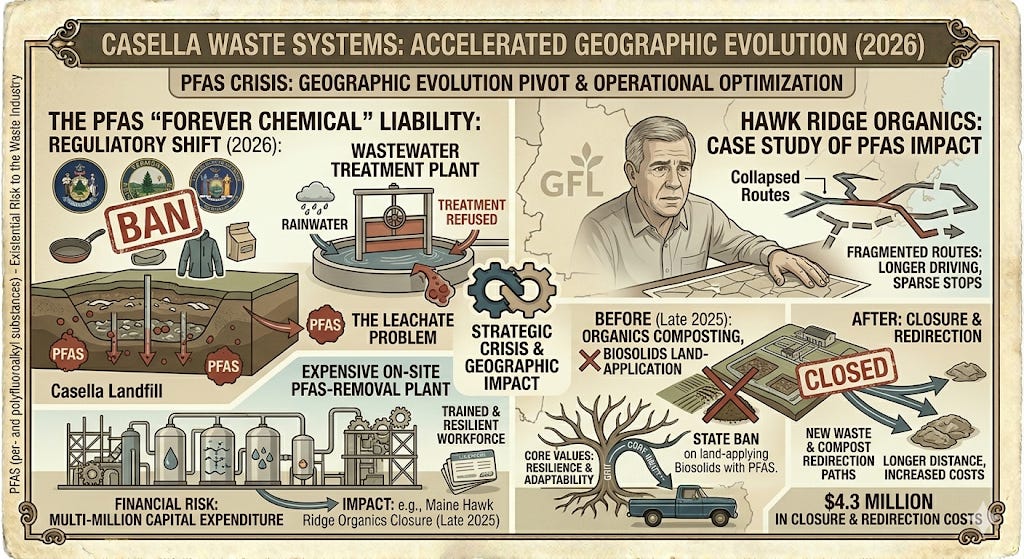
The Regulatory Shift (2026): As of early 2026, several states in Casella’s footprint (including Maine, Vermont, and New York) have enacted strict bans on products containing PFAS.
The Leachate Problem: Rainwater filters through landfills, creating “leachate.” If this liquid contains PFAS, wastewater treatment plants may soon refuse to accept it.
The Financial Risk: Casella may be forced to build incredibly expensive, on-site “PFAS-removal” plants at their major landfills. We are already seeing this impact; in Maine, Casella was forced to close its Hawk Ridge organics facility in late 2025 due to state bans on land-applying biosolids containing PFAS, resulting in $4.3 million in closure and redirection costs.
2. The “Landfill Cliff” & Permitting Gridlock
Casella’s value comes from its landfills, but landfills are finite assets.
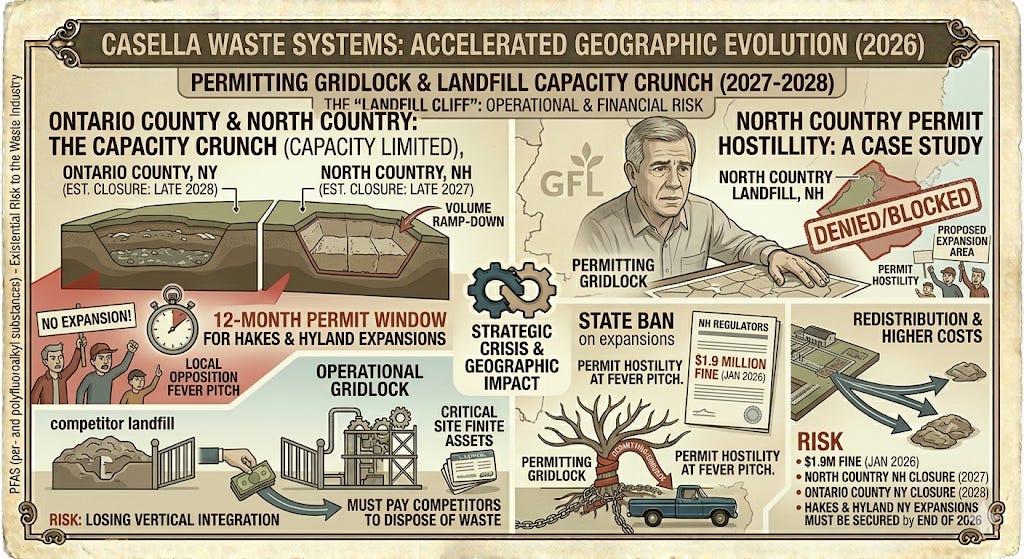
Ontario County & North Country: The company is facing a “capacity crunch” at two of its most critical sites. The Ontario County landfill in NY is slated to close in late 2028, and the North Country landfill in NH is ramping down volumes ahead of a scheduled 2027 closure.
Permit Hostility: Local opposition to landfill expansions has reached a fever pitch. In January 2026, Casella was fined $1.9 million by New Hampshire regulators over operational issues at North Country.
The Risk: If Casella cannot secure expansions for its Hakes and Hyland sites in NY within the next 12 months, they will lose the “vertical integration” that gives them their edge, forcing them to pay competitors to dispose of their waste.
3. Post-Acquisition “Indigestion” (Leverage Risk)
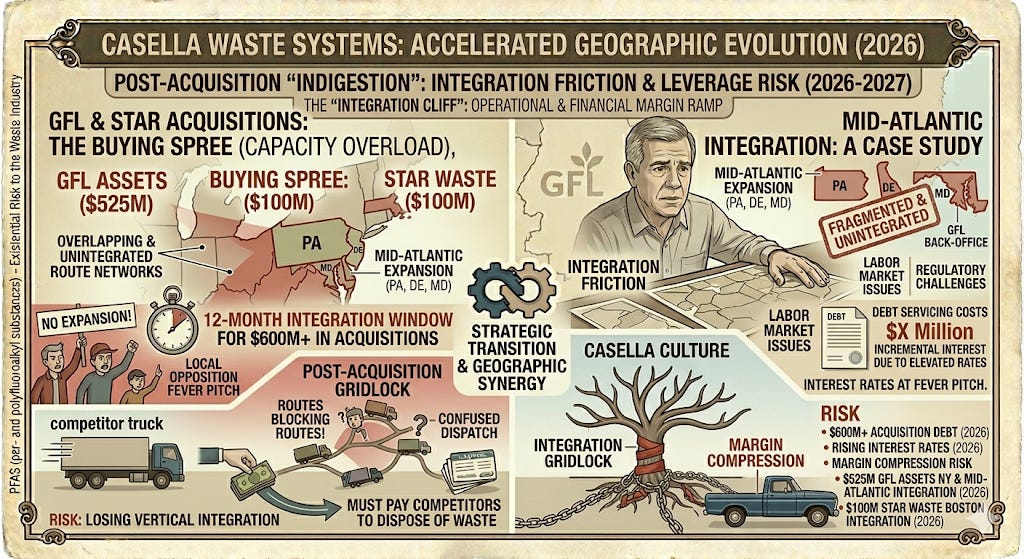
Casella has been on a $600M+ buying spree. While growth is good, it comes with a heavy price tag.
Debt Burdens: While Casella has managed to keep its leverage ratio around 2.5x to 3.0x, the cost of servicing that debt is rising as interest rates remain elevated in 2026.
Integration Friction: Moving into the Mid-Atlantic (PA, DE, MD) means managing a different labor market and different regulatory bodies. If the integration of the $525M GFL assets or the $100M Star Waste deal hits a snag, it could lead to “margin compression”—where revenue goes up but profits go down.
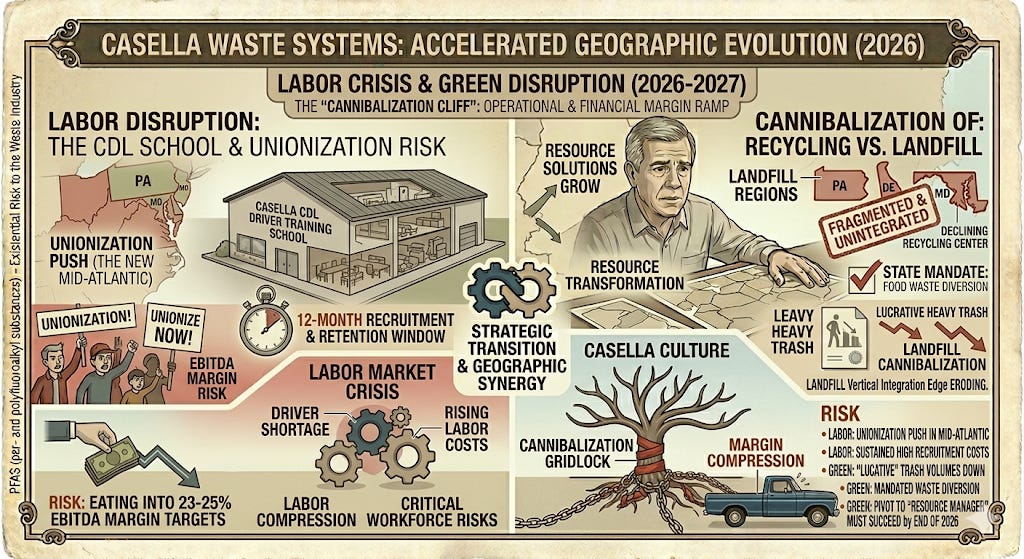
4. Labor and “Green” Disruption
The Driver Shortage: Despite opening their own CDL school, the cost of labor remains the company’s largest variable expense. Any push for widespread unionization in their new Mid-Atlantic markets could significantly eat into their 23-25% EBITDA margin targets.
The Cannibalization of Waste: Casella’s growth in Resource Solutions (recycling/composting) is a double-edged sword. As states mandate more recycling and food waste diversion, the volume of “lucrative” heavy trash going into their landfills decreases. They must successfully pivot to being a “Resource Manager” rather than just a “Garbage Hauler.”
Casella is a race between Asset Scarcity and Regulatory Pressure. They are betting that their landfills will become so rare that they can charge whatever they want, provided the government doesn't make those same landfills a legal liability via PFAS legislation.
To the casual observer, Casella looks like a boring trash company; to a financial analyst, their financial statements reveal "Growth-by-Acquisition" machine that has reached escape velocity.
