

The Century-Old Pivot
Before Nintendo became synonymous with high-definition plumbers and pocket monsters, it was a modest shop in Kyoto hand-painting playing cards on mulberry bark. Very few companies in history have successfully navigated as many industrial shifts as Nintendo—moving from traditional toys to failed taxi services and, eventually, to the undisputed kings of the “Blue Ocean” gaming strategy. Today, we stand at the precipice of their most ambitious era yet. With the successful launch of the Nintendo Switch 2 and a balance sheet that rivals a central bank, Nintendo is no longer just a hardware manufacturer; it is transforming into a global IP powerhouse. This article explores the 130-year journey of the Big N, the financial “fortress” they’ve built, and the bull, bear, and base cases for their next five years of growth.

The Handmade Era (1889–1949)
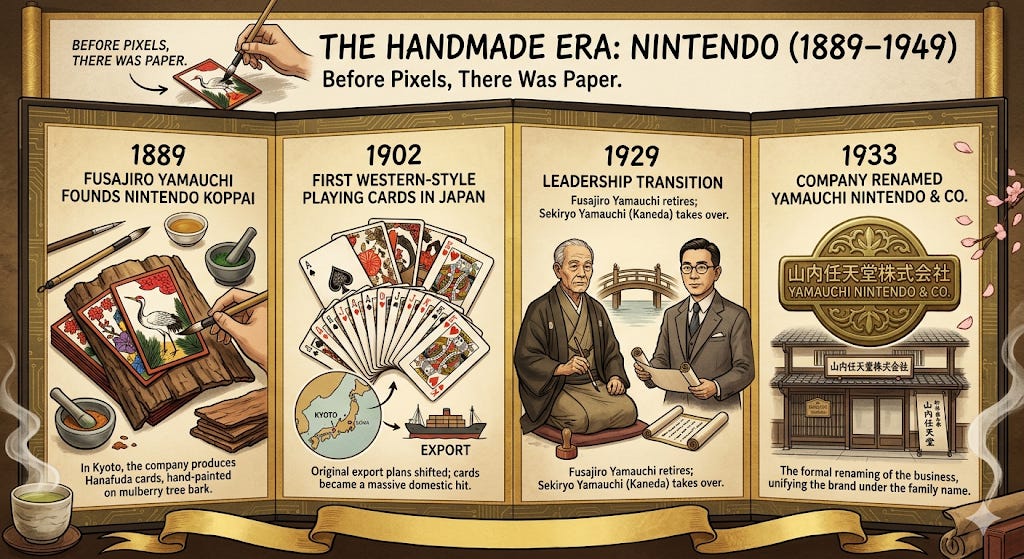
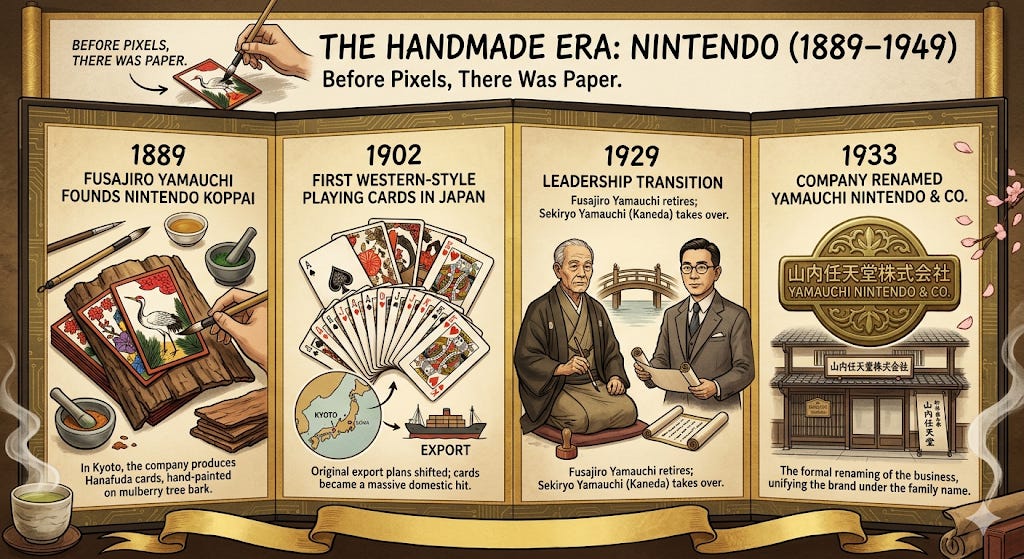
Before pixels, there was paper.
1889: Fusajiro Yamauchi founds Nintendo Koppai in Kyoto. The company produces Hanafuda (flower cards), which were hand-painted on mulberry tree bark.
1902: Nintendo produces the first Western-style playing cards in Japan, originally intended for export but becoming a domestic hit.
1929: Fusajiro retires; his son-in-law, Sekiryo Kaneda (who took the Yamauchi name), takes over.
1933: The company is renamed Yamauchi Nintendo & Co.
The Expansion & Wild Experiments (1949–1972)
The era of “try everything and see what sticks.”
1949: Hiroshi Yamauchi, the 22-year-old great-grandson of the founder, takes over. He would rule with an iron fist for over 50 years.
1959: A pivotal deal with Disney allows Nintendo to put Mickey Mouse on playing cards, selling millions of decks and moving the brand into the “toy” space.
1963: The company officially becomes Nintendo Co., Ltd. * 1960s Diversification: Looking to expand, Nintendo famously (and unsuccessfully) tries its hand at a taxi company, a “love hotel” chain, and instant rice.
1966: Maintenance engineer Gunpei Yokoi invents the Ultra Hand, a lattice-style extendable arm. It sells 1.2 million units, and Yamauchi moves Yokoi from maintenance to product development.
The Birth of Video Games (1973–1983)
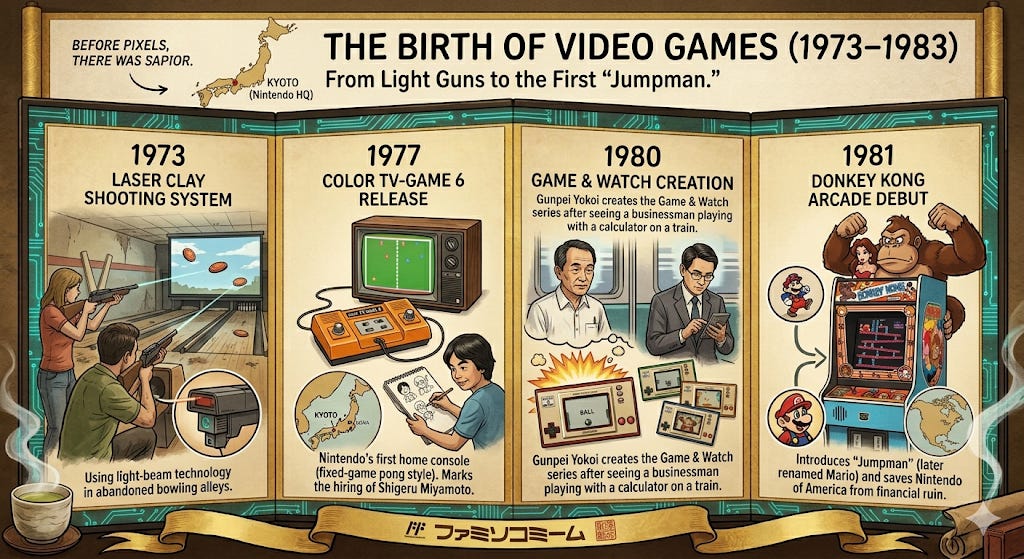
From light guns to the first “Jumpman.”
1973: Nintendo releases the Laser Clay Shooting System, using light-beam technology in abandoned bowling alleys.
1977: Release of the Color TV-Game 6, Nintendo’s first home console (fixed-game pong style). This year also marks the hiring of a young artist named Shigeru Miyamoto.
1980: Gunpei Yokoi creates the Game & Watch series after seeing a businessman playing with a calculator on a train.
1981: Donkey Kong debuts in arcades. It introduces “Jumpman” (later renamed Mario) and saves Nintendo of America from financial ruin.

The Golden Age of 8 and 16-Bit (1983–1995)
The era that saved the industry.
1983: The Family Computer (Famicom) launches in Japan.
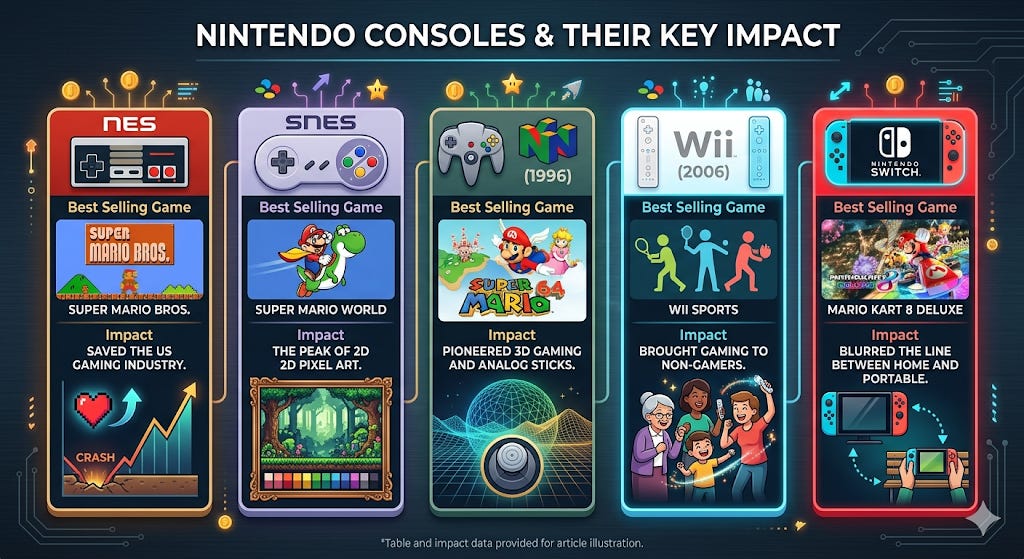
1985: The Nintendo Entertainment System (NES) launches in North America, single-handedly reviving the video game market after the 1983 crash.
1989: The Game Boy is released. Bundled with Tetris, it becomes a global phenomenon.
1990/91: The Super Nintendo (SNES) launches, entering a fierce “Console War” with Sega.
1995: The Virtual Boy launches and fails spectacularly, leading to Gunpei Yokoi’s eventual departure.
The 3D Revolution & Shakeups (1996–2011)
Moving into the third dimension.
1996: Nintendo 64 launches with Super Mario 64, defining how 3D movement works in games. This year also sees the launch of Pokémon in Japan.
2001: Launch of the GameCube and the Game Boy Advance.
2002: Satoru Iwata becomes president, the first non-Yamauchi family member to lead the company.
2004: The Nintendo DS launches. Its dual-screen, touch-sensitive design is initially mocked but becomes the best-selling handheld ever.
2006: The Wii launches, bringing motion controls to the masses and outselling the PlayStation 3 and Xbox 360.
The Modern Era & Hybrid Success (2012–Present)
Refining the “Blue Ocean” strategy.
2012: Wii U launches. Due to confusing marketing and a lack of software, it becomes one of Nintendo’s lowest-selling consoles.
2015: Satoru Iwata passes away; Tatsumi Kimishima takes over as president (later succeeded by Shuntaro Furukawa in 2018).
2016: Pokémon GO and the NES Classic Edition signal a new focus on mobile and nostalgia.
2017: The Nintendo Switch launches. The hybrid “handheld-home” console becomes a massive success, hosting massive hits like Breath of the Wild and Animal Crossing: New Horizons.
2023: The Super Mario Bros. Movie grosses over $1.3 billion, cementing Nintendo’s transition into a broader “entertainment” company.
2025: On June 5, 2025, Nintendo officially launches the Nintendo Switch 2, continuing the hybrid legacy with upgraded hardware.
The Nintendo Switch era is arguably the most important in the company’s history because it proved that Nintendo’s “eccentric” hardware philosophy could dominate the industry again.
Here is an expanded look at that success, the heavy hitters that fueled it, and the dawn of the Nintendo Switch 2.
The Phenomenon of the Switch
The original Switch (launched 2017) became a masterclass in versatility. It arrived after the failure of the Wii U and succeeded not only because of Nintendo’s vast evergreen library, but it solved a universal problem: the choice between high-fidelity TV gaming and portable convenience.
As of early 2026, the Switch has sold over 155 million units, surpassing the Nintendo DS to become the company’s best-selling hardware of all time and the second-highest-selling console in history (trailing only the PS2).
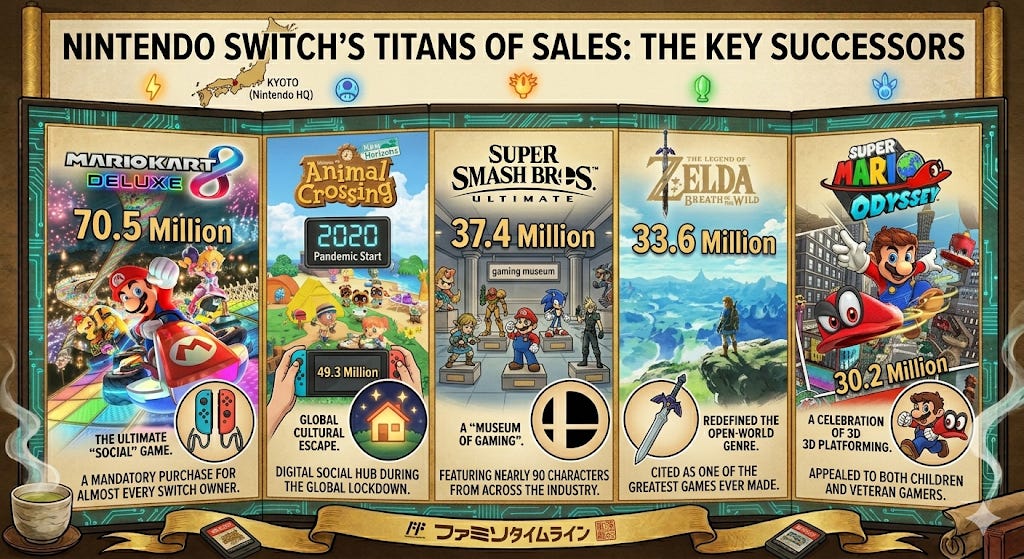
The Evergreens: Top-Selling Games
Nintendo’s software strategy for the Switch was to release “Evergreen” titles—games that sell consistently for years.
The Dawn of the Nintendo Switch 2
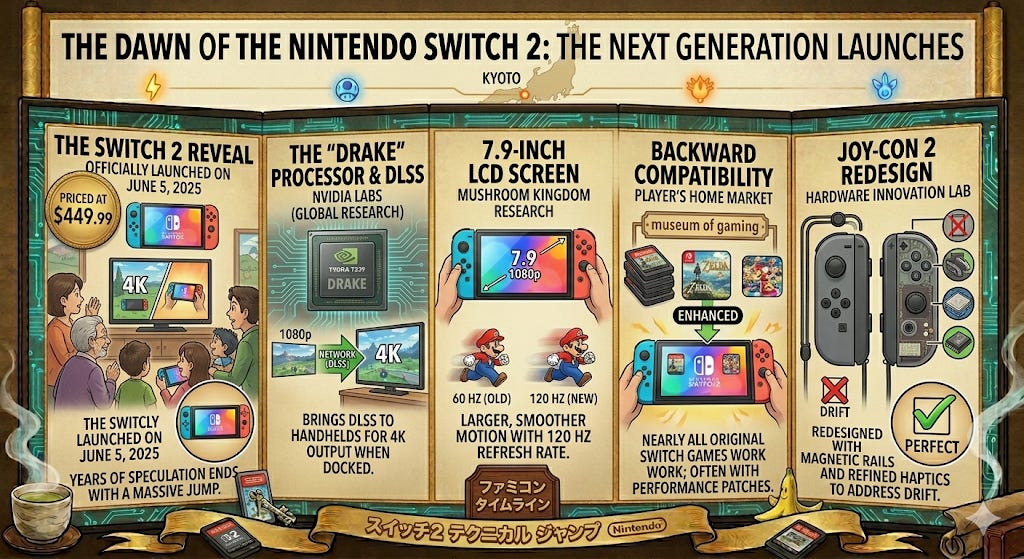
After years of speculation, the Nintendo Switch 2 officially launched on June 5, 2025, priced at $449.99. It maintained the beloved hybrid form factor but brought a massive technical jump.
Technical Leap & Features
The “Drake” Processor: A custom Nvidia Tegra T239 chip that finally brought DLSS (Deep Learning Super Sampling) to handhelds, allowing the console to output 4K visuals when docked.
7.9-inch LCD: A larger, 1080p screen with a 120 Hz refresh rate for much smoother motion.
Backward Compatibility: One of Nintendo’s most player-friendly moves—nearly all original Switch physical and digital games work on the new system, often with “Enhanced” performance patches.
Joy-Con 2: Redesigned with magnetic rails (replacing the sliding mechanism) and refined haptics to address the “drift” issues of the past.
Launch Titles and Beyond
The Switch 2 launch was headlined by Mario Kart World, which shifted the series toward a more open, “hub-based” racing experience and sold over 14 million copies in its first six months.
Other Major Switch 2 Hits (2025–2026):
Pokémon Legends: Z-A: A dual-release (Switch 1 & 2) that has already crossed 12 million sales, with the Switch 2 version praised for its “Mega Evolution” cinematic battles.
Donkey Kong Bananza: The long-awaited 3D return of the DK crew.
Third-Party Support: The increased power allowed major ports that were previously impossible, such as Cyberpunk 2077: Ultimate Edition and Street Fighter 6, which both launched alongside the console.
Pokémon Pokopia (March 2026): The newest entry in the franchise, which just hit shelves and is currently driving a massive surge in hardware sales.
The 2026 Outlook
As we move through 2026, Nintendo is no longer just a “gaming” company; they are an IP powerhouse. With the success of the Super Mario Bros. and Zelda films, the Switch 2 is being positioned as the central hub for all things Nintendo—from games to movies and theme park integration.
The Switch 2’s launch was so successful that it shipped 17.37 million units in just its first four months, making it the fastest-selling console in Nintendo’s 130+ year history
The Nintendo Cinematic Universe (NCU)
Following the billion-dollar success of the first Mario movie, Nintendo has moved into a “Phase 1” of a broader cinematic strategy.
The Super Mario Galaxy Movie (April 1, 2026): The direct sequel to the 2023 hit. It introduces Rosalina and the Lumas, expanding the scope to outer space. Rumors from early trailers suggest a post-credits tease for a Super Smash Bros. crossover event.
The Legend of Zelda (Live-Action) – May 7, 2027: This is Nintendo’s most ambitious film project. Unlike the animated Mario films, this is a live-action epic co-produced with Sony Pictures and directed by Wes Ball (Kingdom of the Planet of the Apes).
Cast: Benjamin Evan Ainsworth is set to play Link, and Bo Bragason will play Zelda.
Future Projects: Reports indicate that Metroid and Star Fox projects are in early development, with Nintendo aiming for a “steady cadence” of one major theatrical release every 18–24 months.
Super Nintendo World: The Living Video Game
Nintendo’s partnership with Universal Destinations & Experiences has turned their digital worlds into physical reality. The “secret sauce” is the Power-Up Band, a wearable that syncs with your phone to track high scores and “keys” collected throughout the land.
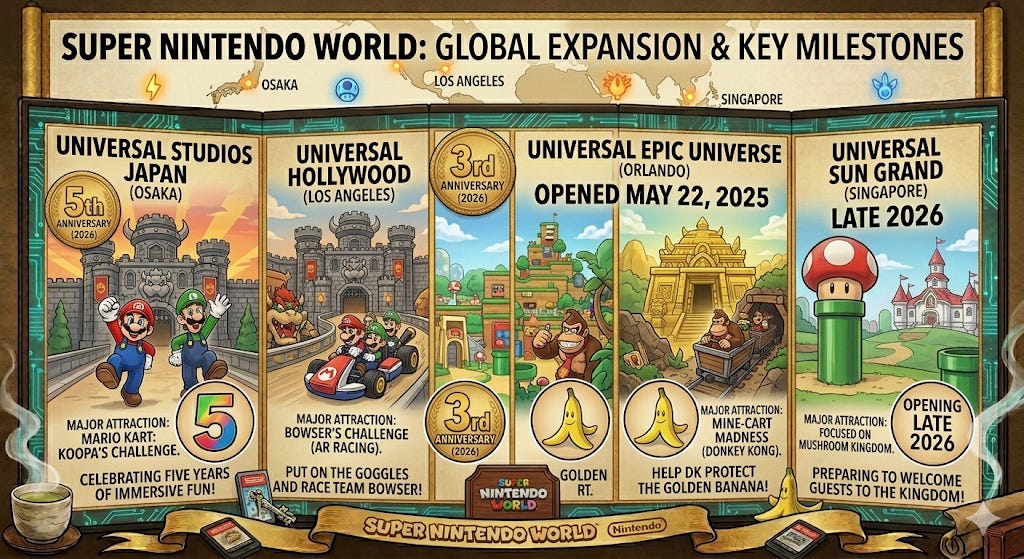
The Donkey Kong Country Expansion: The newest addition to the parks (already live in Orlando and Japan) features a revolutionary “jumping” roller coaster called Mine-Cart Madness. It uses a hidden track system to make it look like your cart is actually leaping over gaps in the rail, just like the SNES games.
PokéPark Kanto: In February 2026, Nintendo and The Pokémon Company opened a dedicated Pokémon-themed land in Japan, signaling that they may eventually separate Pokémon from the “Super Nintendo World” branding to create even larger dedicated spaces.
The 2026 “Flywheel” Strategy
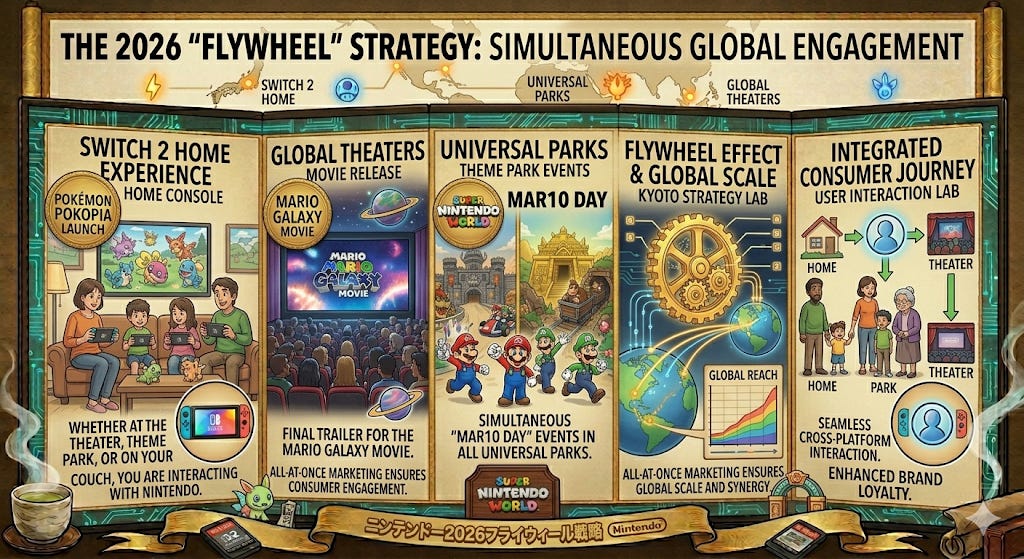
In March 2026, Nintendo launched Pokémon Pokopia for the Switch 2. Simultaneously, they held “MAR10 Day” events in all Universal Parks and released the final trailer for the Mario Galaxy movie. This “all-at-once” marketing ensures that whether a consumer is at a theater, a theme park, or on their couch, they are interacting with Nintendo.
The eShop Evolution & Unified Accounts
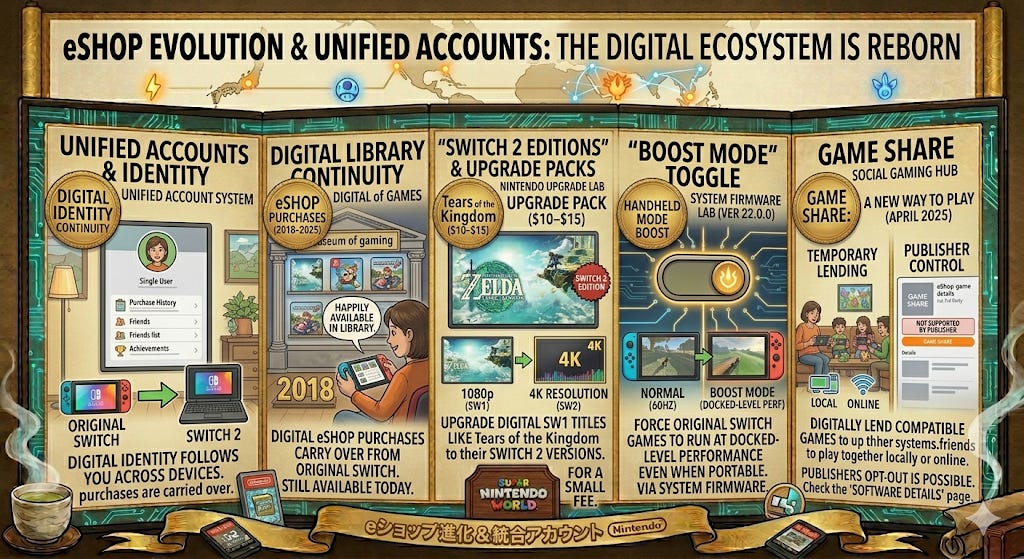
Nintendo has finally moved away from the “reset” strategy of previous generations. The current eShop is built on a unified account system, ensuring that your digital identity follows you across devices.
Digital Library Continuity: One of the biggest wins for users is that digital eShop purchases carry over from the original Switch to the Switch 2. If you bought a digital game in 2018, it is still available in your library today on the new hardware.
“Switch 2 Editions” & Upgrade Packs: To take advantage of the new hardware’s power, Nintendo introduced Upgrade Packs on the eShop. For a small fee (typically $10–$15), players can “upgrade” digital Switch 1 titles like The Legend of Zelda: Tears of the Kingdom to their Switch 2 versions, unlocking 4K resolution and higher frame rates.
The “Boost Mode” Toggle: For original Switch games that haven’t received official patches, the Switch 2 firmware (Version 22.0.0) introduced a system-level Handheld Mode Boost. This allows the console to force original games to run at docked-level performance even while you’re playing portably.
Game Share: A New Way to Play
One of the most significant recent additions to the eShop ecosystem is Game Share, which officially launched in April 2025.
Temporary Lending: You can now “digitally lend” compatible games to up to three other systems at a time. This allows friends to play together locally or online even if only one person owns the game.
Publisher Control: While Nintendo’s first-party titles widely support this, some third-party publishers have opted out, so it’s always worth checking the “Software Details” page on the eShop for the Game Share logo.
Nintendo Switch Online (NSO): The Retro Powerhouse
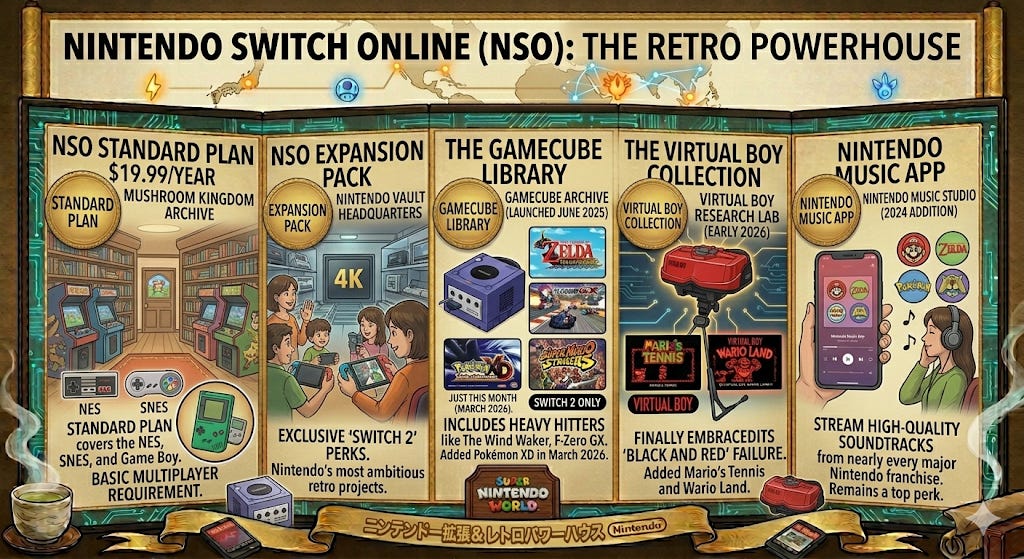
As of March 2026, Nintendo Switch Online has evolved from a basic multiplayer requirement into a massive “Vault” of gaming history. The service is split into two tiers: the Standard Plan ($19.99/year) and the Expansion Pack ($49.99/year).
The Expansion Pack: Exclusive “Switch 2” Perks
While the Standard plan covers the NES, SNES, and Game Boy, the Expansion Pack is where Nintendo has placed its most ambitious retro projects:
The GameCube Library (Switch 2 Only): Launched alongside the Switch 2 in June 2025, this library includes heavy hitters like The Legend of Zelda: The Wind Waker, F-Zero GX, and Super Mario Strikers. Just this month (March 2026), Nintendo added the cult classic Pokémon XD: Gale of Darkness.
The Virtual Boy Collection: In early 2026, Nintendo finally embraced its “black and red” failure from the 90s, adding titles like Mario’s Tennis and Virtual Boy Wario Land to the service.
Nintendo Music App: A 2024 addition that remains a top perk, allowing NSO members to stream high-quality soundtracks from nearly every major Nintendo franchise.

The “Nintendo App Store” & Mobile Integration
Nintendo has finally moved away from its fragmented mobile approach, consolidating its digital presence into a more unified ecosystem.
The New Nintendo Store App (iOS/Android)
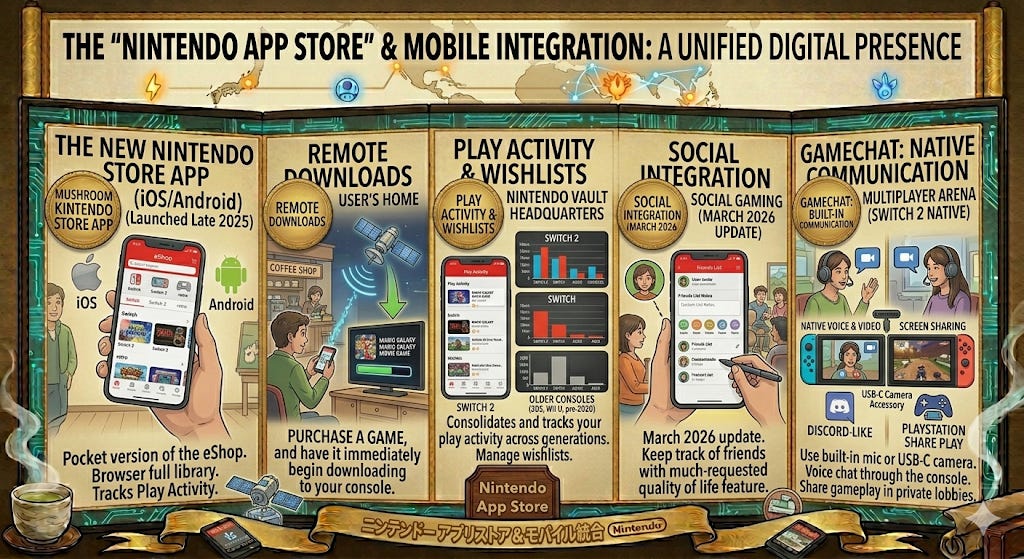
Launched in late 2025, this isn’t just a shopping app—it’s a pocket version of the eShop.
Remote Downloads: You can browse the full Switch and Switch 2 library, purchase a game, and have it immediately begin downloading to your console at home.
Play Activity & Wishlists: The app tracks your “Play Activity” across Switch 2, Switch, and even older consoles like the 3DS and Wii U (for data logged before 2020).
Social Integration: A March 2026 update added Friends List Notes, allowing you to keep track of who your online friends are (a small but much-requested “quality of life” feature).
GameChat: Built-in Communication
For years, Nintendo was criticized for requiring a smartphone for voice chat. With the Switch 2, they introduced GameChat, a native application on the console itself.
Native Voice & Video: Using the built-in microphone (or the new USB-C camera accessory), players can finally voice chat directly through the console.
Screen Sharing: You can now share your gameplay screen with friends in a private lobby, similar to Discord or PlayStation’s “Share Play.”
The Caretaker President: Tatsumi Kimishima (2015–2018)
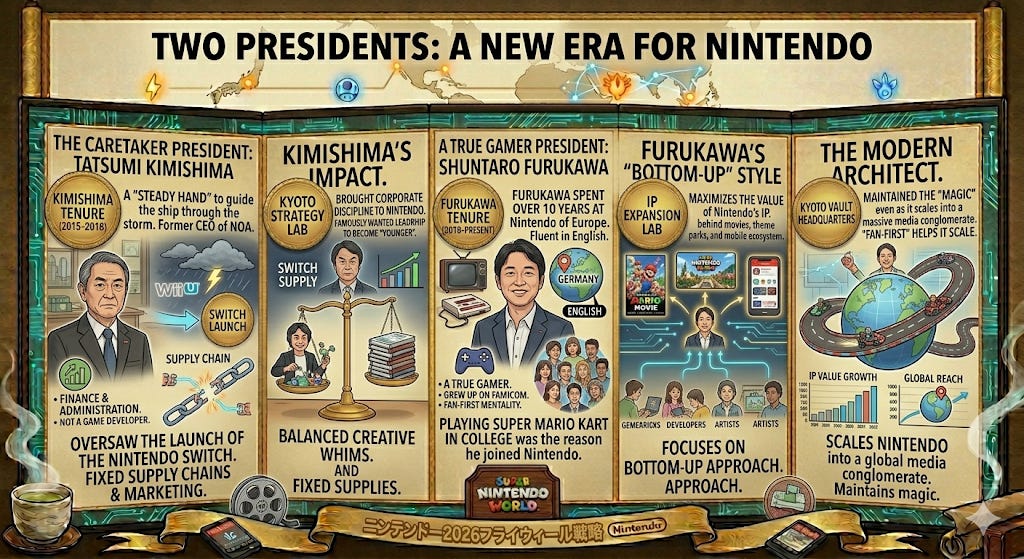
After the tragic passing of Satoru Iwata in 2015, Nintendo was at its most vulnerable. Kimishima, a former banker with 27 years of experience at Sanwa Bank, was seen by many as a “steady hand” to guide the ship through the storm.
Background: Unlike his predecessors, Kimishima wasn’t a game developer. He was a finance and administration expert who had previously served as CEO of Nintendo of America.
Key Achievement: He oversaw the launch of the Nintendo Switch. While Iwata designed the concept, Kimishima was the one who fixed the broken supply chains and marketing strategies left over from the Wii U failure.
The “Stern” Image: Often photographed looking serious and professional, Kimishima brought a corporate discipline to Nintendo that balanced out the creative whims of Shigeru Miyamoto. He famously stated his goal was to “ensure the company’s leadership becomes younger” before he retired.
The Modern Architect: Shuntaro Furukawa (2018–Present)
At 46, Furukawa became one of Nintendo’s youngest presidents. If Kimishima was the “stabilizer,” Furukawa is the “expander.” * The Global Perspective: Furukawa spent over 10 years at Nintendo of Europe in Germany. He is fluent in English and understands Western markets better than almost any previous Japanese executive.
Management Style: He is known for a “bottom-up” approach. Rather than dictating every creative move, he focuses on maximizing the value of Nintendo’s IP. He is the driving force behind the move into movies, theme parks, and the mobile app ecosystem.
A True Gamer: Unlike the banker Kimishima, Furukawa grew up on the Famicom. He famously noted that playing Super Mario Kart in college was the reason he wanted to join Nintendo. This “fan-first” mentality has helped him maintain the company’s “magic” even as it scales into a massive media conglomerate.
Revenue Trends: The “Hybrid” Breakout
The revenue chart highlights two distinct eras of dominance: the Wii/DS peak (2008–2009) and the current Switch/Switch 2 era (2017–Present).
