

When investors talk about emerging markets, the conversation inevitably turns to Latin America—a region of over 600 million people historically plagued by financial friction, poor infrastructure, and intense macroeconomic volatility. For decades, it was a market many global tech giants placed in the “too hard” pile. But where others saw insurmountable barriers, Marcos Galperin saw the foundation for an empire.
Today, MercadoLibre ($MELI) is not just the most valuable company in Latin America; it is the infrastructural backbone of the region’s digital economy. To simply call it the “Amazon of LatAm” drastically understates the reality. MELI is an e-commerce juggernaut, a massive logistics network, a standalone fintech powerhouse, and a highly profitable consumer credit business, all rolled into one inescapable ecosystem.
However, as we look at MELI in mid-2026, the narrative is shifting. With a new CEO at the helm, a deliberate strategy of sacrificing short-term margins for market share, and aggressive competition from the likes of Amazon, Shopee, and Nubank, the stakes have never been higher.
Table of Contents
The Architects of the Super App: MercadoLibre’s Leadership Team
The Battle for LatAm: MercadoLibre’s Competition and the Bear Case
Under the Hood: Breaking Down MercadoLibre’s Financials & KPIs
Valuation & The Base Case: Why MELI is in My “Too Hard” Pile


In this business breakdown we will break down the history of MercadoLibre, analyze its sprawling “Super App” flywheel, dissect the new management team’s vision, and look under the hood at the financial realities driving the business. Finally, we will run the numbers to answer the most difficult question of all: at a premium valuation, does the stock offer long-term investors an adequate margin of safety?
Let’s dive in.
To understand MercadoLibre ($MELI) today—a sprawling ecosystem of e-commerce, fintech, logistics, and credit—you have to go back to the late 1990s, when the internet in Latin America was little more than a dial-up luxury.
The Genesis: A Ride to the Airport
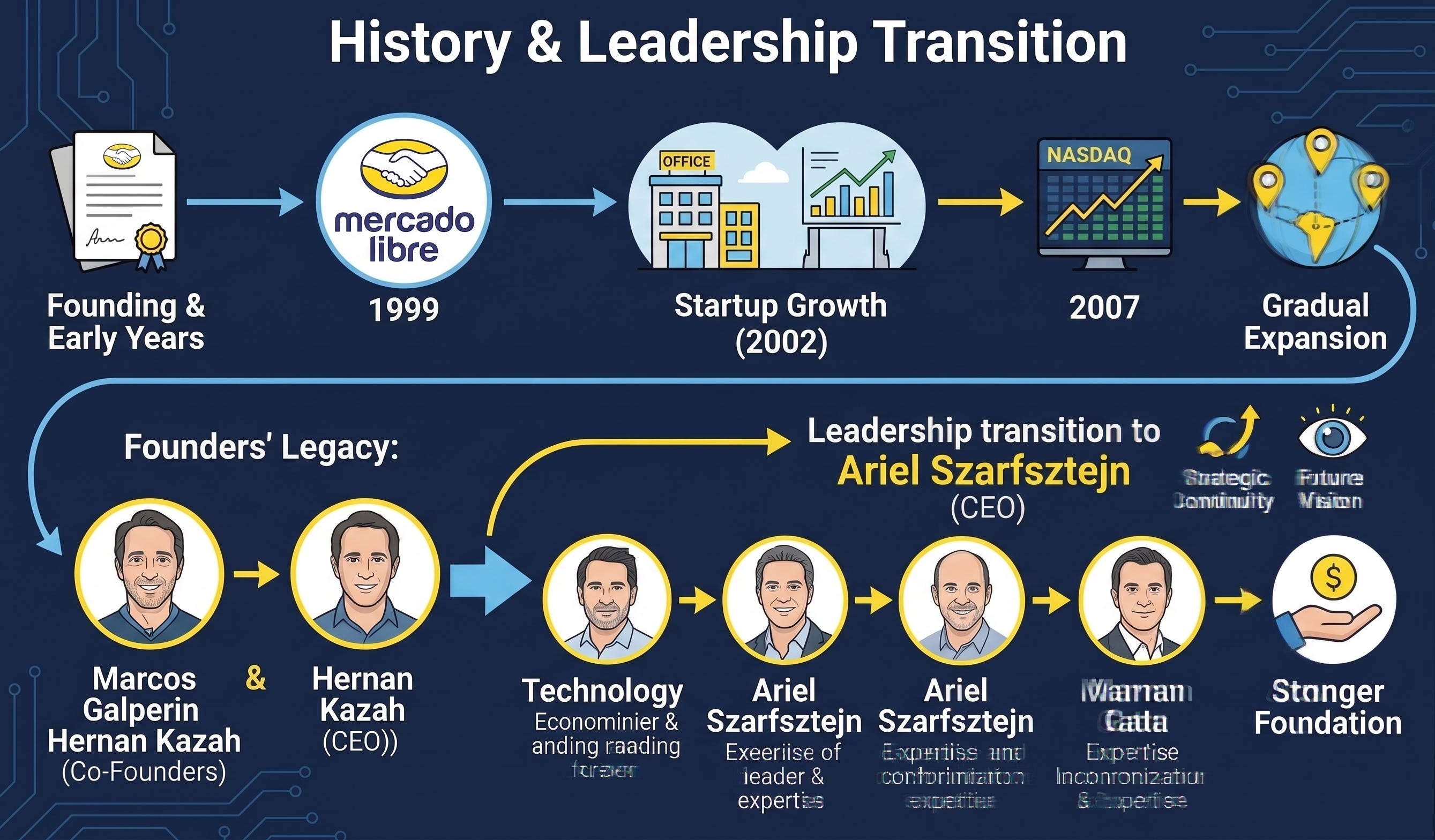
The story of MercadoLibre begins at the Stanford Graduate School of Business in 1999. Marcos Galperin, an Argentine student, had been closely watching the explosive growth of eBay in the United States. He recognized that Latin America’s fragmented retail market, characterized by high friction, low trust, and a lack of transparency, was ripe for an online marketplace.
Galperin’s big break didn’t happen in a boardroom, but in a car. John Muse, co-founder of the private equity firm HM Capital, was a guest speaker at Stanford. Galperin volunteered to drive Muse to the airport after his lecture. By the time they reached the terminal, Galperin had pitched his idea for a Latin American online auction site. Muse was impressed and became one of the company’s first backers, eventually helping Galperin secure funding from JPMorgan Partners, Flatiron Partners, and Goldman Sachs.
Armed with capital, Galperin teamed up with a group of friends and colleagues, including co-founder Hernán Kazah, and launched MercadoLibre in August 1999 from a garage in the Saavedra neighborhood of Buenos Aires, Argentina.
Surviving the Dot-Com Crash & The eBay Alliance (2000-2007)
The timing could not have been more precarious. Just months after launching and expanding into Brazil and Mexico, the dot-com bubble burst. Competitors were folding rapidly, but MercadoLibre had secured just enough runway to survive the nuclear winter of early 2000s tech.
In 2001, MercadoLibre made a defensive and offensive masterstroke: it formed a strategic alliance with eBay. eBay acquired a 19.5% stake in MercadoLibre in exchange for handing over its recently acquired Latin American subsidiary, iBazar, and agreeing not to compete in the region. This partnership gave MercadoLibre a near-monopoly on the region’s online auction space, invaluable technical know-how from the US giant, and the credibility it needed to survive.
In August 2007, MercadoLibre became the first Latin American technology company to list on the NASDAQ.
The Pivot to Fintech: The Birth of Mercado Pago (2003-Present)
While e-commerce was growing, Galperin and his team realized they had a massive structural problem: Latin America was severely underbanked. Credit card penetration was abysmal, and cross-border or even intra-country digital payments were incredibly high-friction. People were literally mailing cash to pay for online goods.
In 2003, they launched Mercado Pago to facilitate transactions on their own marketplace, acting as an escrow service to build trust between buyers and sellers.
This was the inflection point. Mercado Pago eventually grew beyond the MercadoLibre platform. They started offering point-of-sale (POS) machines (Mercado Pago Point) to brick-and-mortar merchants, launched a digital wallet, and rolled out QR code payments. Today, Mercado Pago processes far more transaction volume off the MercadoLibre platform than on it, operating as a standalone fintech titan.
Building the Moat: Logistics and Credit (2013-2020)
By the early 2010s, MercadoLibre dominated search and discovery, and Mercado Pago solved the payment bottleneck. But the physical reality of Latin America—poor infrastructure, unreliable postal services, and high theft rates—remained a barrier.
In 2013, the company launched Mercado Envíos. Initially, it was just a software layer coordinating third-party carriers. But as Amazon began expanding in Brazil, MELI realized they needed to own the physical infrastructure. They poured billions into building fulfillment centers, cross-docking stations, and a massive proprietary delivery network, eventually launching their own cargo airline network (Meli Air) in late 2020.
Simultaneously, in 2017, they launched Mercado Crédito, using their vast troves of proprietary data to offer loans to merchants and consumers who traditional banks ignored.
The Pandemic Supercycle & Beyond
The COVID-19 pandemic accelerated e-commerce adoption in Latin America by roughly a decade. MELI was perfectly positioned to capture this demand. Revenue and user numbers skyrocketed, and the company solidified its status as an indispensable part of daily life in its top three markets: Brazil, Argentina, and Mexico.
Today, MercadoLibre is no longer an “eBay clone.” It is a uniquely Latin American super-app that has built the foundational infrastructure for digital commerce and finance in a region of over 600 million people.
Quick-Reference Timeline
1999 (August): Marcos Galperin and a team of co-founders launch MercadoLibre in Buenos Aires, Argentina. Operations quickly expand to Brazil and Mexico.
2001: eBay acquires a 19.5% stake in MercadoLibre and hands over its LatAm subsidiary, iBazar.
2003: Mercado Pago is launched, initially designed solely to secure transactions on the MELI marketplace.
2007 (August): MercadoLibre IPOs on the NASDAQ under the ticker $MELI.
2013: Mercado Envíos (logistics) is launched, starting as a shipping management tool.
2015: Mercado Pago expands off-platform, offering Mobile Point of Sale (mPOS) devices to physical retailers.
2016: eBay sells the majority of its stake in MercadoLibre.
2017: Mercado Crédito launches, offering loans to merchants and later consumers. MELI enters the Nasdaq-100 index.
2018: Widespread rollout of QR code payments through the Mercado Pago wallet, revolutionizing offline payments in Argentina and Brazil.
2020: The pandemic triggers a massive surge in growth. MercadoLibre launches Meli Air, a dedicated fleet of cargo planes in Brazil and Mexico to control its logistics network.
2021: Mercado Pago secures a financial institution license in Brazil, allowing it to act more like a traditional bank.
2022: The company launches Mercado Coin (a cryptocurrency loyalty program) and expands its credit card offerings.
2024-2026: Continued dominance in the region, with significant market share gains in Mexico and sustained profitability driven by advertising (Mercado Ads) and high-margin credit operations, solidifying its place as Latin America’s most valuable company.
When investors first look at MercadoLibre ($MELI), the lazy comparison is to call it the “Amazon of Latin America.” While true on the surface, this heavily drastically understates what the company actually does.
Because of the unique infrastructural challenges of Latin America—unreliable postal services, high unbanked populations, and fractured credit markets—MELI couldn’t just build a marketplace. They had to build the entire underlying infrastructure for digital commerce and finance from scratch.
Today, MELI operates a “Super App” ecosystem comprising six primary pillars.
The Six Pillars of the Product Ecosystem
1. Mercado Libre (The Marketplace)
This is the core e-commerce engine where it all started. It operates as both a 1P (first-party, where MELI owns the inventory) and 3P (third-party, where external sellers list goods) marketplace. It is the undisputed traffic leader in Latin America, dominating search and product discovery in its core markets of Brazil, Argentina, and Mexico.
2. Mercado Pago (The Fintech Titan)
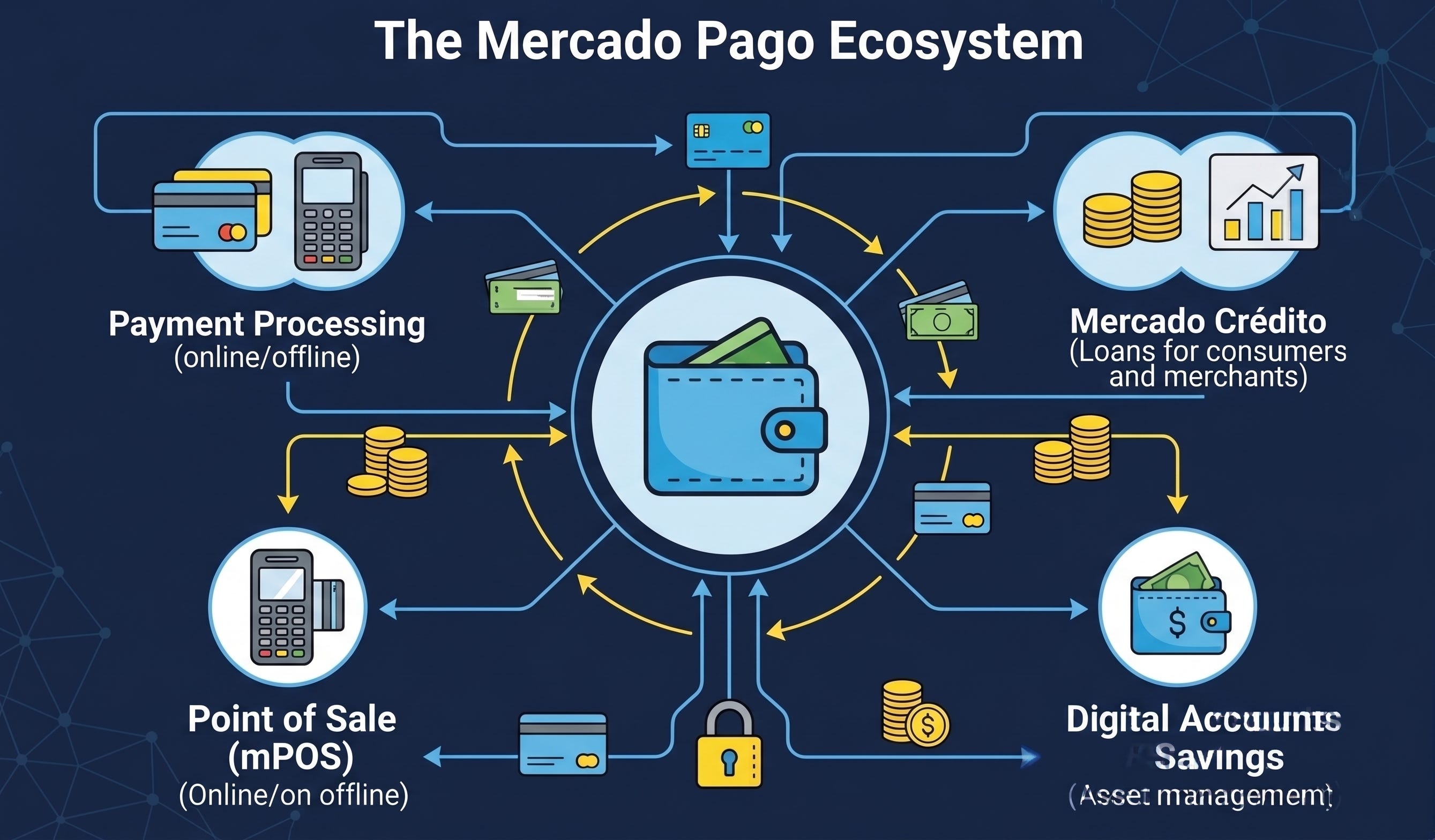
Originally built as a basic escrow service to stop people from getting scammed on the marketplace, Mercado Pago has morphed into a colossal, standalone financial beast.
On-Platform: Processes payments for the Mercado Libre marketplace.
Off-Platform: This is the real growth engine. Pago provides digital wallets, QR code payments at physical stores, and mPOS (mobile point-of-sale) devices for brick-and-mortar merchants. Millions of Latin Americans use Mercado Pago as their primary bank account, paying utility bills, transferring money, and earning yield on their balances.
3. Mercado Envíos (The Logistics Network)
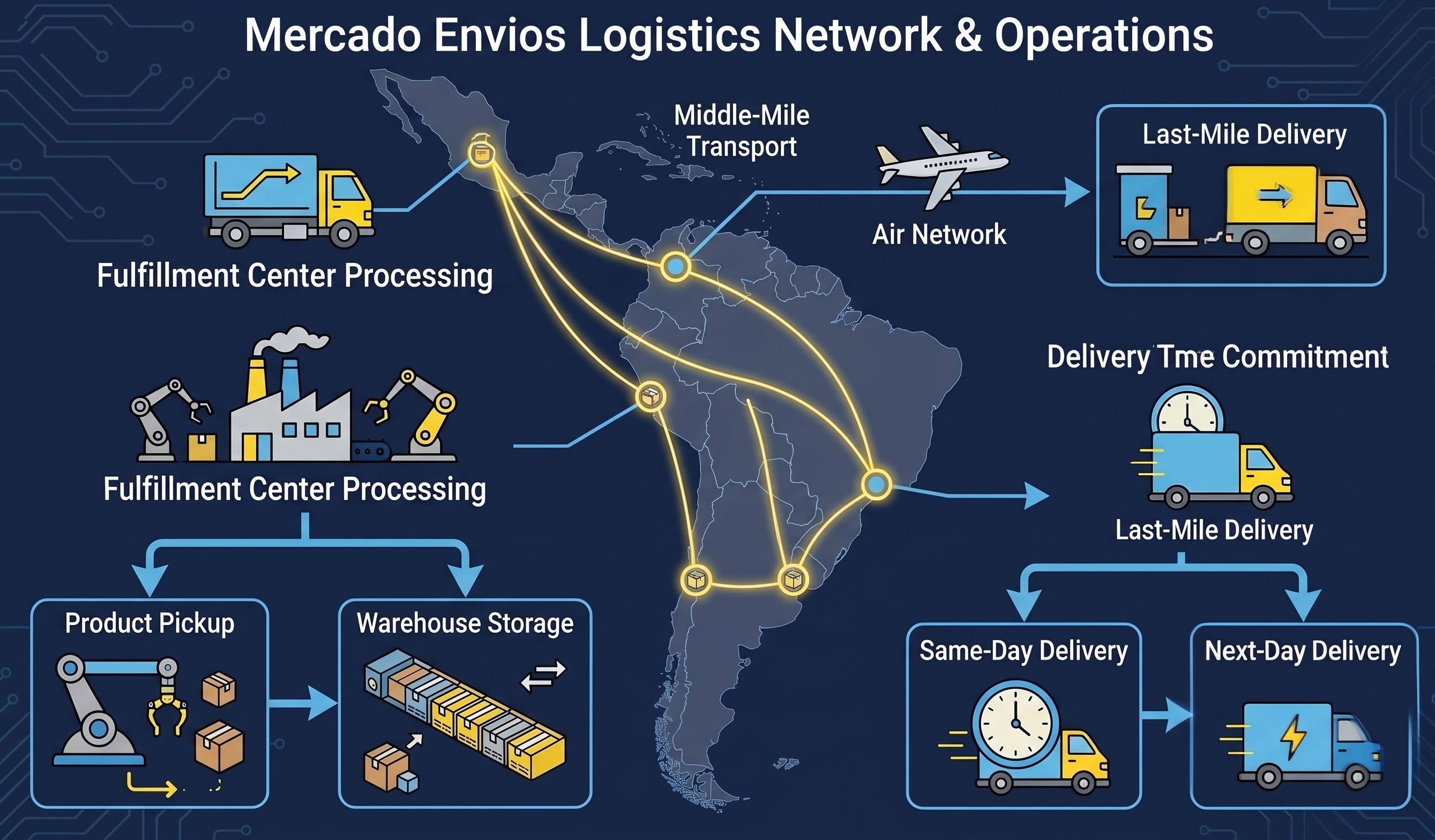
Logistics in Latin America used to be a nightmare of stolen packages and weeks-long delays. Mercado Envíos solved this. It encompasses fulfillment centers, cross-docking, last-mile delivery fleets, and even a dedicated cargo airline (Meli Air). Today, MELI handles the logistics for over 90% of the items sold on its platform, delivering the vast majority within 24 to 48 hours—a feat previously thought impossible in the region.
4. Mercado Crédito (The Credit Arm)
By observing merchant sales histories and consumer purchasing habits, MELI has a data advantage that traditional banks can only dream of. They use this proprietary data to underwrite risk, offering:
Merchant Loans: Working capital for sellers to buy more inventory.
Consumer Loans: “Buy Now, Pay Later” (BNPL) options and credit cards, bringing millions of underbanked consumers into the credit system for the first time.
5. Mercado Ads (The Profit Engine)
Following Amazon’s playbook, MELI launched its own Retail Media Network. Because buyers go to Mercado Libre with high purchase intent, it’s the most valuable digital real estate in Latin America. Brands pay heavily to boost their products in search results. Because the infrastructure is already built, Mercado Ads operates at incredibly high margins, acting as a massive profitability booster for the whole company.
6. Mercado Shops & MELI+
Mercado Shops: Their answer to Shopify, allowing merchants to set up their own white-labeled digital storefronts off the main marketplace, fully integrated with Pago and Envíos.
MELI+ (formerly Mercado Puntos): Their answer to Amazon Prime. A loyalty program offering free shipping, exclusive discounts, and bundled streaming services (like Disney+ or HBO Max) to lock users into the ecosystem.
The Business Model (How They Make Money)
MercadoLibre monetizes this ecosystem through two primary reporting segments:
1. Commerce Revenues:
Take Rates: A percentage fee charged to merchants for every item sold on the marketplace.
Shipping Fees: Revenue generated from merchants and consumers utilizing Mercado Envíos.
Ad Revenue: High-margin income from Mercado Ads.
1P Sales: Direct profit from goods they sell themselves.
2. Fintech Revenues:
Transaction Fees: Fees charged for processing payments off-platform (via POS terminals or QR codes) and online checkouts.
Interest Income: The money made from the loans issued by Mercado Crédito, as well as interest earned from investing the cash sitting in users’ Mercado Pago digital wallets.
Credit Card Fees: Interchange fees and interest from their co-branded credit cards.
The MercadoLibre Flywheel
The true beauty of MercadoLibre isn’t any single product; it’s how they feed into each other to create an unstoppable, self-reinforcing loop. Here is how the MELI Flywheel spins:
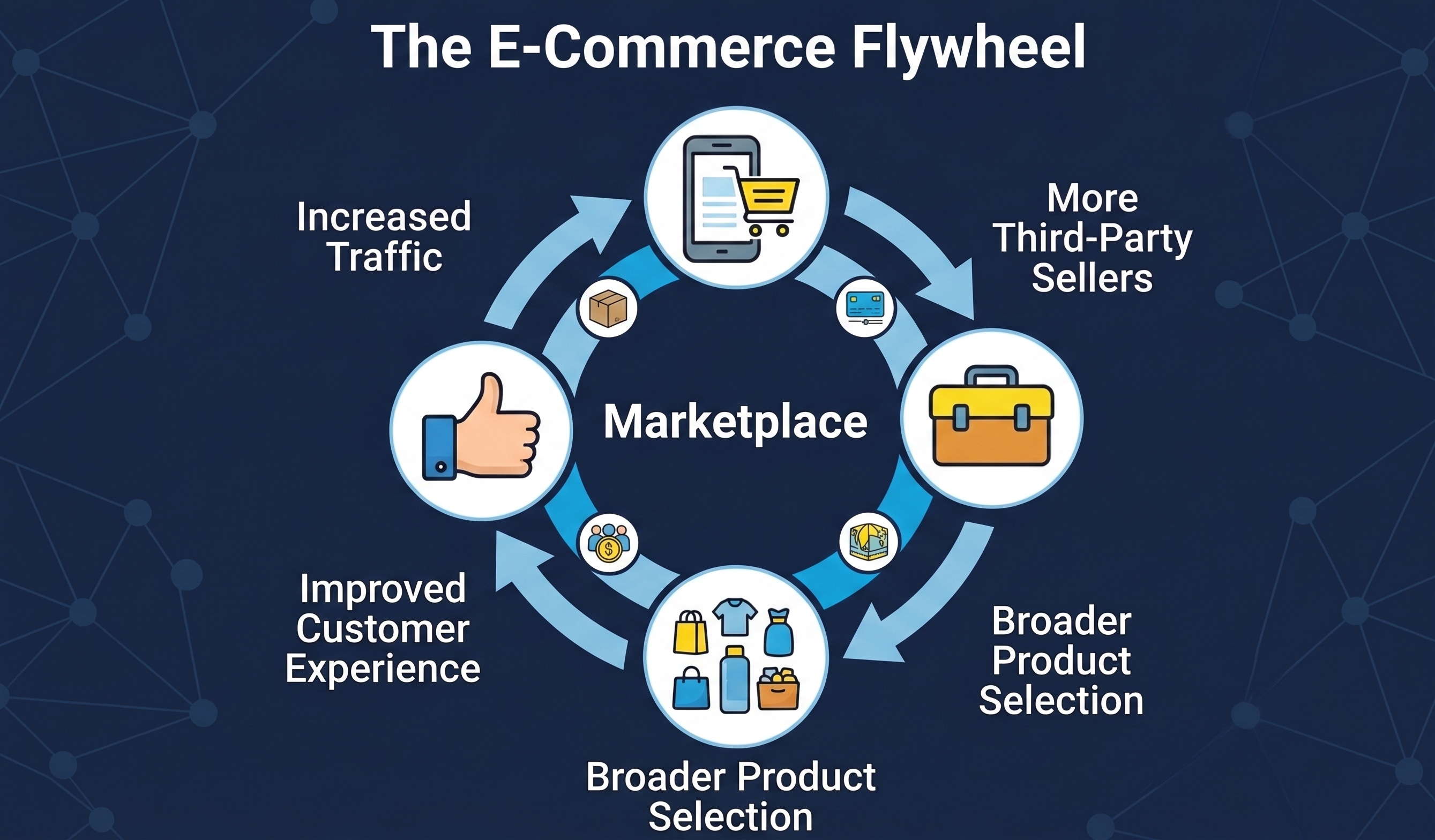
More Traffic & Buyers: The dominant marketplace attracts the most buyers in the region.
More Sellers: Because the buyers are there, merchants have to sell on Mercado Libre.
Logistics Scale (Envíos): As transaction density increases, MELI invests more in logistics, driving down the per-unit cost of delivery and making shipping lightning fast.
Better User Experience: Fast shipping and a massive product selection lead to extremely happy customers, who subscribe to MELI+ and buy more frequently (looping back to step 1).
The Fintech Kicker (Pago): All these transactions run through Mercado Pago. Sellers take their earnings in Pago and use it to pay their suppliers. Buyers keep money in the Pago wallet to buy more goods.
The Data/Credit Advantage (Crédito): MELI watches all this money flow. They use this data to offer a loan to the merchant (so they can buy more inventory to sell) and a credit line to the buyer (so they can afford to buy it).
The Profit Kicker (Ads): With merchants competing for all these flush buyers, they pay MELI for advertising space to stand out, generating pure profit that MELI reinvests into better logistics and cheaper credit.
Every new product MELI launches lowers friction in the Latin American economy, locking both buyers and sellers deeper into their walled garden. Once a merchant is using MELI for sales, shipping, payments, and loans, the switching costs are practically insurmountable.
The Architects of the Super App: MercadoLibre’s Leadership Team
One of the most compelling aspects of MercadoLibre for long-term investors is the stability and caliber of its management team. For over two decades, the company was led by a tight-knit “Stanford Mafia”—a core group of executives who met at Stanford Business School, built the company from a garage in Buenos Aires, and stayed together to scale it into a regional behemoth.
However, 2026 marked the beginning of a new era. For the first time since the company’s founding in 1999, the top job changed hands, signaling a massive transition from a founder-led startup to a multi-generational corporate empire.
Here are the key figures steering the MercadoLibre ecosystem today.
1. Marcos Galperin (Founder & Executive Chairman)
To understand MercadoLibre, you have to understand Marcos Galperin. He is to LatAm tech what Jeff Bezos is to American e-commerce—a relentless visionary who saw the future before the infrastructure even existed to support it.
The Legacy: Galperin served as CEO from 1999 until the end of 2025. Under his tenure, MELI survived the dot-com crash, fended off fierce regional competition from Amazon and Shopee, and built a massive logistics and fintech moat from scratch.
The Current Role: On January 1, 2026, Galperin officially stepped down as CEO to become Executive Chairman. He remains heavily involved in high-level strategy and vision but has handed the day-to-day operational reins to the next generation of leadership.
2. Ariel Szarfsztejn (Chief Executive Officer)
Taking over for a legendary founder is never easy, but Ariel Szarfsztejn is as battle-tested as they come. Appointed CEO on January 1, 2026, Szarfsztejn is a brilliant operator who has had his hands in nearly every crucial part of the MELI flywheel.
The Operator: Joining in 2017 after a stint at the Boston Consulting Group (BCG) and travel site Despegar, Szarfsztejn quickly made his mark. Crucially, he spent four years running Mercado Envíos. He was the architect of MELI’s shift from asset-light shipping software to owning billions of dollars in physical logistics infrastructure.
The Promotion: Before becoming CEO, he served as President of Commerce, running the entire regional e-commerce marketplace. His elevation to CEO signals that MELI is highly focused on operational execution, logistics dominance, and expanding the commerce engine’s profitability.
3. Osvaldo Gimenez (President of Mercado Pago)
If Galperin built the marketplace, Osvaldo Gimenez built the bank. Gimenez is another Stanford MBA who joined MELI in 2000. Today, he runs Mercado Pago, the crown jewel and primary growth engine of the company.
The Fintech Mastermind: Gimenez took a basic escrow service and turned it into the largest fintech platform in Latin America. Under his leadership, Pago rolled out POS devices to street vendors, pioneered QR code payments across the continent, and secured banking licenses in key markets like Brazil. As Pago increasingly becomes a standalone neo-bank, Gimenez is arguably managing a business that could eventually eclipse the e-commerce marketplace in valuation.
4. Martin de los Santos (Chief Financial Officer)
Martin de los Santos took over the CFO role in early 2024, following the unexpected departure of long-time CFO Pedro Arnt (who left to run dLocal).
The Credit Expert: Before becoming CFO, de los Santos spent six years as the head of Mercado Crédito (2017–2023). His appointment to CFO is incredibly telling. Because MELI is deeply embedded in consumer and merchant lending, having a CFO who intimately understands risk underwriting, credit portfolios, and fintech unit economics is a massive strategic advantage.
5. The Core Supporting Cast
Sean Summers (CMO & EVP of Advertising): Summers is tasked with running Mercado Ads. As MELI leans into its high-margin retail media network (the “Amazon Ads” playbook), Summers is responsible for turning marketplace traffic into pure profit.
Daniel Rabinovich (Chief Operating Officer): Rabinovich joined in 2000 as an application architect and rose through the ranks as CTO before becoming COO. He is the technical glue holding the sprawling, multi-country digital infrastructure together.
Agustin Costa (EVP of Shipping): Taking over the logistics empire that Szarfsztejn built, Costa (another BCG alum and Harvard MBA) now oversees the delivery of billions of packages a year, managing fleets of vans, planes, and massive fulfillment centers.
The Road Ahead: Management’s Vision and the Next Decade of Growth
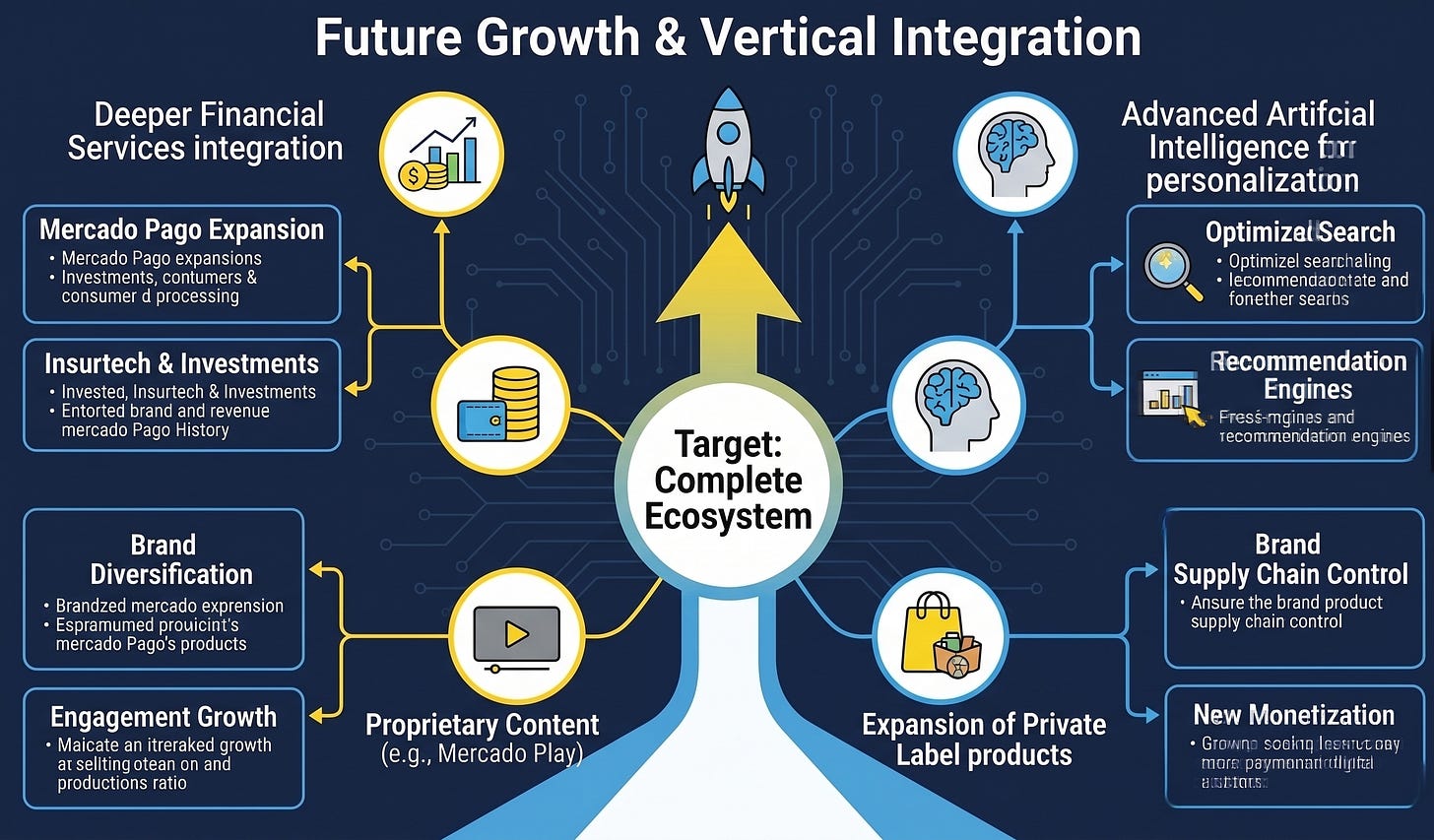
With the historic 2026 transition from founder Marcos Galperin to new CEO Ariel Szarfsztejn, the market has been watching closely to see how MercadoLibre will evolve. The era of the “land grab”—simply establishing e-commerce and digital payments in Latin America—is largely over.
Today, management’s vision is centered on optimization, margin expansion, and total ecosystem lock-in. Under Szarfsztejn and his executive team, MELI is executing on four primary growth pillars to secure its dominance for the next decade.
1. Winning the Mexican Battleground
While Brazil remains MELI’s largest and most profitable market, and Argentina remains its historical home, Mexico is the growth engine.
Mexico has historically been highly fragmented, with intense competition from Amazon and Asian players like Shopee. Szarfsztejn and his team are pouring billions of dollars of CapEx into Mexico to build an unassailable logistics moat. The vision here is to replicate the Brazilian playbook: dominate ultra-fast delivery (sub-24 hours) to the point where consumers simply stop checking competitor websites. By coupling this aggressive logistics expansion with Mercado Pago’s credit offerings, MELI aims to become the default digital operating system for Mexican consumers.
2. Mercado Pago: From “Digital Wallet” to “Primary Bank”
Under Osvaldo Gimenez, Mercado Pago has already won the unbanked and underbanked populations. The new vision is much more aggressive: stealing the heavily banked middle and upper classes from traditional financial institutions and digital rivals like Nubank.
Management’s future growth strategy for Pago involves:
Deposit Capture: Offering highly competitive yield on balances sitting in Mercado Pago accounts to make it the primary checking/savings account for LatAm users.
Credit Card Expansion: Scaling their co-branded and proprietary credit card portfolios to capture higher transaction volumes and interest income.
The Investment Hub: Expanding beyond simple savings into mutual funds, fractional stock trading, and crypto, keeping user wealth permanently locked inside the MELI ecosystem.
3. The Retail Media Goldmine (Mercado Ads)
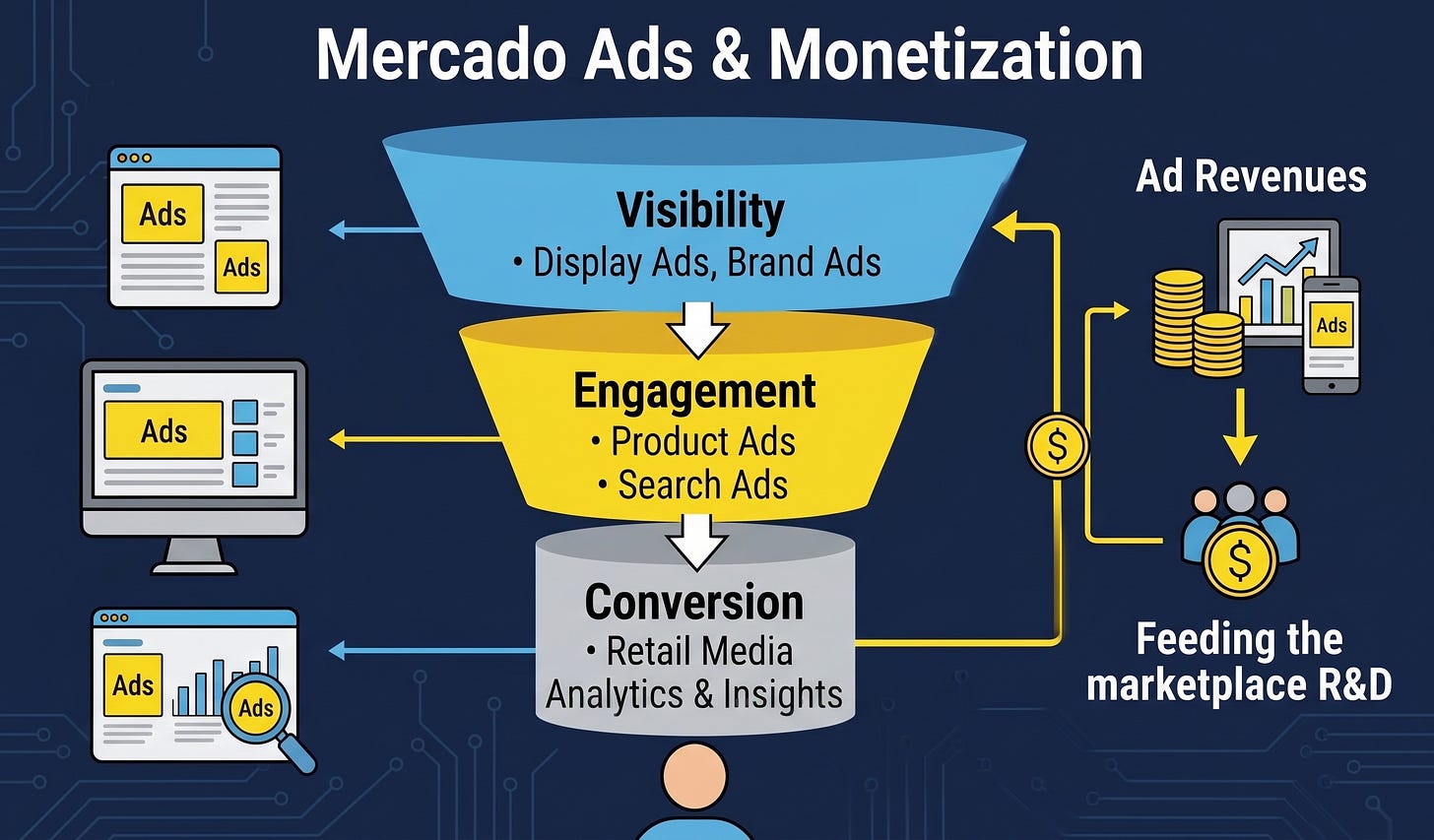
If you listen to recent earnings calls, CFO Martin de los Santos and CMO Sean Summers continually hammer home one phrase: Retail Media.
Currently, Mercado Ads represents a low single-digit percentage of Gross Merchandise Volume (GMV). Management’s vision is to scale this to Amazon’s levels (roughly 5% of GMV or more). Because the infrastructure for the marketplace already exists, every incremental dollar earned through ads drops almost entirely to the bottom line. This is the “profit engine” that will allow Szarfsztejn to keep shipping costs low for consumers while simultaneously expanding the company’s overall operating margins.
4. Artificial Intelligence & Operational Efficiency
As a former Chief Operating Officer, Szarfsztejn is obsessed with efficiency. The management team is leaning heavily into AI, not as a buzzword, but as a core operational tool:
Credit Underwriting: Using proprietary, AI-driven models to analyze millions of micro-data points (from how fast a user types to their shipping history) to issue loans with incredibly low default rates.
Logistics Routing: Optimizing the Meli Air fleet and last-mile delivery vans to shave pennies off every package delivered, widening the moat against competitors who lack the scale to match these efficiencies.
Merchant Tools: Providing 3P (third-party) sellers with generative AI tools to instantly create optimized product listings, run automated ad campaigns, and forecast inventory needs.
The Battle for LatAm: MercadoLibre’s Competition and the Bear Case
While MercadoLibre is the undisputed heavyweight champion of Latin American e-commerce and fintech, the region is too lucrative to ignore. The days of MELI operating without serious, well-capitalized competition are over.
As we look toward the remainder of 2026 and beyond, MercadoLibre faces a multi-front war. Here is a breakdown of the competitive landscape and the legitimate risks—the “bear case”—that investors need to understand.
The E-Commerce War
MercadoLibre’s e-commerce dominance is not uniform across Latin America; the competitive dynamics vary drastically by country.
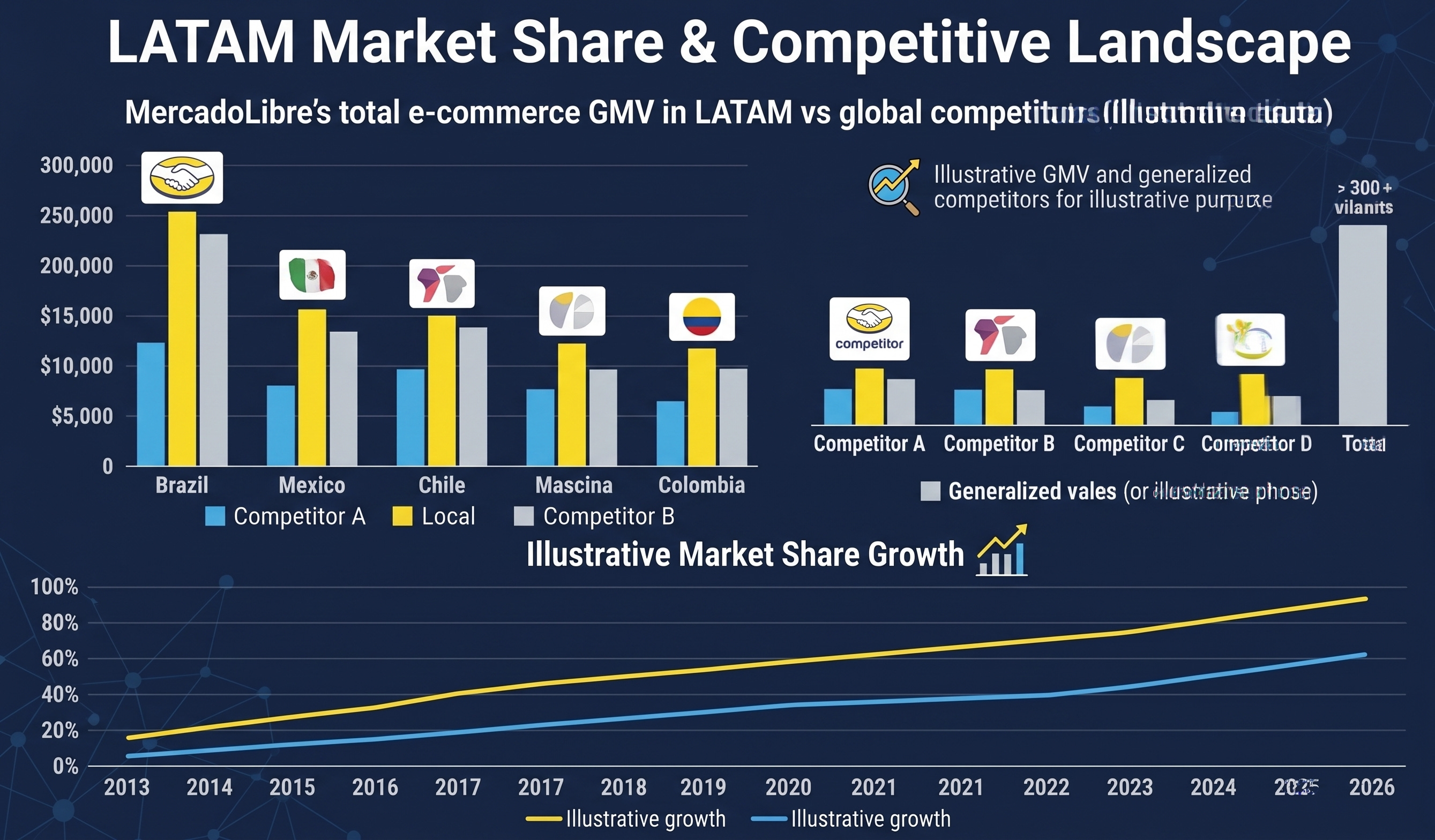
1. Amazon: The Mexican Standoff
Amazon and MercadoLibre do not compete equally everywhere. In Argentina and Colombia, MELI operates as a near-monopoly. However, in Mexico, it is a fierce, head-to-head battle.
While MELI has poured billions into Mexican logistics to build out “Mercado Envíos,” Amazon has matched them dollar for dollar with localized Prime offerings. Currently, the market share is highly fragmented and contested. Amazon tends to lead in consumer electronics and books, while MELI maintains a strong grip on automotive parts, fashion, and beauty. The risk here is a perpetual price and shipping subsidy war that permanently depresses profit margins in the region’s fastest-growing market.
2. Shopee & Temu: The Asian Invasion in Brazil
Brazil is MercadoLibre’s largest and most profitable market, but it is currently under siege by Asian discount platforms, most notably Shopee (owned by Sea Limited) and, increasingly, Temu.
Shopee has been aggressively targeting the Brazilian market by appealing to price-sensitive consumers and offering massive shipping subsidies. By early 2026, Shopee had actually surpassed MELI in terms of sheer order volume in Brazil, though MELI still dominates in Gross Merchandise Volume (GMV) because they sell higher-ticket items.
The entry of Temu has only escalated this. To defend its market share, MELI has been forced into a defensive posture, expanding free shipping and absorbing higher logistics costs to keep buyers from defecting.
The Fintech War: The Clash with Nubank
If the e-commerce battle is about logistics, the fintech battle is about the consumer’s wallet. Mercado Pago’s primary adversary is Nubank, the Brazilian digital banking juggernaut.
Nubank is aggressively expanding its product suite and geographic footprint (moving heavily into Mexico and Colombia). While Mercado Pago originated as a merchant payment tool and moved into consumer banking, Nubank started as a consumer credit card and is now moving into merchant services.
Both companies are racing to become the primary financial operating system for the LatAm middle class. The risk for MELI is that Nubank’s superior brand loyalty and specialized banking focus allow it to capture the most lucrative credit card and high-yield savings customers, leaving Mercado Pago with a less profitable user base.
The Bear Case: What Could Go Wrong?
Beyond direct competitors, there are structural and financial risks that form the core of the bear case for $MELI in 2026.
1. The Margin Compression Threat
This is the number one issue Wall Street is currently fixated on. Throughout 2025 and into 2026, MercadoLibre has seen its operating margins compress. The company argues this is a deliberate, temporary “investment cycle”—sacrificing short-term profit to subsidize shipping and aggressively acquire users to lock them into the flywheel before competitors can.
The bear case (echoed by analysts at firms like JPMorgan and UBS) is that this investment cycle has no clear end date. If MELI is forced to permanently subsidize shipping to fend off Shopee and Temu, the highly profitable, cash-gushing business model investors are paying a premium for may never fully materialize. Growth without operating leverage is a red flag.
2. Credit Risk in a Volatile Region
The Mercado Crédito portfolio is highly profitable during good times, but it represents the highest-risk use of capital in the ecosystem. Latin America is historically prone to macroeconomic shocks, currency devaluations, and inflation spikes.
MELI issues unsecured loans to consumers and merchants. While their AI-driven underwriting and proprietary data have kept Non-Performing Loans (NPLs) manageable, a severe regional recession could cause defaults to spike rapidly, consuming capital and wiping out profits from the e-commerce side of the business.
3. Dilution and Capital Requirements
Building out an Amazon-style logistics network and a massive credit book requires an immense amount of cash. While MELI generates strong free cash flow, if the margin pressure continues or the credit book sours, they may need to raise capital. While not an immediate threat, historical dilution (like the 14.8% share count increase between 2015 and 2025) is a risk long-term investors must monitor.
Under the Hood: Breaking Down MercadoLibre’s Financials & KPIs
If you look at a chart of MercadoLibre’s recent earnings, a very clear narrative emerges for 2026: explosive top-line revenue growth at the expense of near-term profitability.
Under Ariel Szarfsztejn’s leadership, MELI is unapologetically trading margin for market share. They are pouring cash into logistics, subsidizing free shipping in Brazil, and rapidly expanding their credit card portfolio. Wall Street has been torn on this, but a look at the underlying KPIs shows that the “flywheel” we discussed earlier is spinning faster than ever.
Here is a breakdown of the key metrics and financial realities defining MercadoLibre right now, based on their explosive Q2 2026 print.
1. The Top-Line Numbers: Unprecedented Scale
Latin America is notoriously difficult due to extreme foreign exchange (FX) volatility, particularly in Argentina. Yet, MercadoLibre continues to post growth numbers that defy the law of large numbers.
Net Revenue: In Q2 2026, MELI posted $10.17 billion in net revenue, representing a massive 50% year-over-year increase (and 43% FX-neutral). This was their fastest pace of revenue growth in four years.
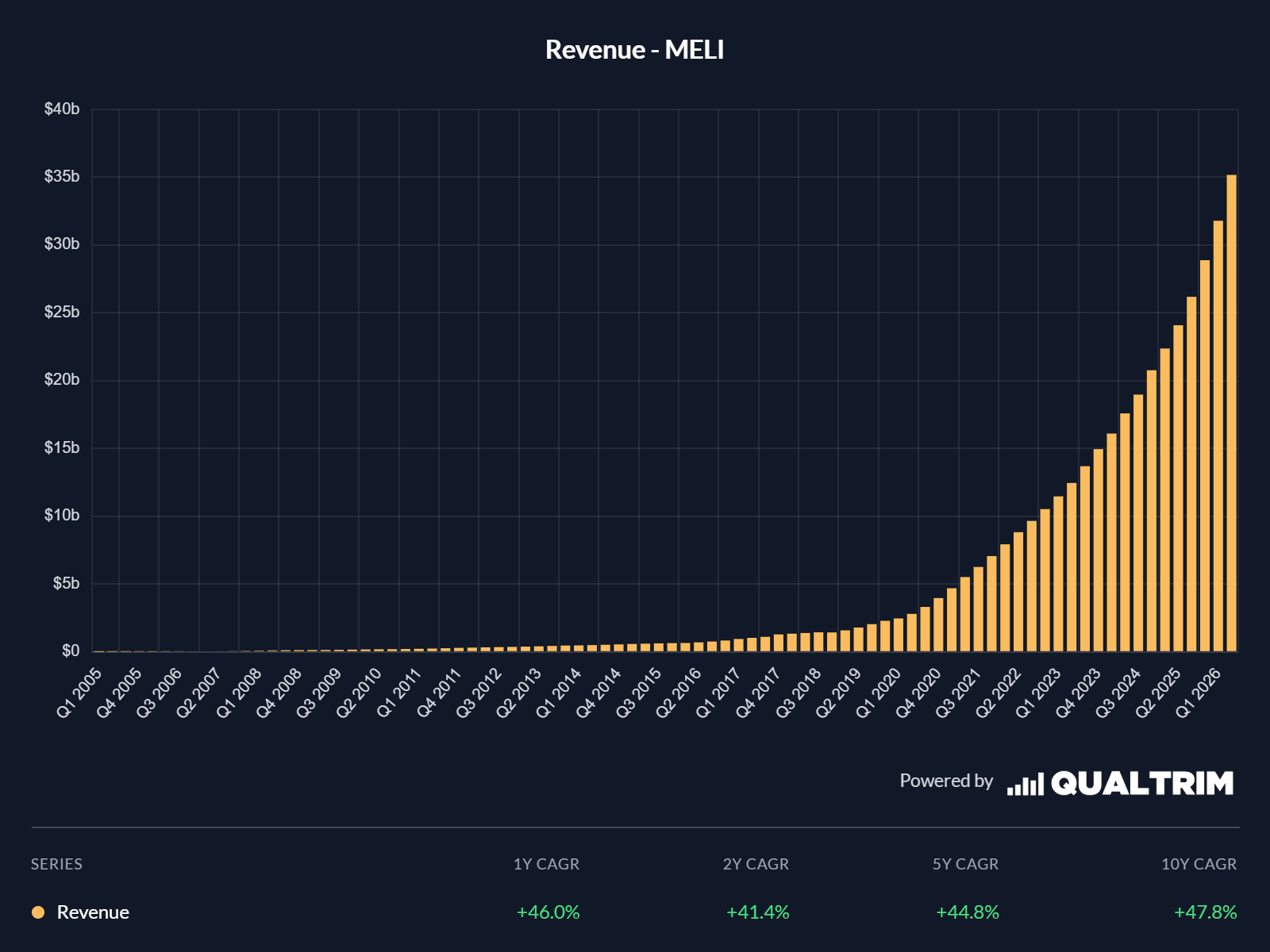
The “Ecosystemic” User: This is the most vital KPI management tracks. “Ecosystemic” users—those who use both the e-commerce marketplace and the Mercado Pago fintech platform—grew 37% YoY in mid-2026. These users generate 70% more Gross Merchandise Volume (GMV) and double the Assets Under Management (AUM) compared to single-platform users. MELI+ subscriptions (their Prime equivalent) surged 72% YoY, acting as a direct funnel to create these highly profitable, locked-in users.
2. Commerce KPIs: The Marketplace Engine
The e-commerce business is currently laser-focused on user acquisition and volume leverage.
Gross Merchandise Volume (GMV): Reached an astonishing $21.9 billion in Q2 2026, up 44% YoY.
Unique Active Buyers: Hit 89 million users.
Items Sold (The Volume Play): The aggressive decision to lower the free shipping threshold in Brazil a year ago is paying massive dividends in volume. While it hurts margins, items sold in Brazil surged 56% recently. They are training consumers to buy everyday, low-ticket items on MELI, not just expensive electronics.
3. Fintech KPIs: The Beast is Awake
Mercado Pago is no longer a sidekick to the marketplace; it is a financial juggernaut operating at an incredible scale.
Total Payment Volume (TPV): In Q2 2026, TPV crossed the psychological barrier of $100 billion for a single quarter (up 56% YoY). To put that in perspective, they are processing over $400 billion annualized.
Fintech Active Users: Reached 88 million, essentially matching the active buyer count on the commerce side.
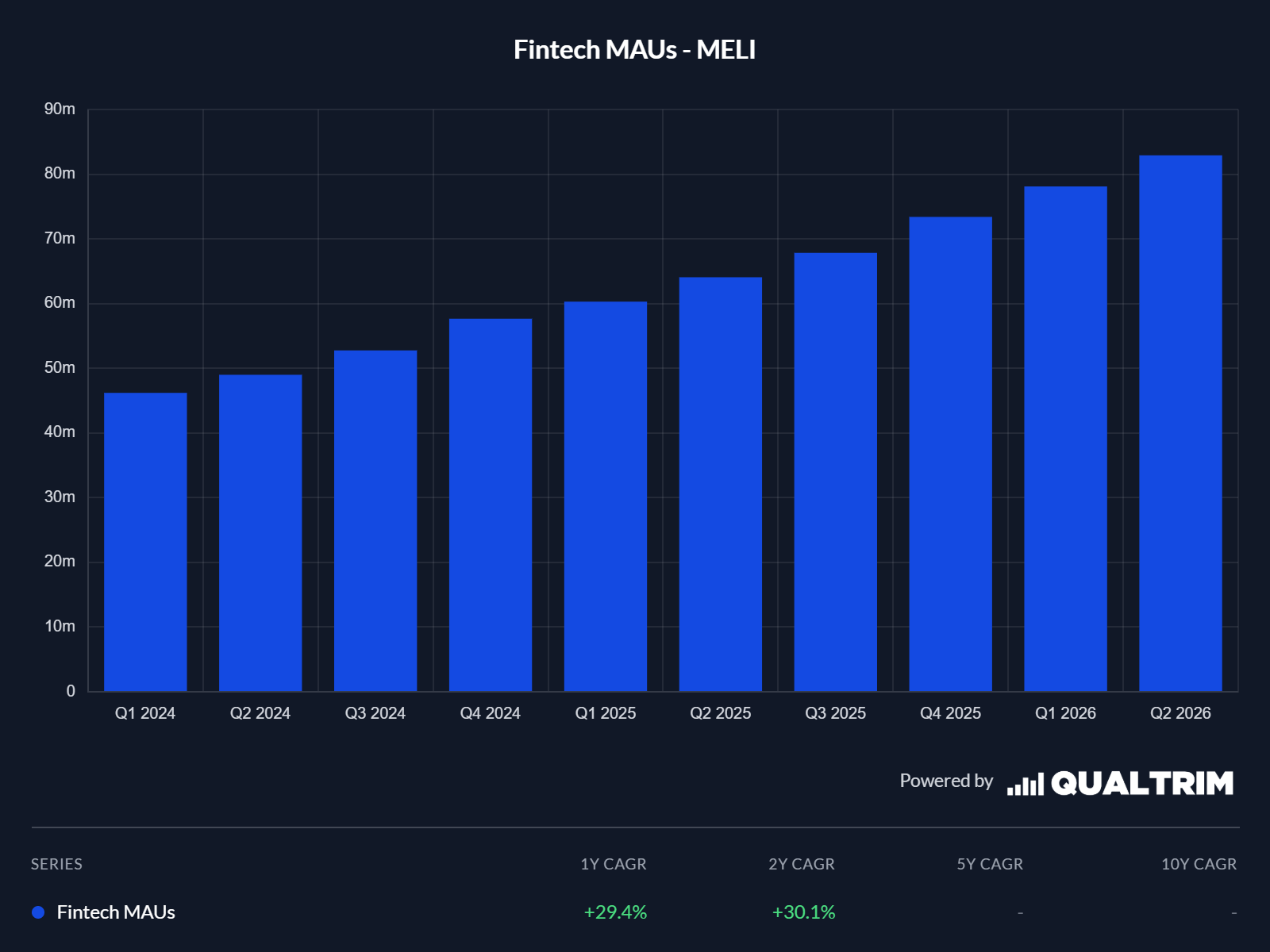
The Credit Portfolio: Total loans surpassed $16 billion. A major driver here is the rapid issuance of Mercado Pago credit cards (over 2.7 million issued in Q1 alone).
Asset Quality (NPLs): With a massive credit book comes risk. Fortunately, their 15-to-90-day Non-Performing Loan (NPL) ratio remains steady at roughly 7.0% overall, and a very healthy 4.6% specifically for credit cards. Their AI-driven underwriting continues to prove resilient.
4. The Profitability Squeeze (The Bear Caveat)
Here is where the bear case we discussed earlier rears its head. Funding all this growth is expensive, and margins are compressing as a result.
Operating Margins: Dropped to 6.7% in Q2 2026, a steep decline of 550 basis points from the 12.2% seen a year earlier. Income from operations actually fell 17% YoY to $683 million despite revenue jumping 50%.
Net Income & EPS: Net income slipped to $466 million (down 11% YoY), and EPS dropped.
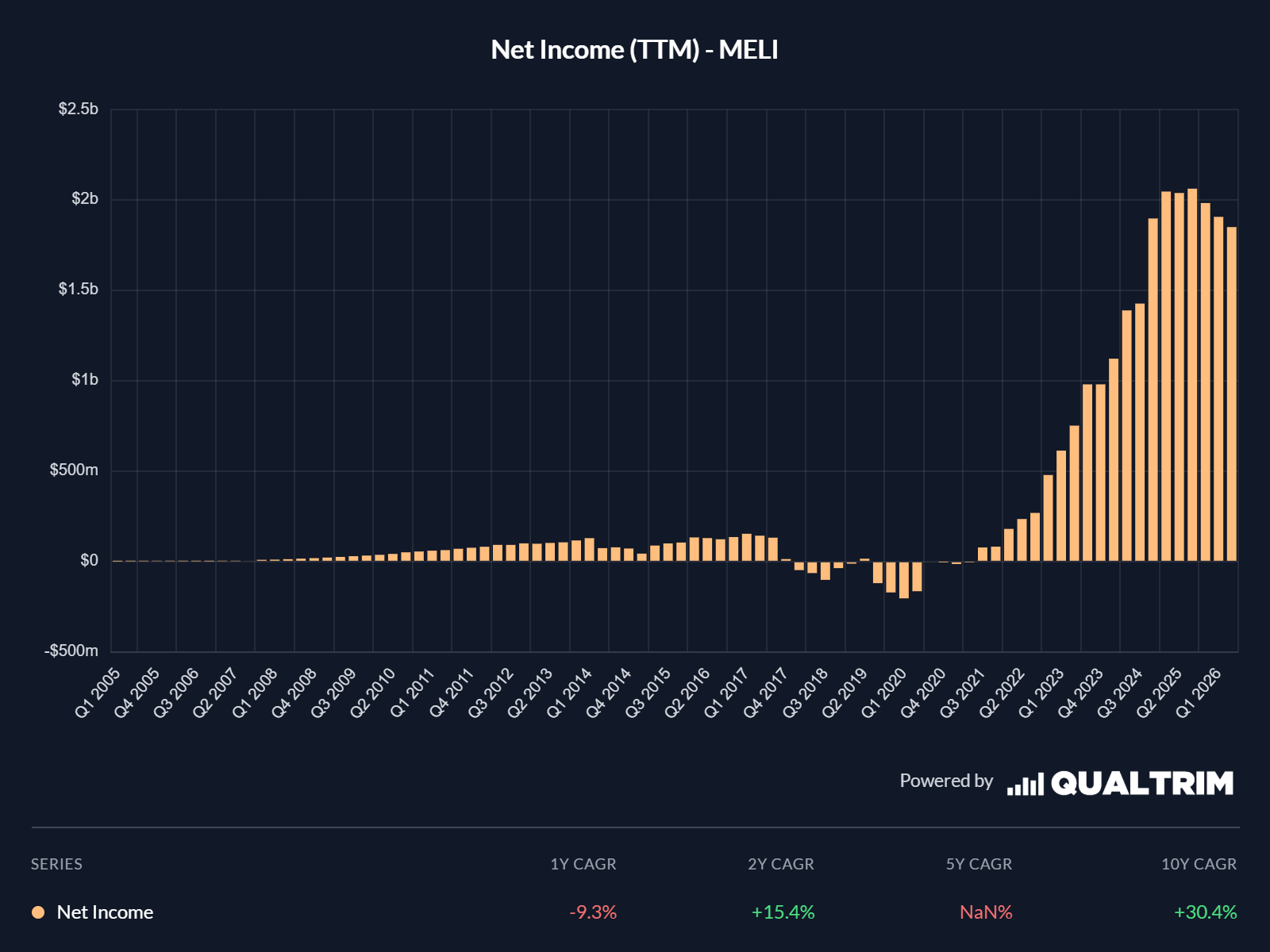
Why the compression? Beyond shipping subsidies, hardware costs for their Point-of-Sale (POS) devices in Mexico and Brazil are eating into the acquiring business margins. Furthermore, they are shifting heavily toward credit cards, which have a lower Net Interest Margin After Losses (NIMAL) compared to traditional high-interest personal loans.
The Takeaway for Investors
MercadoLibre is currently failing traditional “value investing” profitability tests—but that is entirely by design. The 2026 financials show a management team that is willingly taking a hit to EPS to ensure that Amazon, Shopee, and Nubank do not gain an inch of ground in Latin America.
If they can convert this massive wave of new “ecosystemic” users into long-term, high-margin customers, the current margin compression will be remembered as a brilliant, moat-building investment cycle. If the margins never recover, however, the stock’s premium valuation will become very difficult to justify.
Valuation & The Base Case: Why MELI is in My “Too Hard” Pile
After diving deep into MercadoLibre’s history, its sprawling ecosystem, and the intense competitive landscape, we inevitably arrive at the most difficult question for any investor: What is the stock actually worth?
Walkthrough: Breaking Down the Numbers
To see how the model and metrics come together in real-time, check out the video walkthrough below where we break down the financials and plug the variables into the CompoundingAlpha DCF model:
I am going to be entirely transparent here. When it comes to modeling out MercadoLibre’s future cash flows, I have placed this company firmly in my “too hard” pile.
Between the massive currency fluctuations (FX) in Argentina and Brazil, the unpredictable macroeconomic shifts in Latin America, and the fact that MELI is simultaneously running a capital-intensive logistics network and an unsecured credit book, building a high-conviction valuation model is incredibly difficult. Looking at the current price, I either find it overvalued, or I am simply missing a qualitative premium that the market is willing to pay for this “Super App” monopoly.
Because of this, I am only modeling a Base Case scenario. Rather than relying on standard EPS—which is heavily distorted by their current investment cycle—I am basing this model on the Adjusted Free Cash Flow (FCF) metric provided by management to represent the company’s true underlying earnings power.
The Base Case DCF Model
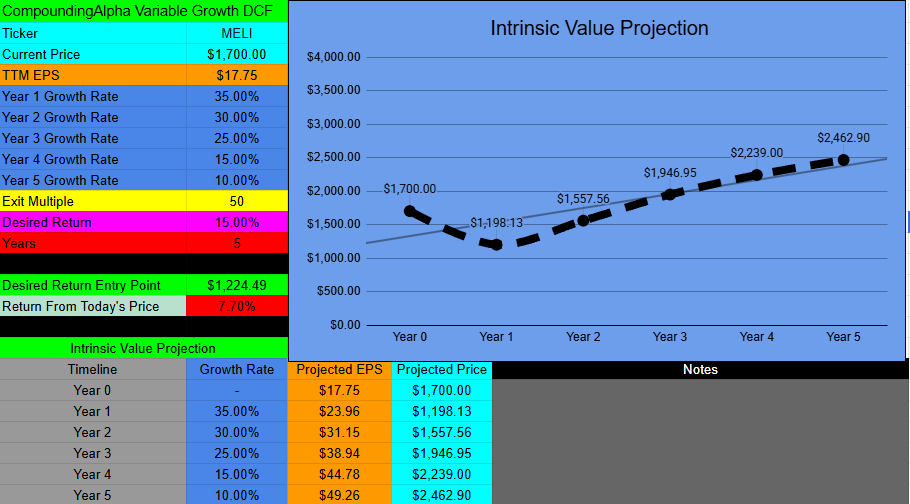
Based on the CompoundingAlpha Variable Growth DCF model, here is how the math shakes out if we assume MELI can maintain a highly successful, yet decelerating, growth trajectory over the next five years.
The Assumptions
Current Stock Price: $1,700.00
Starting Metric (Adjusted FCF/Share): $17.75. We are using this as our baseline “earnings” figure for Year 0. This metric is stated in company earnings and strips out financing activities inflating Meli’s traditional free cash flow.
Variable Growth Rates: We model a strong near-term trajectory that gradually fades as the law of large numbers takes hold:
Year 1: 35.00% (Projected Adj. FCF/Share: $23.96)
Year 2: 30.00% (Projected Adj. FCF/Share: $31.15)
Year 3: 25.00% (Projected Adj. FCF/Share: $38.94)
Year 4: 15.00% (Projected Adj. FCF/Share: $44.78)
Year 5: 10.00% (Projected Adj. FCF/Share: $49.26)
Exit Multiple: 50x. This is a premium multiple, but it is historically in line with what the market assigns to dominant, moat-protected tech monopolies at maturity.
Desired Annualized Return: 15.00%.
The Projections & Outputs
If management executes on this growth curve, in Year 5, MercadoLibre will be generating roughly $49.26 in Adjusted FCF per share.
Applying our 50x exit multiple to that Year 5 cash flow, we get an Intrinsic Value Projection of $2,462.90 per share by 2031.
The Verdict: No Margin of Safety
Here is why MELI remains in the “too hard” pile for me.
If you buy the stock today at $1,700, and the company executes perfectly on this base case to reach $2,462.90 in five years, your annualized return from today’s price is only 7.70%.
For a company operating in Latin America with significant FX and credit risks, a 7.7% CAGR does not provide an adequate margin of safety. It barely beats the historical average of the S&P 500, and you are taking on considerably more risk.
In order to achieve a standard market-beating 15% desired return, my model indicates a required entry point of $1,224.49. I believe after studying the business for sometime, I am either missing something or the company is overvalued. Based off the number of investors piling into this name I'm comfortable saying I might be missing something here. With that being said I'm also comfortable sitting on the sidelines. Let me know in the comments.
Incredible analysis! I was thinking about taking a position in MELI back in 2022. If I had known then, what I know now from reading this, I would’ve pounced on it.
great writeup. i sometimes post on my X account telling people not to buy MELI. just its stock chart alone would scare me away.