

If you asked the average investor to name the best-performing technology stocks of the 21st century, they would likely rattle off names like Apple, Amazon, or Microsoft. Very few would mention a relatively obscure, Toronto-based company that doesn’t build consumer gadgets or flashy cloud platforms.
Yet, Constellation Software ($CSU.TO) is arguably one of the greatest wealth-creation engines in modern history. Often referred to as “the largest software company you’ve never heard of,” Constellation has quietly compounded capital at staggering rates, transforming a $25 million initial investment into a $75+ billion global software conglomerate.
Led by its famously reclusive founder, Mark Leonard—often dubbed “Canada’s Warren Buffett”—Constellation has executed a seemingly simple but incredibly difficult-to-replicate strategy: acquire niche, mission-critical Vertical Market Software (VMS) companies, keep their local management in place, improve their operations, and never sell them.
This deep dive explores the timeline, the strategy, the risks, and the valuation of the ultimate compounding machine.
Table of Contents
The Constellation Playbook: Acquisition Strategy & Selection Criteria
Inside the Verticals: What Do Constellation’s Companies Actually Do?
The Architects of the Machine: Management & Shareholder Alignment
Deep dives are only half the equation. Want to see if Constellation makes the cut? Join me as we put this research into practice and build a high-conviction allocation strategy from the ground up in the CompoundingAlpha Portfolio

Check the Scorecards
Want to see how our research grades out? View our 1-page fundamental breakdowns—scoring every company on Growth Potential, Profitability, Balance Sheet, Return on Capital, Shareholder Yield, Management, Moat, and Execution Certainty

Since its inception, the company has executed a seemingly simple but incredibly difficult-to-replicate strategy: acquire niche, mission-critical Vertical Market Software (VMS) companies, keep their local management in place, improve their operations, and never sell them.
Here is the timeline of how Constellation grew from a $25 million initial investment into a $75+ billion global software conglomerate.
1990s: The Foundation
February 1995: Mark Leonard, a former venture capitalist who spent 11 years at Venture West Capital, officially founds Constellation Software in Toronto, Ontario. He starts with roughly C$25 million in initial funding, backed primarily by OMERS (Ontario Municipal Employees Retirement System) and a few institutional investors.
1995–1999: Leonard establishes the core thesis: buy small, sticky Vertical Market Software (VMS) businesses with high switching costs. The company begins aggressively acquiring businesses across North America, focusing on sectors like public transit, golf course management, and public housing. To manage the rapid influx of acquisitions, Constellation develops its decentralized structure, forming distinct operating groups (like Volaris and Harris Computer Systems) to oversee specific verticals.
2000s: Public Markets and Global Expansion
May 2006: Constellation Software goes public on the Toronto Stock Exchange (TSX: CSU) at an IPO price of C$17.00 per share, raising approximately C$80 million. The IPO provides the capital needed to accelerate international expansion, particularly into Europe and Australia, and gives the public its first real look at Constellation’s cash-generating machine.
2009: Amidst the Great Recession, Constellation’s focus on mission-critical, recurring-revenue software proves its resilience. The company successfully navigates the global financial crisis without cutting its dividend, cementing its reputation for durable cash flows.
2010s: Scaling the Acquisition Engine
2013: Constellation makes its first major European consolidation play by acquiring Total Specific Solutions (TSS), a Netherlands-based software provider, for approximately $270 million.
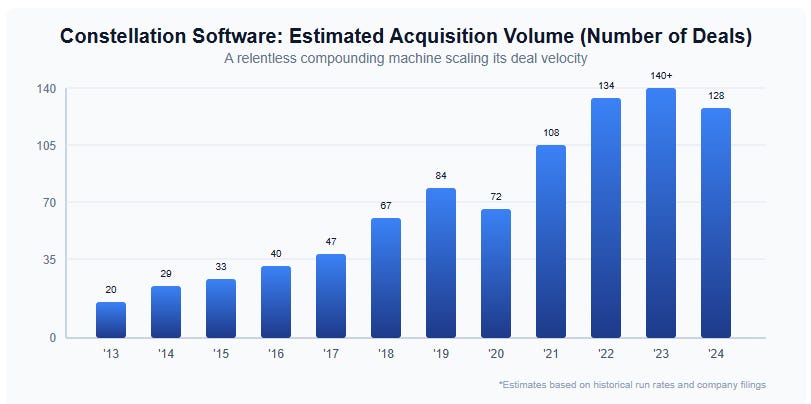
2015: The scale of the compounding engine becomes highly visible. Constellation is deploying over C$500 million annually into acquisitions, balancing its traditional strategy of dozens of small “bolt-on” deals with larger vertical platform acquisitions.
2016: Annual revenue crosses the C$2 billion mark, representing a 10x increase since its 2006 IPO.
January 2018: Constellation acquires Acceo Solutions for $250 million, which stands as its second-largest acquisition at the time, demonstrating a willingness to write larger checks as the company scales. By the end of 2018, the portfolio exceeds 500 operating companies, and revenue surpasses $3 billion USD.
2020s: The Spin-Off Era and Leadership Transition
January 2021: Constellation completes the spin-off of Topicus.com, merging its TSS operating group with Topicus. Constellation shareholders receive a dividend-in-kind of Topicus shares. This move proves that Constellation’s decentralized model can successfully incubate and spin out entirely new, independent public software platforms while retaining controlling economics.
March 2022: Constellation acquires Allscripts’ Hospitals and Health Systems business for $700 million, one of the largest acquisitions in its history, expanding its footprint in the healthcare vertical.
February 2023: Constellation acquires US-based media software provider WideOrbit. Concurrently, it spins out its communications and media software portfolio as an independent public company, Lumine Group Inc. (TSX-V: LMN). Constellation shareholders again receive shares via a dividend-in-kind.
End of 2023: The company achieves a record year of capital deployment, investing over $2.3 billion in acquisitions globally.
2024: Constellation’s market capitalization exceeds $65 billion, with annual revenue surpassing $10 billion. The company now oversees more than 1,000 businesses across over 100 industry verticals, employing over 64,000 people globally.
September 2025: In a massive transition for the company, founder and long-time CEO Mark Leonard announces his resignation as President for health reasons, effective September 25, 2025. Mark Miller, the Chief Operating Officer, steps into the President role. Leonard remains on the board of directors. At the time of his resignation, the stock price had grown more than 260x over 30 years—a staggering compound annual return of roughly 35%.
2026 (Present): Under Mark Miller’s leadership, Constellation continues its relentless pace of acquisitions and capital deployment. The company deployed over $800 million in Q1 2026 alone, proving the machine is still running at full speed as they navigate the evolving landscape of AI and remain fiercely committed to their decentralized, buy-and-hold-forever philosophy.
Key Takeaways for Investors
When looking at this timeline, three distinct phases of Constellation’s lifecycle emerge:
The Incubation Phase (1995-2005): Proving the VMS buy-and-hold thesis in private markets.
The Compounding Phase (2006-2020): Going public and executing hundreds of small cash-flow-generating acquisitions, refining the decentralized operating group structure.
The Platform/Spin-off Phase (2021-Present): Recognizing that massive scale requires larger deals and new public vehicles (Topicus, Lumine) to maintain high return rates, while successfully managing the transition away from its legendary founder.
The Constellation Playbook: Acquisition Strategy & Selection Criteria
Constellation Software’s compounding magic is not derived from a few lucky, massive acquisitions, but rather the programmatic, disciplined execution of hundreds of small-to-medium-sized deals. To achieve this at scale, the company relies on a rigorous, decentralized M&A playbook.
The Target: Vertical Market Software (VMS)
Unlike Horizontal Software (e.g., Microsoft Office, Salesforce, which serve all industries), Vertical Market Software is built for a highly specific industry or niche—think software designed exclusively for managing independent yoga studios, municipal water utilities, or boutique vineyards.
Selection Criteria: What Makes the Cut?
Constellation evaluates potential targets through a strict lens, looking for specific characteristics that guarantee durable cash flow:
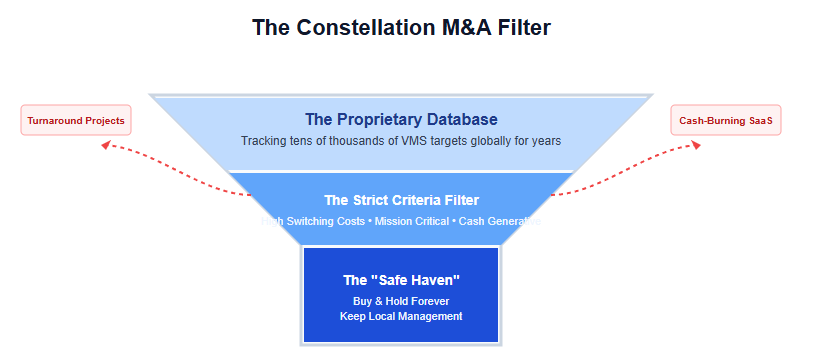
Mission-Criticality & High Switching Costs: The software must be essential to the customer’s daily operations. If a customer cannot run their business without the software, churn rates approach zero. The pain and cost of switching to a competitor must heavily outweigh the cost of renewing the software license.
Niche Dominance (Big Fish, Small Pond): Constellation prefers markets that are too small to attract tech giants or heavily funded venture capital startups, but large enough to support a highly profitable, dominant incumbent.
High Quality of Revenue: They look for a high percentage of recurring revenue (historically maintenance contracts, increasingly SaaS subscriptions). Predictable cash flow is paramount.
Consistent Financial Performance: The target must have a proven track record of profitability and cash generation. Constellation applies strict internal “hurdle rates” (Return on Invested Capital requirements) for every deal.
Strong Management Teams: Constellation prefers to buy businesses with competent management teams who are willing to stay on post-acquisition to continue running the day-to-day operations.
Sourcing Deals at Scale: The Proprietary Database
How does Constellation consistently find hundreds of companies to buy every year? They don’t wait for investment bankers to bring them deals.
Constellation maintains a massive, proprietary database containing tens of thousands of VMS companies globally. They track these targets for years, sometimes decades. Deal sourcing is highly decentralized: business unit managers and M&A leads across the various operating groups are constantly reaching out to founders, taking them to dinner, and building relationships.
When a founder is finally ready to retire or sell, Constellation is already there. They leverage their reputation as a “safe haven”—a permanent home that won’t fire the founder’s employees or strip-mine the company, which often allows Constellation to buy businesses at a fair price without entering competitive, banker-run auctions.
The Financial Engine: Strict Hurdle Rates
Constellation is notoriously disciplined regarding valuation. They do not buy on revenue multiples; they buy based on cash flow.
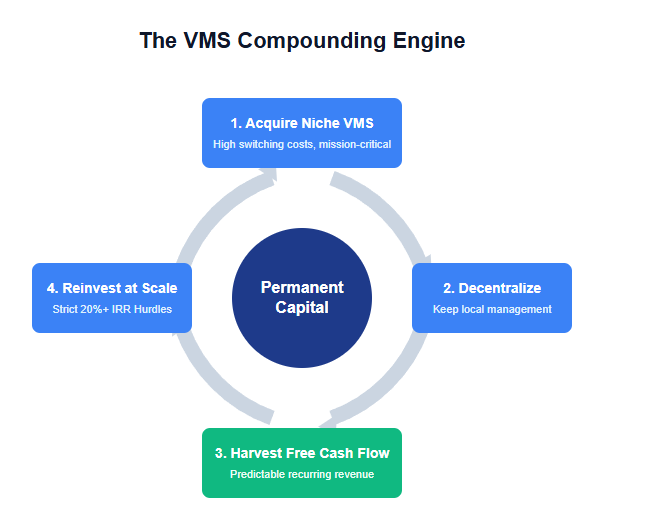
Every potential acquisition is modeled out over a decade to calculate an Internal Rate of Return (IRR). Historically, Constellation has targeted exceptionally high hurdle rates—often 20% to 25% or higher IRR for smaller, traditional VMS bolt-on acquisitions.
However, as the company has scaled, Mark Leonard acknowledged that to deploy billions of dollars annually, they would need to do larger deals. Because larger companies are more competitively priced, Constellation has shown a willingness to accept slightly lower—but still highly attractive—hurdle rates (e.g., mid-teens IRR) for these larger “platform” acquisitions.
Red Flags: What Constellation Avoids
To understand what Constellation is, you must understand what they are not. They will typically walk away from companies exhibiting these traits:
Cash-Burning Startups: They do not buy “growth-at-all-costs” companies. If a company requires continuous injections of capital to fund massive Sales & Marketing (S&M) or R&D just to survive, Constellation is not interested.
Intensely Competitive, Horizontal Markets: They avoid markets where they would have to compete with deep-pocketed tech titans or heavily commoditized software providers.
“Turnarounds” (Historically): While they have taken on slightly more complex carve-outs as they have scaled, Constellation’s bread-and-butter is buying already-good businesses at fair prices, rather than buying distressed businesses and trying to fix them.
Post-Acquisition: The “Buy and Hold Forever” Model
Once a company is acquired, Constellation’s operational playbook kicks in:
Permanent Capital: Constellation almost never sells an acquired business. This “safe haven” reputation makes them a highly attractive buyer for founders who care about the legacy of their company and the job security of their employees.
Extreme Decentralization: Decision-making is pushed down to the Operating Groups (Volaris, Harris, Jonas, etc.) and further down to the individual business unit managers. There is very little corporate bloat at the headquarters level.
Best Practices and Benchmarking: While highly decentralized, Constellation forces its portfolio companies to rigorously track and share standardized metrics. A struggling business unit manager can easily look up the internal playbook or call a peer within Constellation who successfully solved the same problem (e.g., optimizing pricing or reducing customer acquisition costs).
Portfolio Diversity, Key Verticals, and Revenue Concentration
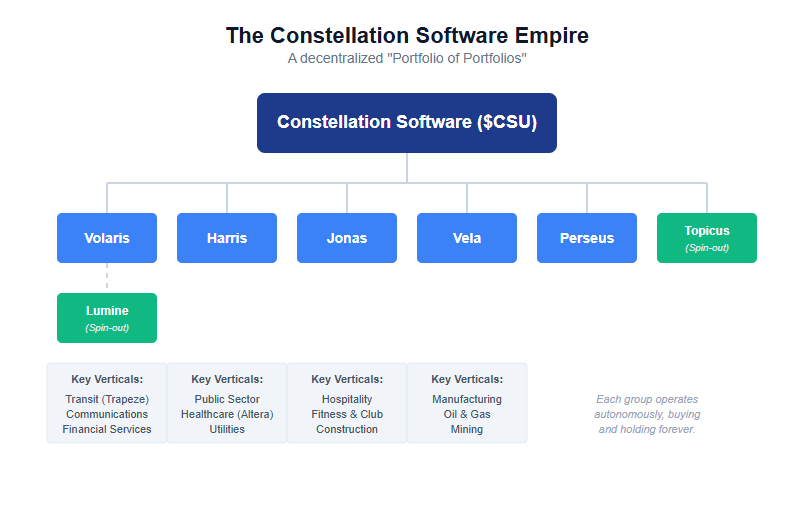
One of Constellation’s greatest strengths is its extreme diversification. Unlike traditional software companies that rely on a flagship product, Constellation is a decentralized “portfolio of portfolios.”
The Operating Groups
To manage over 1,000 separate businesses, Constellation organizes them into distinct “Operating Groups,” each acting as a mini-Constellation with its own M&A teams and capital allocation mandates. The core groups include:
Volaris Group: Focuses heavily on transit, communications, and financial services. (Lumine Group was famously spun out from Volaris).
Harris Computer Systems: Heavily concentrated in the public sector (utilities, local government) and healthcare.
Jonas Software: Dominates hospitality, club management, fitness, and construction software.
Vela Software: Focuses on industrial, oil & gas, and manufacturing software.
Perseus Group: Targets niches like dealerships, home building, and real estate.
Meaningful Verticals and Biggest Acquisitions
While Constellation plays in over 100 verticals, some have become massive revenue engines due to larger platform acquisitions:
Healthcare: This is a major vertical, primarily managed through Harris. In 2022, Constellation made one of its largest acquisitions ever, buying Allscripts’ Hospitals and Health Systems business for $700 million (now operating as Altera Digital Health).
Public Transit: Trapeze Group (under Volaris) was one of Mark Leonard’s earliest major successes and remains a massive player in routing and managing public transportation globally.
Communications & Media: Before being spun out as Lumine Group, Constellation built a massive communications vertical, capped off by the acquisition of WideOrbit (a U.S. media software provider) for an implied valuation of over $1 billion in 2023.
Revenue Concentration (The Power of Granularity)
Constellation’s portfolio differentiation is practically unmatched in the public markets.
No Single Point of Failure: Because the company owns well over 1,000 distinct VMS businesses, revenue concentration is exceptionally low. The largest single business unit within Constellation represents only a very low single-digit percentage of total global revenue.
Customer Diversification: Constellation serves millions of customers across its verticals. No single customer—even massive government entities—accounts for more than 1% to 2% of total consolidated revenue.
Deal Size Median vs. Outliers: While headline-grabbing deals like Allscripts ($700M) or TSS ($270M) happen, the vast majority of Constellation’s revenue is stitched together by hundreds of smaller businesses bought for $2 million to $10 million. It is the ultimate granular portfolio.
Inside the Verticals: What Do Constellation’s Companies Actually Do?
To truly understand Constellation’s “moat,” it helps to look at exactly what these VMS businesses do on a day-to-day basis. Here is a deep dive into three of their most critical verticals and the software that powers them:
1. Healthcare (Case Study: Altera Digital Health)
What it is: Acquired from Allscripts for $700 million and rebranded as Altera (managed under the Harris operating group), this is a classic Electronic Health Records (EHR) and hospital IT management system.
What it actually does: It is the digital nervous system for hospitals and clinics. Doctors use it to pull up patient histories, prescribe medications, and order lab tests. The hospital administration uses it to manage clinical workflows, track patient flow from the ER to a bed, and ensure medical coding and billing are accurate.
Why it’s the perfect VMS: The switching costs are astronomically high. Ripping out a hospital’s EHR requires years of planning, massive capital expenditure, and entirely retraining exhausted doctors and nurses—all while trying to safely care for patients. Because of this disruption, hospitals almost never switch EHR providers once a system is deeply integrated, resulting in highly predictable, recurring revenue for Constellation.
2. Public Transit (Case Study: Trapeze Group)
What it is: Trapeze is a cornerstone of the Volaris operating group (specifically operating within its Modaxo transit portfolio).
What it actually does: Trapeze provides the “command and control” software for municipal transit authorities. It handles fixed-route bus scheduling (making sure buses arrive on time based on traffic and demand), driver rostering (scheduling shifts for thousands of unionized drivers), fleet maintenance tracking, and paratransit dispatching (on-demand transport for the elderly or disabled).
Why it’s the perfect VMS: A city literally cannot run its public transportation without this software. If the software goes down, buses don’t deploy, and the city grinds to a halt. Furthermore, government transit authorities have notoriously complex and slow procurement cycles (RFPs). Once a company like Trapeze wins a government contract, it is highly shielded from new startup competition because transit authorities value stability and proven track records over flashy new technology.
3. Communications & Media (Case Study: WideOrbit)
What it is: Acquired in 2023 and forming the backbone of the recently spun-out Lumine Group, WideOrbit is a powerhouse in the media space.
What it actually does: It is essentially a “traffic and billing” system for local television and radio broadcasters. When a local car dealership buys a 30-second commercial during the evening news, WideOrbit is the software that schedules exactly when that commercial will air, ensures it doesn’t run right next to a competitor’s ad, tracks that it actually played, and then generates the invoice to bill the dealership.
Why it’s the perfect VMS: This software is the cash register for broadcasters. It directly manages their primary revenue stream (advertising inventory). Retraining a station’s entire sales force and operations team on a new billing and traffic system poses an immediate threat to daily revenue generation. As a result, stations are highly loyal to WideOrbit, treating the software as an indispensable, mission-critical utility.
The Architects of the Machine: Management & Shareholder Alignment
If Constellation’s M&A playbook is the engine, its management philosophy and executive compensation structure are the high-octane fuel. Constellation is arguably the most fiercely aligned company in the public markets, largely due to the culture instilled by its founder, Mark Leonard.
Mark Leonard: The Reclusive Capital Allocator
Mark Leonard is famous in value investing circles not just for his staggering returns, but for his extreme aversion to the spotlight. There are very few publicly available photos of him. He does not give media interviews, he does not go on CNBC, and he rarely participates in quarterly earnings calls, preferring to let the numbers speak for themselves. He is famously frugal, historically flying commercial coach and avoiding the typical trappings of a billionaire tech founder.
For years, Leonard’s primary communication with the public was his annual Shareholder Letters. Written with Buffett-esque candor, these letters broke down Constellation’s internal metrics, admitted mistakes freely, and discussed capital allocation with intense academic rigor. (He stopped writing them regularly when he felt competitors were using the letters to reverse-engineer Constellation’s M&A strategy).
The “Anti-Dilution” Compensation Structure
Many modern tech companies compensate executives heavily with stock options or Restricted Stock Units (RSUs). While this sounds like it aligns management with shareholders, it often severely dilutes the equity of existing shareholders over time.
Constellation does not issue stock options. Instead, they have implemented a uniquely brilliant, cash-based system that forces executives to have “skin in the game”:
Mandatory Share Purchases: When senior executives earn a cash bonus (which is tied tightly to Return on Invested Capital (ROIC) and organic revenue growth), they are required to use a significant portion (often 75%) of their after-tax bonus to purchase Constellation shares on the open market.
The Lock-Up: Once purchased, those shares are placed in a lock-up period (typically 3 to 5 years). The executives cannot sell them.
This system is a masterclass in alignment. Management only gets paid a bonus if they deploy capital efficiently (high ROIC). When they get that bonus, they have to buy the stock just like any retail investor (meaning no dilution for existing shareholders). Because the stock is locked up for years, management is highly incentivized to make long-term, rational decisions rather than pumping the stock for a quick, short-term exit.
You now understand the “why”—you know why Constellation Software is the quietest compounding machine in the tech industry, how they built an impenetrable moat through Vertical Market Software, and why Mark Leonard’s alignment with shareholders is the gold standard for management.
But understanding the company is only half the battle. Now, we have to answer the hardest question in investing: What is it worth?
In the second half of this deep dive, we go beyond the story. I’m pulling the curtain back on the financials, including:
The Bear Case: The exact risks that could break this compounding engine.
The Financial Reality: How the machine generates cash in 2026.
The Quantitative Edge: My custom 5-year DCF models for Base, Bear, and Bull scenarios.
The Investment Thesis: My bottom-line verdict on whether CSU.TO is a “Buy,” “Hold,” or “Sell” at today’s prices.
Unlock the full analysis to see how the math behind the machine stacks up against current market prices.
