

In medieval warfare, a castle’s survival didn’t just depend on the strength of its army; it depended on the width and depth of the moat surrounding it. If your castle was full of gold, you needed a formidable barrier to keep invaders at bay.
Business is no different.
If a company creates something highly profitable, competitors will inevitably try to storm the castle and take a share of those profits. To survive and generate outsized returns over the long haul, a company needs an “economic moat.”
But not all moats are created equal. Based on how they protect the business, we can categorize them into five distinct types. Let’s break down the mechanics of each and look at the companies that have used them to become bulletproof.
The Math Behind the Moat: The Persistence of ROIC
For retail investors, a moat is often a qualitative feeling—a fuzzy sense that a brand is “strong” or a product is “sticky.” But for sophisticated capital allocators, a moat is a harsh, measurable mathematical reality.
It is the structural mechanism that allows a company to sustain a Return on Invested Capital (ROIC) that consistently exceeds its Weighted Average Cost of Capital (WACC) over a long time horizon.
A Quick Primer on the Metrics:
ROIC (Return on Invested Capital):
For Beginners: How much cash profit a business generates for every dollar put into it. If you put $100 into a lemon stand and it generates $15 in profit, your ROIC is 15%.
For Advanced Readers: Net Operating Profit After Tax (NOPAT) divided by invested capital. It is the ultimate metric of management’s capital efficiency.
WACC (Weighted Average Cost of Capital):
For Beginners: What it cost the company to get the money to build the business in the first place (interest on loans, expectations of shareholders).
For Advanced Readers: The blended cost of debt and equity. This is the company’s “hurdle rate.”
If a company has an ROIC of 15% and a WACC of 8%, it is creating 7% of pure economic value. In a perfectly competitive market, these outsized profits act as a magnet. Competitors flood in, driving prices down and customer acquisition costs up until the industry’s returns revert to the mean (where ROIC equals WACC).
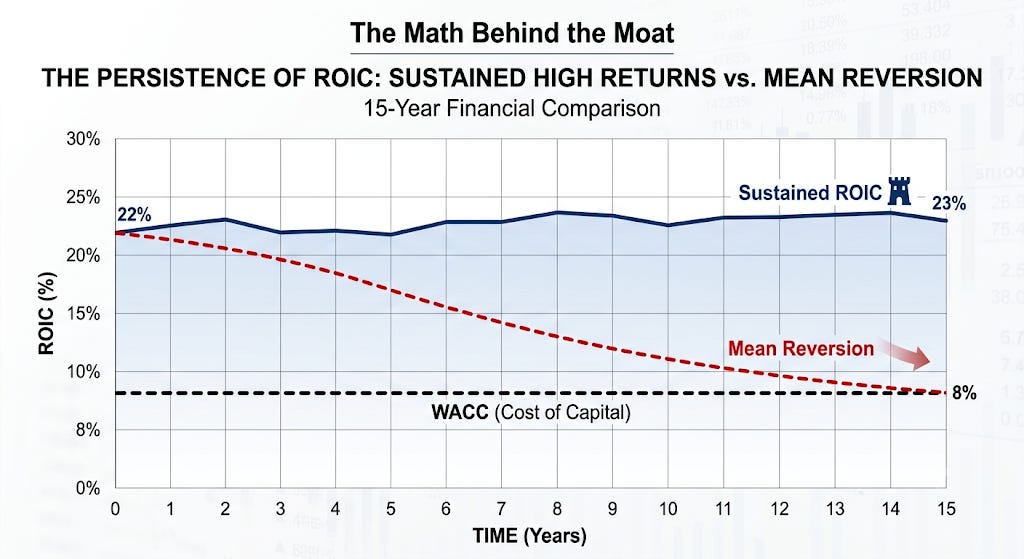
An economic moat is the only force capable of disrupting this law of corporate gravity. It extends the timeline of excess returns, allowing a business to compound wealth over decades rather than mere quarters.
Understanding the math is just the first step. To actually generate alpha, you need to know how to identify these structures in the wild, and more importantly, how to avoid the ‘value traps’ that fool retail investors.
In the rest of this premium deep-dive, we are going to break down:
The 5 specific architectures of an economic moat (with modern examples).
The 4 ‘False Flags’ that trick investors into buying value traps.
A complete Case Study on Apple’s ‘Compounding Moats’.
The Moat Detective’s Checklist: The exact metrics to look for in a 10-K to prove a moat exists.
Upgrade your subscription to unlock the full framework and the rest of today’s analysis.
