

The financial landscape in Latin America is undergoing a massive transformation, driven by a wave of innovative fintech companies challenging traditional banking structures. At the forefront of this revolution are two undisputed giants: Nubank and Mercado Pago. Both have fundamentally altered how millions of people manage their money, yet they approach the market from distinct origins and with different core philosophies.
Whether you are a consumer looking for a new digital wallet, a small business owner seeking payment solutions, or simply an observer of the global fintech boom, understanding the nuances between these two platforms is crucial. This article provides a dive into Nubank and Mercado Pago, comparing their origins, core offerings, target audiences, and the unique advantages each brings to the table.
The Genesis: Different Paths to Fintech Dominance
To truly understand how Nubank and Mercado Pago operate today, one must look at how they started. Their origin stories heavily influence their current ecosystems.
Nubank: The Challenger Bank
Founded in 2013 in São Paulo, Brazil, by David Vélez, Cristina Junqueira, and Edward Wible, Nubank was born out of frustration. The founders experienced firsthand the notoriously bureaucratic, expensive, and opaque traditional banking system in Brazil.
Their mission was simple but audacious: to “fight complexity and empower people.” They started with a single product—a no-fee, distinctive purple credit card managed entirely through a sleek mobile app. By focusing intensely on customer experience, transparency, and a lack of hidden fees, Nubank quickly amassed a cult-like following. Today, it stands as one of the largest independent neobanks in the world, expanding its services far beyond that initial credit card.
Mercado Pago: The Ecosystem Enabler
Mercado Pago’s story begins much earlier, in 2003. Initially, Mercado Pago was created to solve a specific problem: facilitating secure payments within the Mercado Libre e-commerce platform.
It was an escrow service, building trust between buyers and sellers in a region where online fraud was a significant concern and credit card penetration was low. Over time, Mercado Pago evolved from a simple payment gateway into a comprehensive digital wallet and financial services platform, extending its reach far beyond the Mercado Libre marketplace to physical stores, online merchants, and everyday consumers.
Core Offerings: What Can You Actually Do?
While both platforms have expanded significantly and their services increasingly overlap, their core strengths reflect their origins.
The Nubank Experience: Banking Simplified
Nubank’s approach is centered on replacing the traditional bank account with a streamlined, digital-first alternative.
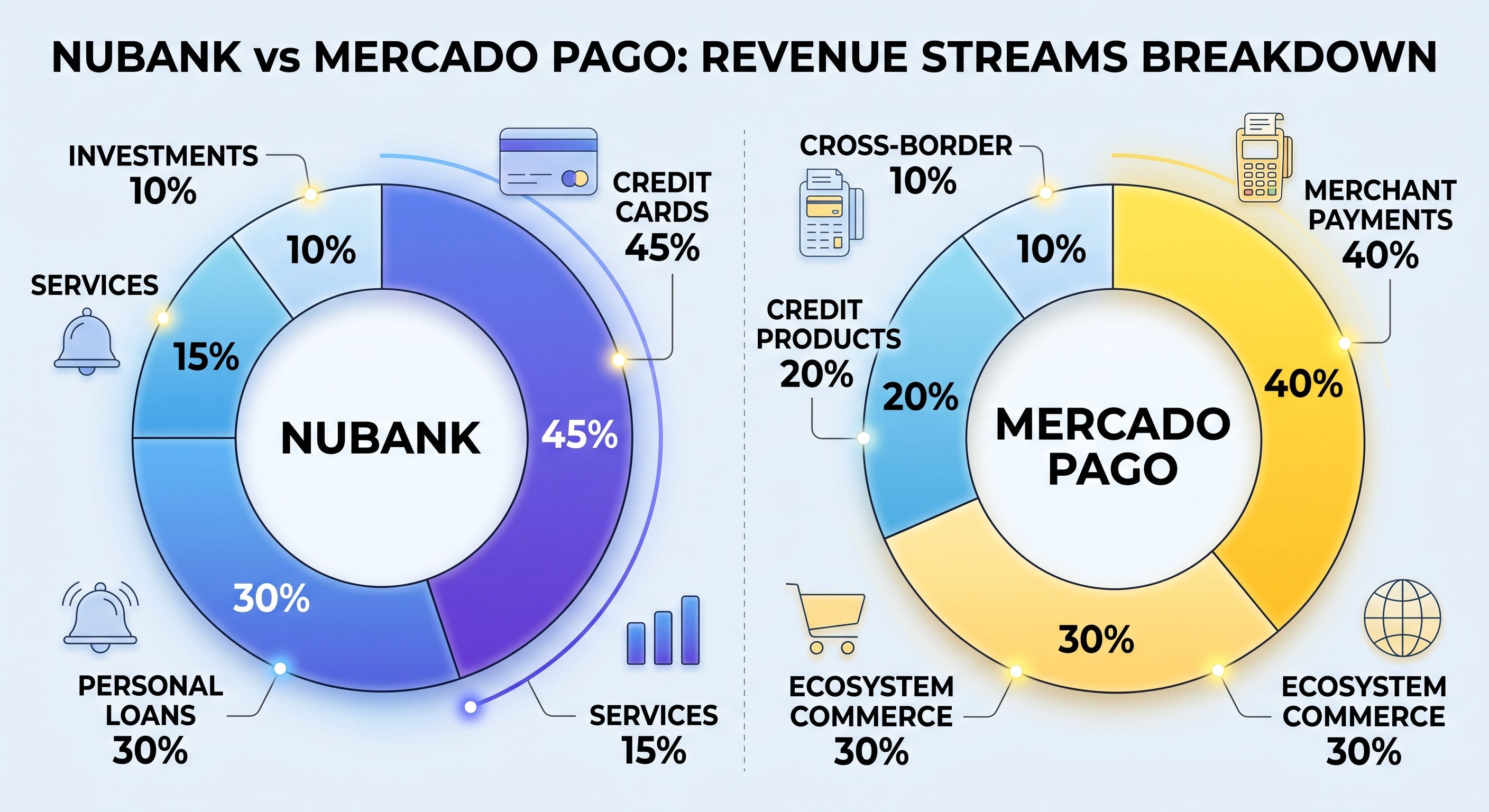
The NuConta (Digital Account): The cornerstone of Nubank’s offering is its digital account. It’s known for having zero maintenance fees, free transfers (TED/PIX in Brazil), and an interface that makes tracking expenses effortless. Crucially, money sitting in a NuConta automatically yields interest (often pegged to the local CDI rate), making it an attractive place to park daily funds.
Credit and Debit Cards: The iconic purple card remains a massive draw. Nubank utilizes proprietary algorithms to offer credit to individuals who might be ignored by traditional banks. The app allows users to easily adjust limits, block/unblock the card, and view transactions in real-time.
Investments and Insurance: Nubank has aggressively expanded into wealth management, offering easy-to-understand investment options directly within the app, catering to both beginners and more experienced investors. They also offer simplified life and mobile phone insurance policies.
Loans: Personal loans are available with transparent interest rates and flexible repayment options, all managed seamlessly through the app.
In essence, Nubank wants to be your primary, everyday bank, handling everything from your paycheck to your investments in one unified, user-friendly space.
The Mercado Pago Ecosystem: Money in Motion
Mercado Pago’s strength lies in its versatility as a payment and commerce engine, acting as a bridge between the physical and digital worlds.
The Digital Wallet: The Mercado Pago app is a powerful wallet. Users can load money via bank transfer, credit card, or even by depositing cash at affiliated physical locations (like lotteries or pharmacies). This balance can be used to pay bills, recharge mobile phones, and make purchases. Like Nubank, funds held in the wallet often generate a daily yield.
Point-of-Sale (POS) Solutions: This is where Mercado Pago truly shines. They offer a range of affordable card readers (the “Point” series) that have empowered millions of micro-merchants, street vendors, and small businesses to accept credit and debit cards, fundamentally changing local commerce.
Mercado Crédito: This is their credit arm, offering loans not just to consumers, but crucially, to merchants based on their sales history within the Mercado Libre/Mercado Pago ecosystem. This access to working capital is a game-changer for small businesses.
E-commerce Integration: Unsurprisingly, Mercado Pago provides seamless checkout solutions for online stores, leveraging the immense trust and user base it has built through Mercado Libre.
QR Code Payments: Mercado Pago has been a massive driver of QR code adoption in Latin America, allowing users to pay at physical stores simply by scanning a code with their phones.
In essence, Mercado Pago wants to be the ultimate facilitator of transactions, making it as easy as possible to move money, whether you are buying a coffee on the street or running an online store.
Head-to-Head: Key Similarities
Despite their different starting points, Nubank and Mercado Pago share several fundamental characteristics that define their success:
Financial Inclusion: Both companies have been instrumental in banking the unbanked and underbanked populations in Latin America. By lowering barriers to entry (no physical branches, simplified requirements, free accounts), they have brought millions into the formal financial system.
Digital-First Convenience: Both rely on highly rated, intuitive mobile applications. They have successfully gamified and simplified the user experience, making tasks that were once tedious (like paying a bill or checking a balance) quick and painless.
Yielding Accounts: Both platforms recognize the high inflation environments in many Latin American countries. Offering a daily yield on account balances is a key strategy for user retention, ensuring that customers’ money isn’t losing value while sitting idle.
Embrace of Instant Payments: Both have heavily integrated instant payment systems, most notably PIX in Brazil, which has revolutionized money transfers in the country.
Head-to-Head: The Crucial Differences
The divergence between the two becomes clear when you look at their primary focus and target audience.
1. The Breadth of the Ecosystem
Nubank operates as a standalone financial institution. Its ecosystem is self-contained, focused on deepening the financial products it offers its users (credit, insurance, investments, crypto).
Mercado Pago is intrinsically tied to a broader commerce ecosystem. The synergy with Mercado Libre is a massive advantage. Users who sell on Mercado Libre naturally use Mercado Pago, and users who buy on Mercado Libre are incentivized to use the wallet. This creates a “sticky” ecosystem that is hard for competitors to replicate.
2. Physical vs. Digital Presence
Nubank is almost entirely digital. While they issue physical cards, their interaction with the real world is minimal.
Mercado Pago has a significant physical footprint through its millions of deployed POS machines and QR code standees in stores, restaurants, and street stalls across the region. You physically see the Mercado Pago brand in daily life much more often than you see Nubank.
3. Approach to Credit
Nubank relies heavily on alternative data and proprietary algorithms to underwrite consumer credit, often extending small initial limits and growing them as the user proves reliable.
Mercado Pago leverages the vast amount of transactional data it possesses. They know exactly how much a merchant sells or how much a consumer buys on their platforms, allowing them to offer highly targeted loans (Mercado Crédito) with a strong understanding of the borrower’s cash flow.
The Economics of Acquisition: How They Win (and Keep) Users
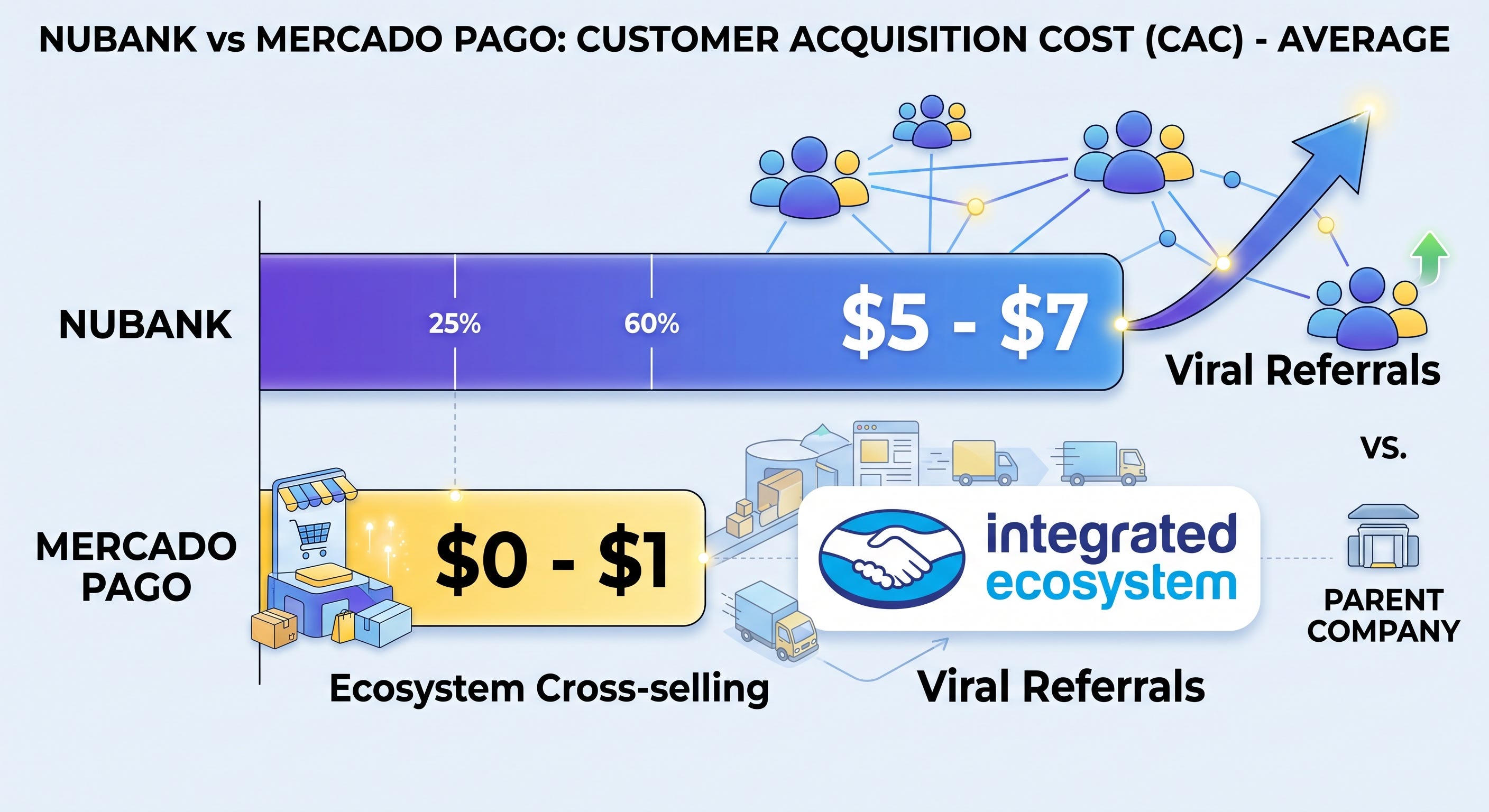
Traditional banks in Latin America historically spent massive sums—often over $100 per customer—on marketing, physical branch maintenance, and administrative overhead to acquire new accounts. The secret to Nubank and Mercado Pago’s profitability despite offering free accounts lies in their radically low Customer Acquisition Cost (CAC). However, their strategies for achieving this are entirely different.
Nubank: The Viral Loop and Fanatical Loyalty
Nubank treats customer service as its primary marketing engine. By creating a genuinely lovable product in a sector historically despised by consumers, they turned their early users into vocal advocates.
Word-of-Mouth: For years, the only way to get a Nubank credit card was through an invite from an existing user. This manufactured exclusivity made the distinctive purple card a status symbol. Today, 80% to 90% of Nubank’s new customers still come organically through word-of-mouth or direct unpaid searches.
High Net Promoter Score (NPS): Nubank consistently boasts one of the highest NPS scores of any financial institution globally. Because their users evangelize the brand for free, Nubank’s CAC hovers around a staggering $5 to $7 per user. This incredible efficiency means they become profitable on a new user very quickly, even if that user only generates a small amount of revenue at first.
Mercado Pago: The E-Commerce Flywheel
Mercado Pago doesn’t rely on manufactured exclusivity; it relies on utility and ecosystem lock-in. Their acquisition strategy is a masterclass in cross-selling.
The Mercado Libre Funnel: Millions of people visit Mercado Libre every day simply to shop. When a user buys a pair of shoes, they are smoothly routed through Mercado Pago to process the payment. To incentivize users to actually open a full digital wallet, they are offered irresistible perks: discounts on purchases, free shipping tiers via the “Meli+” loyalty program, or immediate credit access.
Zero-Cost Acquisition: For users already in the Mercado Libre ecosystem, the cost for Mercado Pago to acquire them as a fintech customer is functionally zero.
The B2B Anchor: On the merchant side, a vendor wants to sell on Mercado Libre or process a physical credit card in their store. To do so, they must use a Mercado Pago account. The commerce need dictates the financial adoption, creating an inescapable “flywheel” where commerce drives fintech, and fintech facilitates more commerce.
The Ultimate Battleground: Mexico and the Race for “Principalidade”
Having largely saturated their native market of Brazil, both Nubank and Mercado Pago have set their sights on Mexico as the ultimate frontier. Mexico is Latin America’s second-largest economy, but it suffers from notoriously low banking penetration—historically, roughly half of all adults have been unbanked, creating a massive opportunity for disruption.
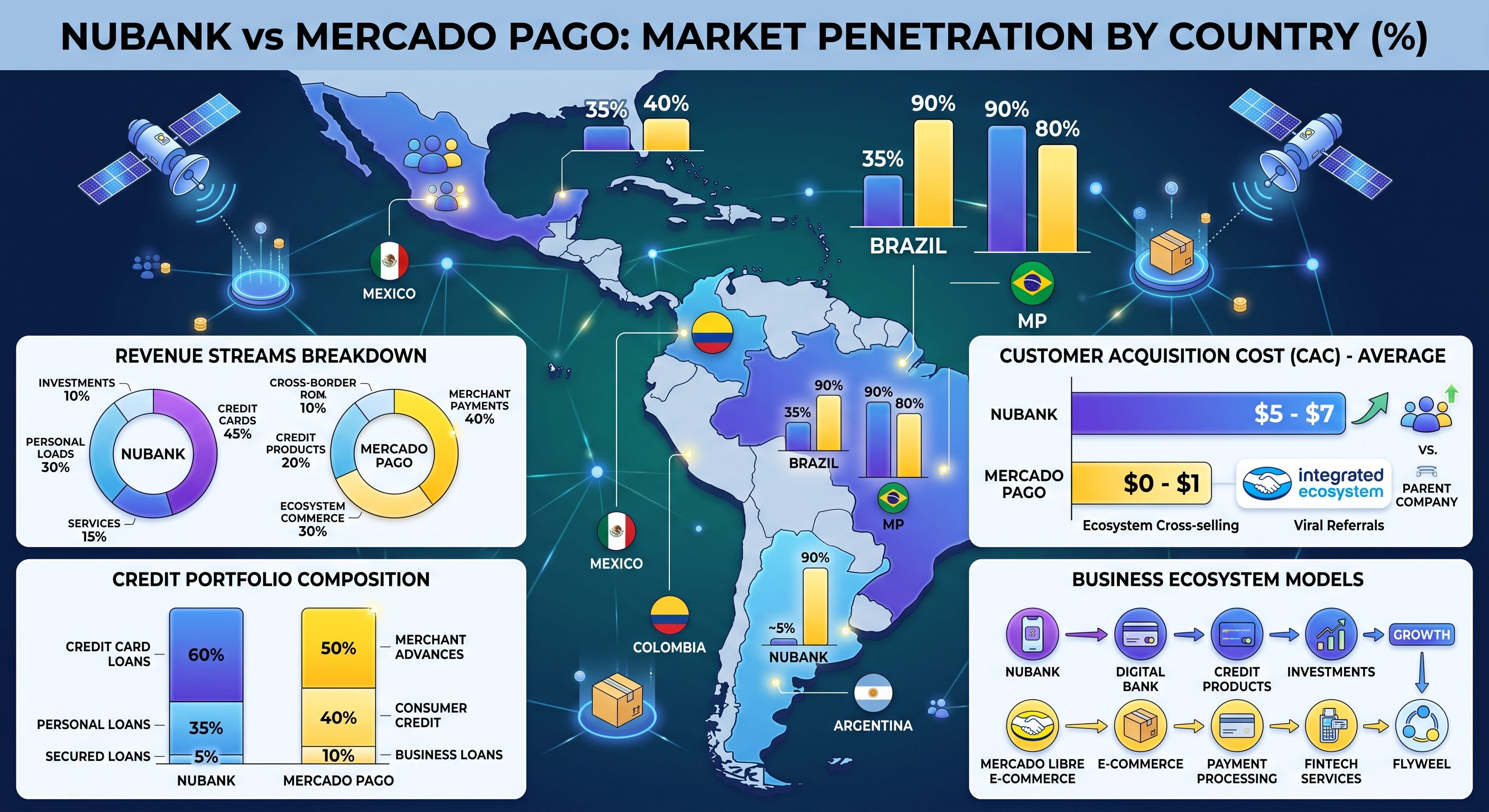
However, simply acquiring users in Mexico is no longer enough. The current phase of the war is all about achieving “principalidade”—an industry term meaning “primary account status.”
For years, users might have downloaded a fintech app for a specific perk (like a secondary credit card or a discount on an e-commerce purchase) while keeping their actual paycheck in a traditional bank. Both Nubank and Mercado Pago know that long-term profitability requires moving beyond being a “side-wallet.” They want to be the place where a customer’s salary is deposited (the nómina). Once a fintech captures a user’s payroll, they become the central hub for that user’s entire financial life, from paying utility bills to taking out mortgages.
The Weapon of Choice: High-Yield Wars and Banking Licenses
To lure massive amounts of deposits away from traditional banks, both companies engaged in an aggressive “yield war,” offering incredibly high-interest rates (often well over 10% or even 15% annually) simply for leaving money in their Mexican accounts. This acted as a powerful customer acquisition tool.
But to truly capture the payroll market, they needed heavier regulatory firepower. Operating under lighter financial licenses (like Mexico’s SOFIPO structure) limited the scope of products they could offer. Consequently, both engaged in a highly publicized race to secure full, official banking licenses from Mexican regulators.
In mid-2026, Nubank successfully secured its authorization to operate as a full bank in Mexico, cementing its status as the country’s largest digital bank (with over 15 million customers) and announcing a massive $4.2 billion investment commitment to the country. This license crucially allows them to roll out direct payroll accounts, striking directly at the heart of Mexico’s traditional banking oligopoly. Mercado Pago has aggressively pursued its own banking license filings, aiming to leverage the ubiquity of Mercado Libre deliveries to convince Mexicans to trust them with their life savings.
The battle for Mexico proves that the Nubank vs. Mercado Pago rivalry is no longer just about issuing credit cards or processing merchant payments—it is a race to become the undisputed, primary financial operating system for an entire continent.
Weathering the Storm: Who is Better Prepared for a Credit Crisis?
Latin America is historically prone to macroeconomic volatility, high interest rates, and inflation. In a severe economic downturn or a sudden spike in consumer defaults, how vulnerable are these two giants?
Nubank: The High-Wire Balancing Act
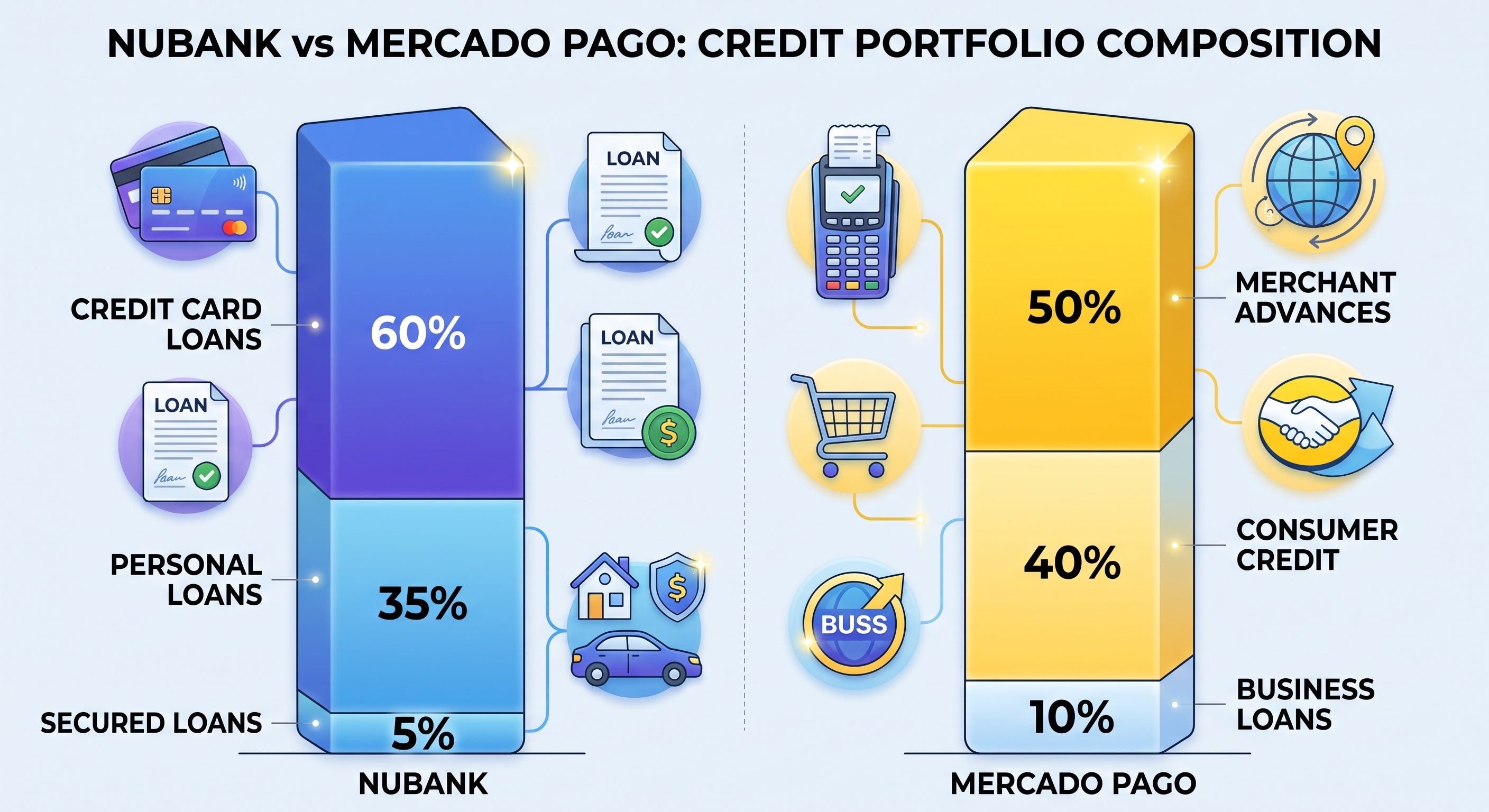
Nubank’s primary vulnerability lies in its heavy exposure to unsecured retail credit—specifically, credit card balances and personal loans. When a recession hits and unemployment rises, these are often the first debts consumers stop paying. Because Nubank is a pure-play financial institution, a massive spike in Non-Performing Loans (NPLs) directly impacts its core bottom line.
However, Nubank’s defense mechanisms are formidable. First, their entire DNA is built on superior, AI-driven credit underwriting. They constantly monitor consumer behavior and can aggressively tighten credit limits at the first sign of macroeconomic trouble. Furthermore, Nubank has amassed a massive base of retail deposits (money sitting in NuContas). This provides them with an incredibly cheap source of funding, giving them a thick cushion of liquidity. In fact, Nubank operates with significant excess capital; their massive deposit base far exceeds the size of their active credit portfolio. Because they self-fund their lending using these cheap retail deposits, they are largely insulated from sudden freezes in external credit markets. To further insulate themselves, Nubank has recently begun diversifying into lower-risk, secured lending, such as payroll-deductible loans (credit assigned directly from a user’s paycheck), which are much safer during a crisis.
Mercado Pago: The Diversification Shield
Mercado Pago approaches a credit crisis with a structural advantage: immense diversification. While they do offer consumer loans, a massive portion of their credit portfolio is directed at merchants (B2B lending).
Crucially, these merchant loans are often implicitly collateralized by the merchant’s sales on the Mercado Libre or Mercado Pago platforms. If a merchant owes Mercado Pago money, the platform simply deducts the loan repayment directly from the merchant’s incoming sales revenue before depositing the rest into their account. This dramatically lowers the risk of default compared to an unsecured consumer loan.
Furthermore, Mercado Pago employs a distinct strategy to fund its rapid credit expansion. Rather than relying entirely on a retail deposit base, Mercado Pago frequently packages its credit portfolios and sells them to investors on the open market (through securitization vehicles like FIDCs). This strategy offloads a significant portion of the credit risk to third-party investors and frees up capital immediately to fund new loans. However, it also means their credit engine relies somewhat on the continued appetite of external open-market investors.
More importantly, Mercado Pago is shielded by its parent company. Even if the credit arm takes a severe hit, Mercado Libre still generates massive, stable revenue streams from e-commerce commissions, advertising, and payment processing fees. They do not rely solely on interest income to survive.
The Future: Convergence and Competition
The fascinating aspect of the Nubank vs. Mercado Pago dynamic is that they are increasingly moving into each other’s territory.
Nubank is aggressively expanding its offerings for small businesses (Nubank PJ), recognizing the lucrative potential of the B2B market. Conversely, Mercado Pago is continuously adding more consumer-banking features to its wallet, such as improved investment options and physical credit cards, aiming to become the primary financial hub for its users.
Both companies are also looking beyond their strongest market (Brazil) and expanding aggressively into Mexico and Colombia, setting the stage for a continent-wide battle for fintech supremacy.
Ultimately, the real winners in this rivalry are the consumers and small businesses of Latin America. The intense competition between Nubank and Mercado Pago continues to drive down costs, improve services, and force traditional banks to innovate or risk obsolescence. Whether you favor the sleek simplicity of the purple card or the ubiquitous utility of the blue ecosystem, the financial future of the region is undeniably digital.