The 130-Year-Old Startup
Texas Pacific Land Corporation (TPL) is a 19th-century railroad relic that has accidentally become the most dominant infrastructure play of the 21st-century energy and AI revolutions. After a century of sleepy existence as a passive land trust, TPL has undergone a radical transformation into a “synthetic tech-utility.” By leveraging a “Whole-Acre” strategy, the company is now monetizing every vertical layer of its 880,000-acre Permian Basin footprint—from the oil and gas royalty interests deep subsurface to the water infrastructure on the ground and the massive AI data center campuses now rising above it. With software-like net margins exceeding 60%, a debt-free balance sheet, and a newly minted spot in the S&P 500, TPL is no longer just a land story; it is a high-velocity capital allocation machine. This deep dive explores how a legacy liquidation vehicle became the “toll booth” of the Permian, and whether its current “AI premium” offers a margin of safety or a peak-valuation trap.
1871 – 1887: The Railway Roots and Land Grants
The story begins not with oil, but with the expansion of the American West.
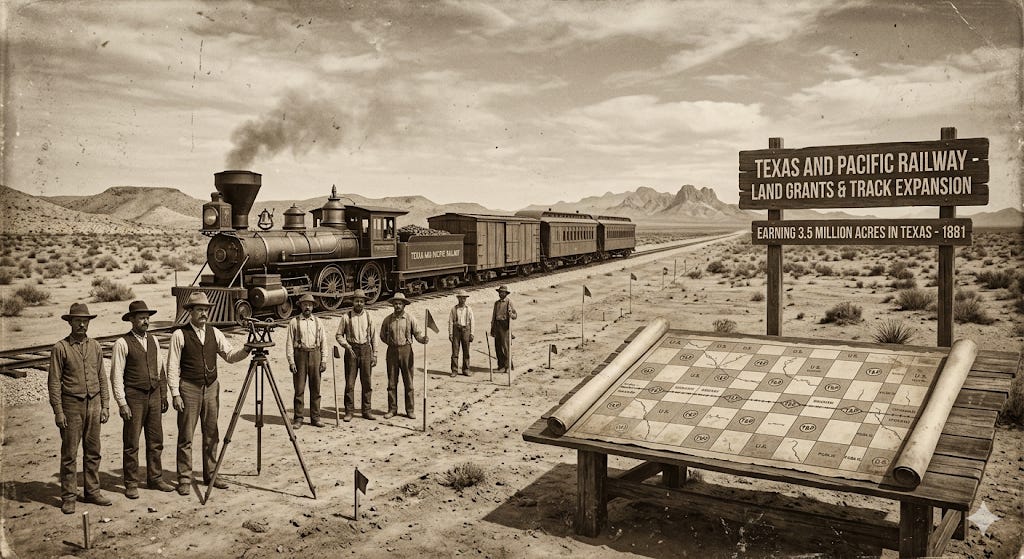
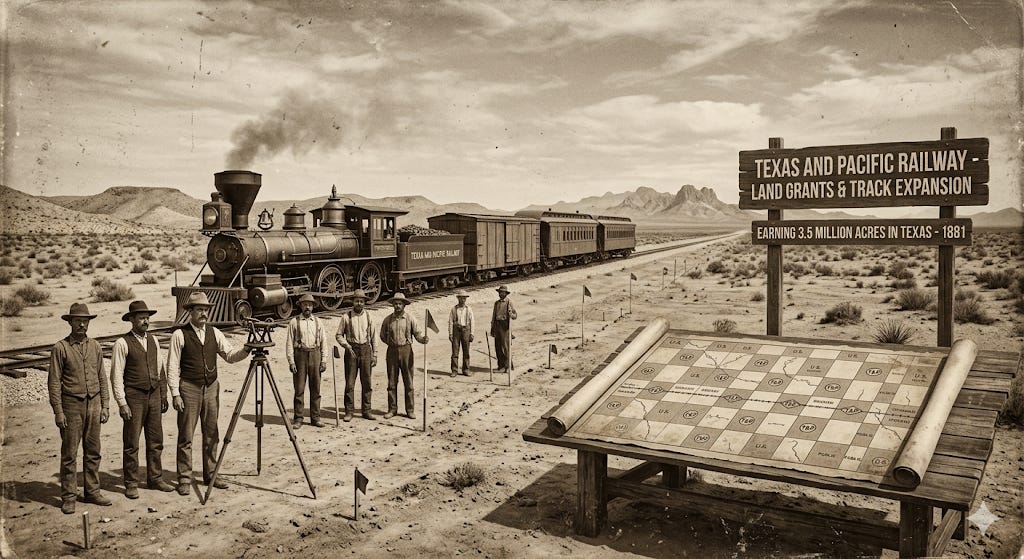
1871: The Texas and Pacific Railway (T&P) is created by a federal charter to build a transcontinental railroad from Marshall, Texas, to San Diego, California.
The Land Deal: To incentivize the build, the state of Texas and the U.S. government granted the railway millions of acres of land—alternating “checkerboard” sections—for every mile of track laid.
1881: Jay Gould takes control. By this time, the T&P had laid nearly 1,000 miles of track, earning it approximately 3.5 million acres in Texas alone.
1887 – 1888: The railway overextends itself financially. Facing bankruptcy and drought, the T&P is forced into receivership.
1888 – 1950s: The Era of the “Passive Trust”
When the railway failed, the bondholders didn’t want the defunct railroad; they wanted the land that backed their debt.
Feb 1, 1888: The Texas Pacific Land Trust (TPLT) is formed. The 3.5 million acres of land are placed into this trust for the benefit of the bondholders.
The Original Mission: The trust’s sole mandate was to manage and slowly liquidate the land to pay back the bondholders. It was designed to go out of business.
1920: The “Abrams #1” well in Mitchell County strikes oil, marking the first discovery in what would become the legendary Permian Basin. TPL realized that the land they were trying to sell sat on top of a literal gold mine.
1927: TPL sub-share certificates begin trading on the New York Stock Exchange (NYSE).
1954 – 2010: The Mineral Spin-off and Dormant Years
For decades, TPL was a sleepy, obscure entity that primarily made money from grazing leases and selling small parcels of land.
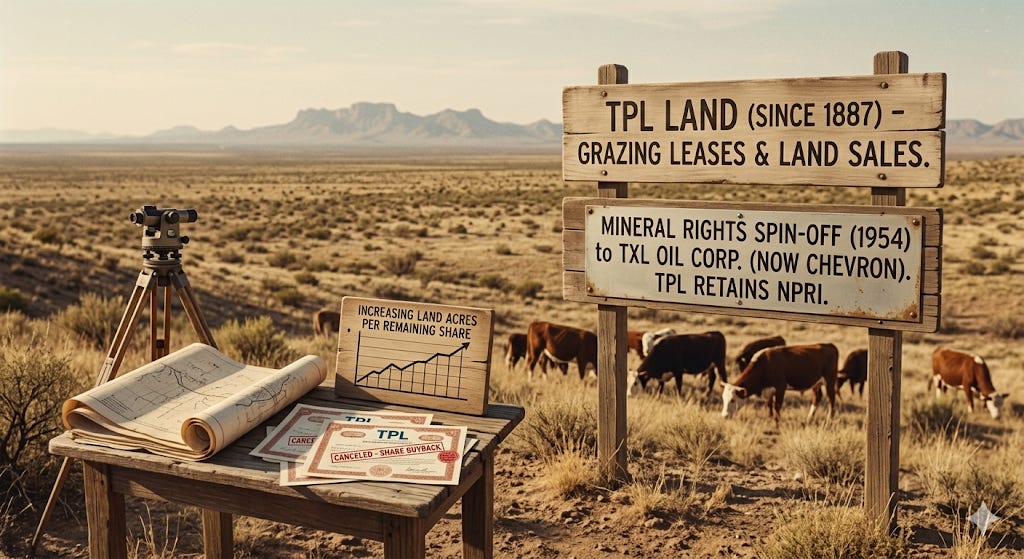
1954: TPL spins off its mineral rights into a new entity called TXL Oil Corporation. TPL retains “non-participating royalty interests” (NPRI) under much of the land but gives up the active exploration rights.
1962: Texaco (now Chevron) acquires TXL Oil. This is why Chevron is a primary operator on TPL’s acreage today.
The Buyback Strategy: During this long “quiet” period, the trustees used excess cash to relentlessly buy back and cancel shares. Because they were slowly selling land but rapidly buying back shares, the “land-per-share” ratio grew significantly for remaining owners.
2010 – Present: The Shale Revolution and Corporate Evolution
The invention of hydraulic fracturing and horizontal drilling turned TPL from a passive landholder into a “landlord of the Permian.”
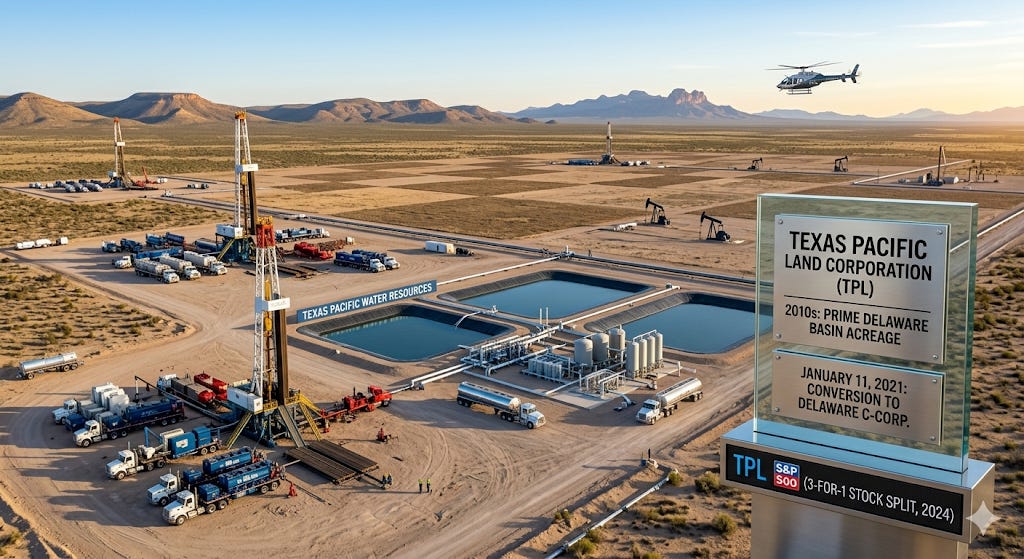
2010s: The Permian Basin becomes the most productive oil field in the U.S. TPL’s checkerboard acreage in the Delaware Basin (part of the Permian) becomes the “prime real estate” of the energy world.
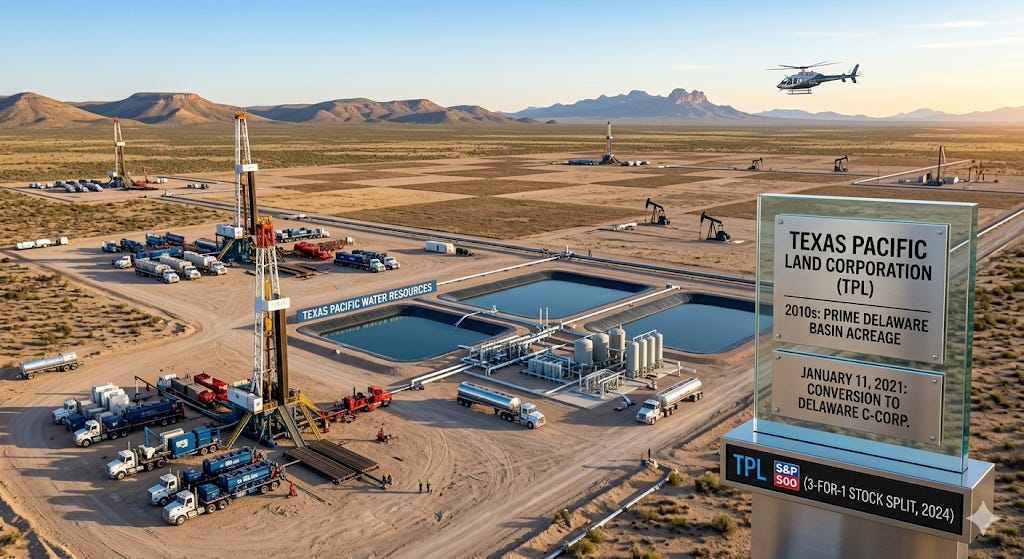
2017: TPL forms Texas Pacific Water Resources. Recognizing that fracking requires massive amounts of water, TPL begins charging operators to source water from its land and dispose of “produced water” back into it.
January 11, 2021: After a high-profile proxy battle with activist investors (including Murray Stahl and Eric Oliver) over governance, the 132-year-old Trust officially converts into a Delaware C-Corporation (Texas Pacific Land Corporation).
2024: TPL is added to the S&P 500, cementing its status as a blue-chip energy infrastructure play.
The Modern Engine: A Multi-Layered Monopoly
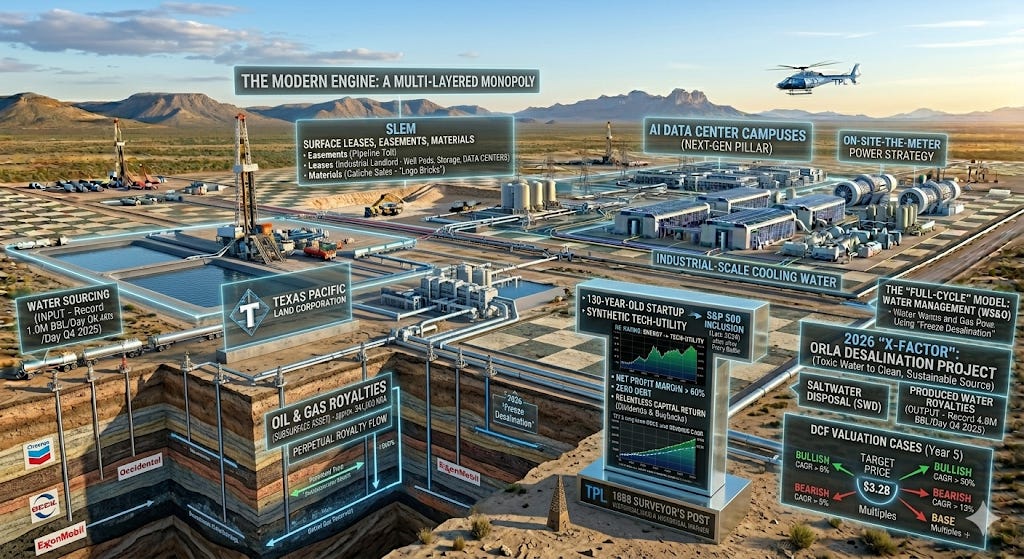
If the first century of Texas Pacific Land’s existence was defined by a slow, passive liquidation of railroad land, the modern era is defined by radical monetization. TPL has evolved from a sleepy land trust into what is effectively a synthetic tech-utility. The company no longer views its assets as mere dirt and rocks; they view their 880,000 acres as a vertical stack of high-margin opportunities. By owning the surface, the water beneath it, and the mineral rights even deeper underground, TPL has created a “closed-loop” economy where they collect a fee at every single stage of industrial activity.
Whether an operator is drilling for oil, moving gas through a pipe, recycling wastewater, or powering an AI cluster, they are likely paying TPL for the privilege. This “Whole-Acre” strategy is divided into three distinct pillars, each reinforcing the other to create a compounding machine with some of the highest margins in the S&P 500.
Oil & Gas Royalties (The Subsurface Asset)
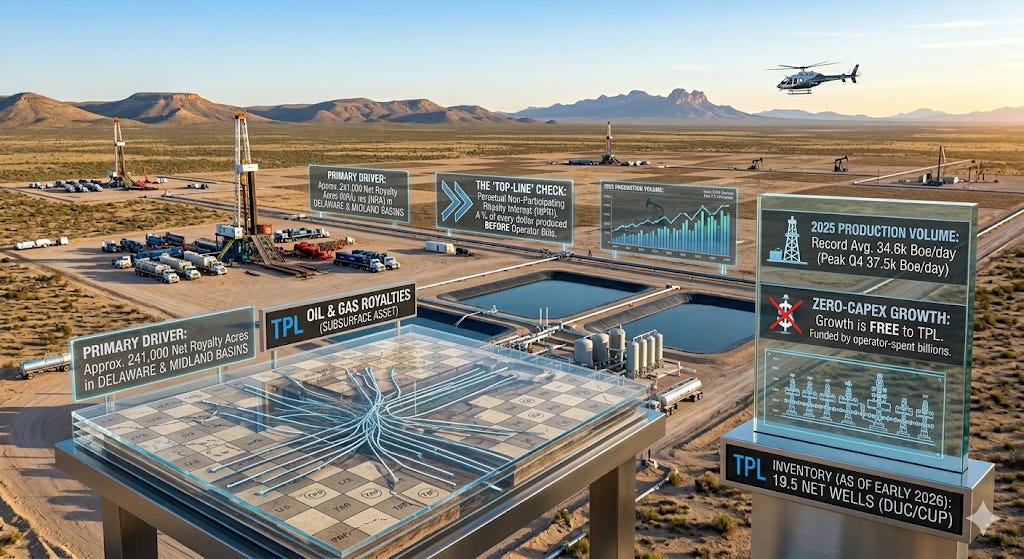
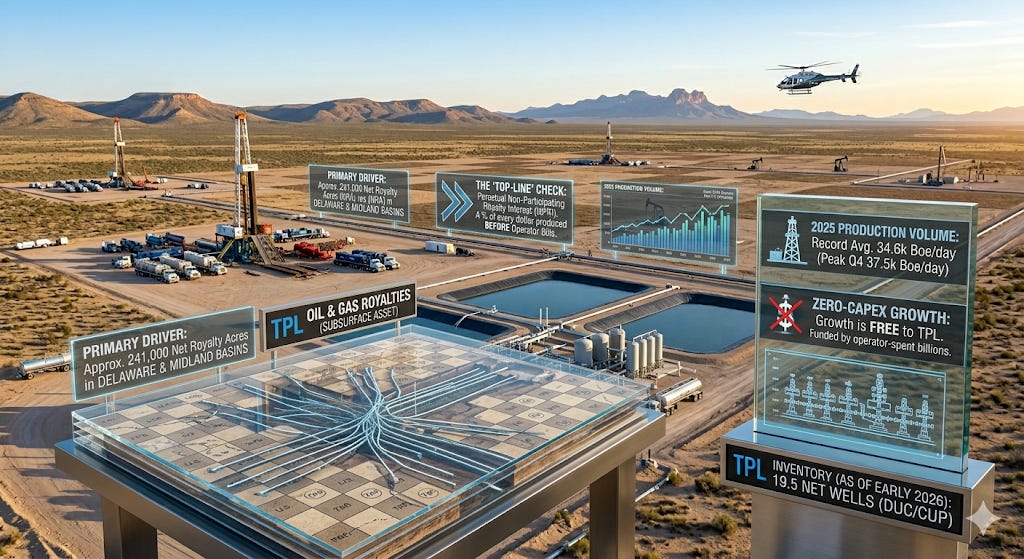
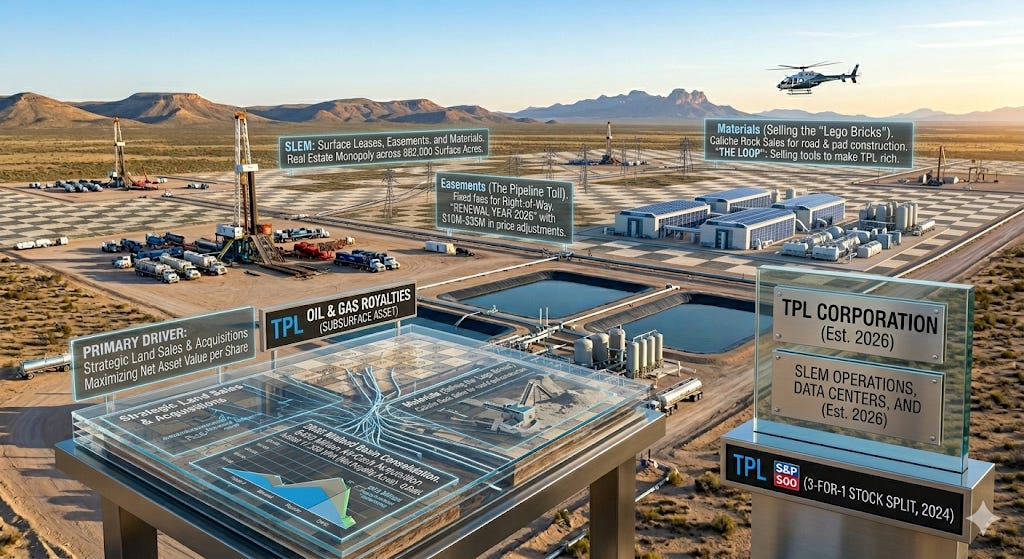
This is the segment’s primary driver. TPL owns approximately 241,000 Net Royalty Acres (NRA), primarily in the high-growth Delaware and Midland Basins of the Permian.
The “Top-Line” Check: TPL holds a Perpetual Non-Participating Royalty Interest (NPRI). This means they receive a percentage of every dollar of oil and gas produced from their land before the drilling companies (like Chevron or Occidental) even pay their own bills.
Production Volume: In 2025, TPL hit a record average production of 34.6 thousand barrels of oil equivalent (Boe) per day, peaking at 37.5 thousand Boe/day in Q4.
Zero-CapEx Growth: TPL does not pay for rigs, labor, or fracking. Their growth is entirely “free” to them, funded by the billions of dollars their tenants (the operators) spend to develop the land.
Inventory (The Pipeline): As of early 2026, TPL has a massive “shadow” inventory of future income, including 19.5 net wells currently in the “DUC” (Drilled but Uncompleted) or “CUP” (Completed but not Producing) stages.
SLEM: Surface Leases, Easements, and Materials
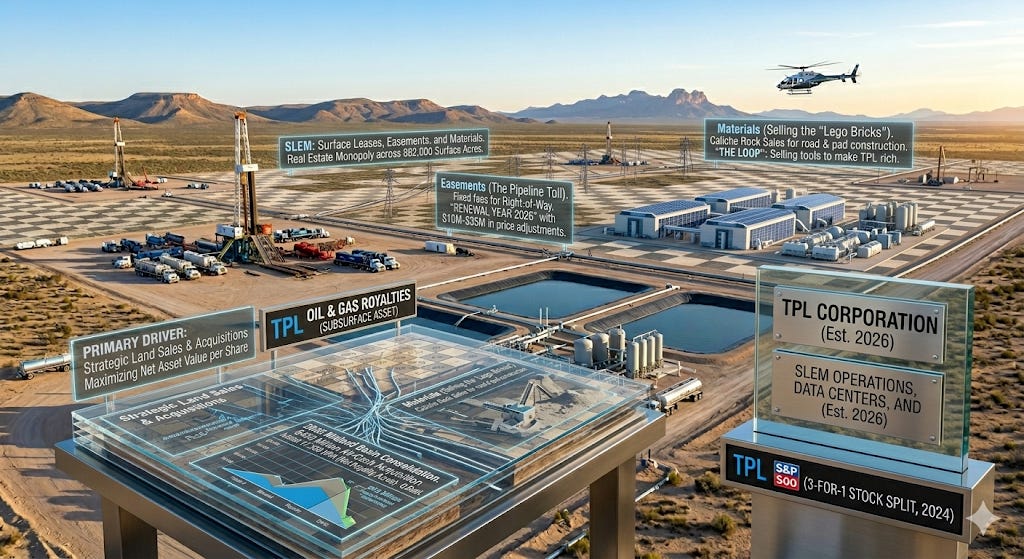
While the oil is underground, TPL also owns the surface rights to approximately 882,000 acres. They monetize the surface through a strategy they call SLEM, which functions like a real estate monopoly.
Easements (The Pipeline Toll)
If an energy company wants to move product, they almost always have to cross TPL land.
Pipeline & Power Lines: TPL charges fixed fees for the right-of-way to install oil/gas pipelines and electrical lines.
Renewal Revenue: Management recently highlighted that 2026 is a “renewal year” for many legacy contracts, which could bring in an additional $10 million to $35 million in recurring annual revenue just from price adjustments.
Leases (The Industrial Landlord)
Well Pads & Storage: Operators pay TPL for the physical space to place their equipment.
Data Centers (The 2026 Catalyst): TPL is now leasing massive tracts of land for AI Data Center campuses. Their land is ideal because it is flat, remote (low noise/security concerns), and has direct access to natural gas for on-site power generation.
Materials (Selling the “Lego Bricks”)
Caliche Sales: Caliche is a calcium-carbonate rock found on TPL’s land. It is the essential material used to build the roads and drilling pads needed for oil operations.
The Loop: TPL sells the rocks to the operators so they can build the infrastructure that eventually pays TPL a royalty. They are essentially selling the tools used to make them rich.
Strategic Land Sales & Acquisitions
TPL doesn’t just hold land; they actively manage the portfolio to maximize “net asset value” per share.
Opportunistic Sales: They occasionally sell surface land for municipal development or large-scale industrial use when the price is right.
Consolidation: In late 2025, TPL completed a massive $450 million all-cash acquisition of mineral and royalty interests in the Midland Basin. This move added 17,300 net royalty acres to their books without taking on a single dollar of debt.
The “Full-Cycle” Model: Water Management
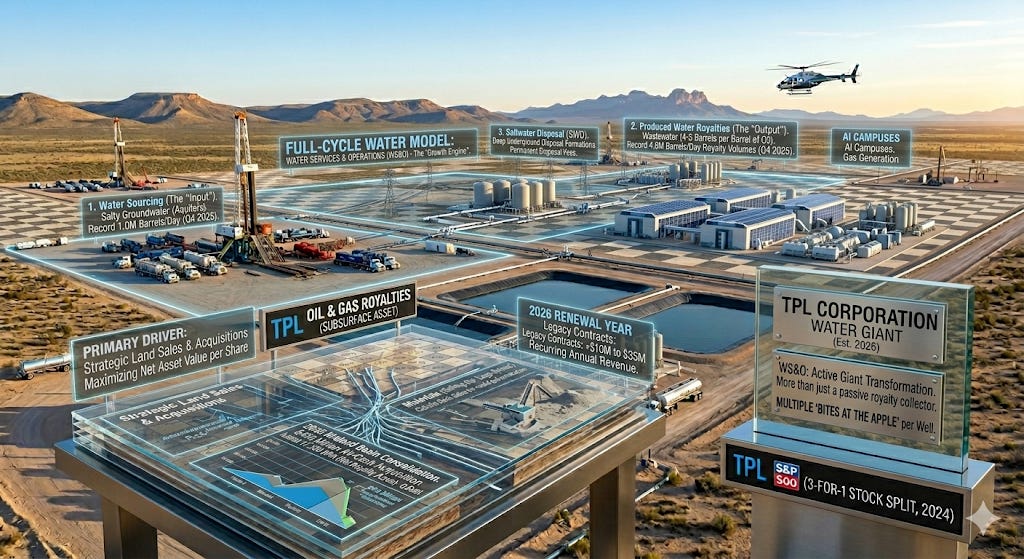
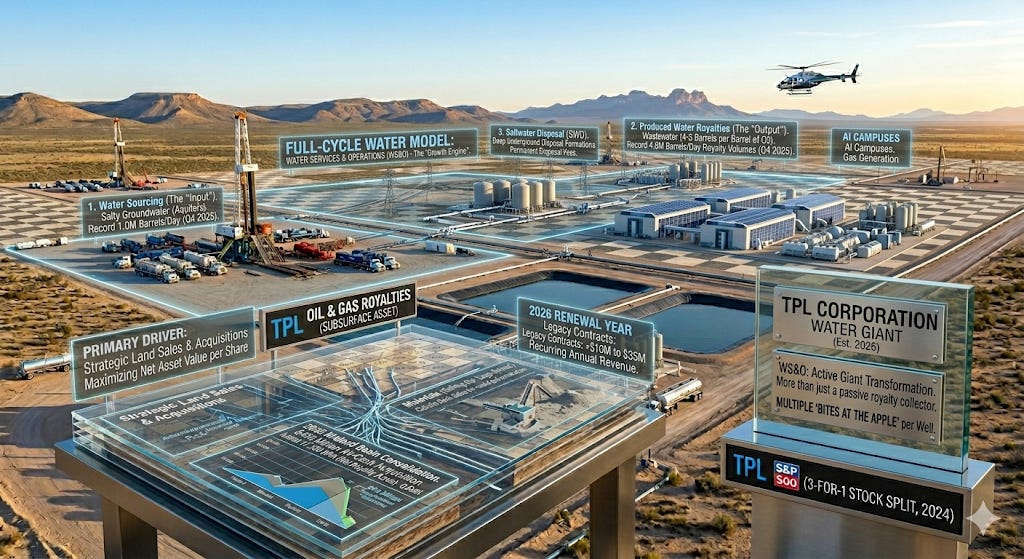
TPL doesn’t just sell water; they manage the entire lifecycle of water for oil and gas operators. This creates multiple “bites at the apple” for every well drilled on their land. While the Land & Resource Management segment is the "fortress," the Water Services & Operations (WS&O) segment is the "growth engine."this is how TPL shifted from only a passive royalty collector to an active giant.
Water Sourcing (The “Input”): Operators need massive amounts of water to frack a well (often 500,000+ barrels per well). TPL sells brackish (salty) groundwater from its own aquifers.
2025 Performance: Hit a record 1.0 million barrels per day in sales volume by Q4 2025.
Produced Water Royalties (The “Output”): For every barrel of oil that comes up, 4–5 barrels of “produced water” (salty, mineral-rich wastewater) come with it. If an operator moves or disposes of this water on TPL land, TPL collects a royalty.
2025 Performance: Produced water royalty volumes reached a record 4.8 million barrels per day in Q4.
Saltwater Disposal (SWD): TPL earns fees for the permanent disposal of this wastewater into deep underground formations.
Strategic Infrastructure & Assets
TPL has spent the last few years building a massive, “moated” physical network that competitors cannot easily replicate.
The Pipeline Network: TPL owns hundreds of miles of water pipelines. Because they also own the surface rights, they don’t have to pay for “right-of-way” easements like their competitors do, giving them a structural margin advantage.
Automation: Their systems are highly automated with Variable Frequency Drive (VFD) pumps and real-time monitoring. This allows them to shut off production instantly to protect aquifers or respond to grid demand.
Storage & Logistics: They maintain massive “frack ponds” and storage facilities that act as a buffer, ensuring they can meet the high-volume spikes in demand when a major operator starts a “zipper frack” (simultaneous fracking of multiple wells).
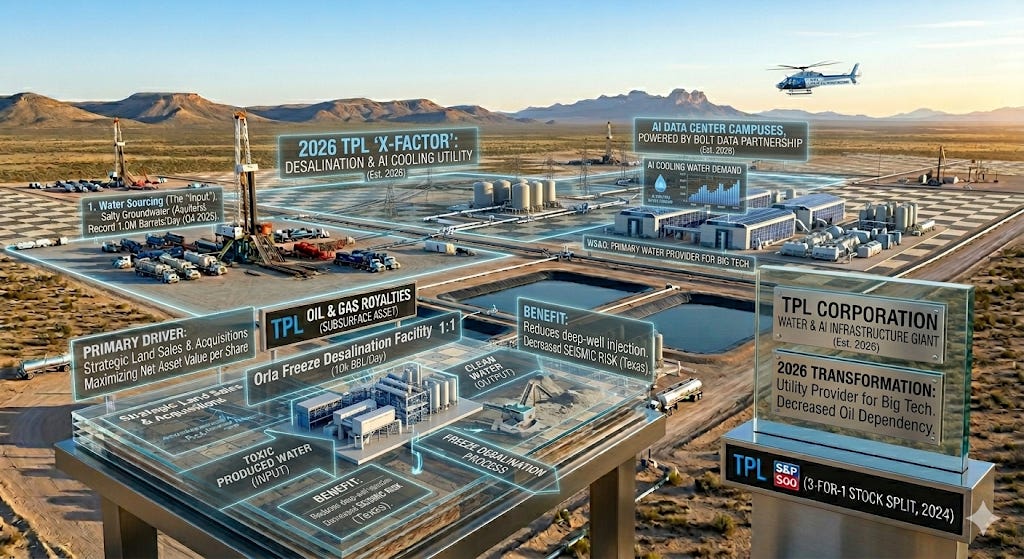
The 2026 “X-Factor”: Desalination & AI Cooling
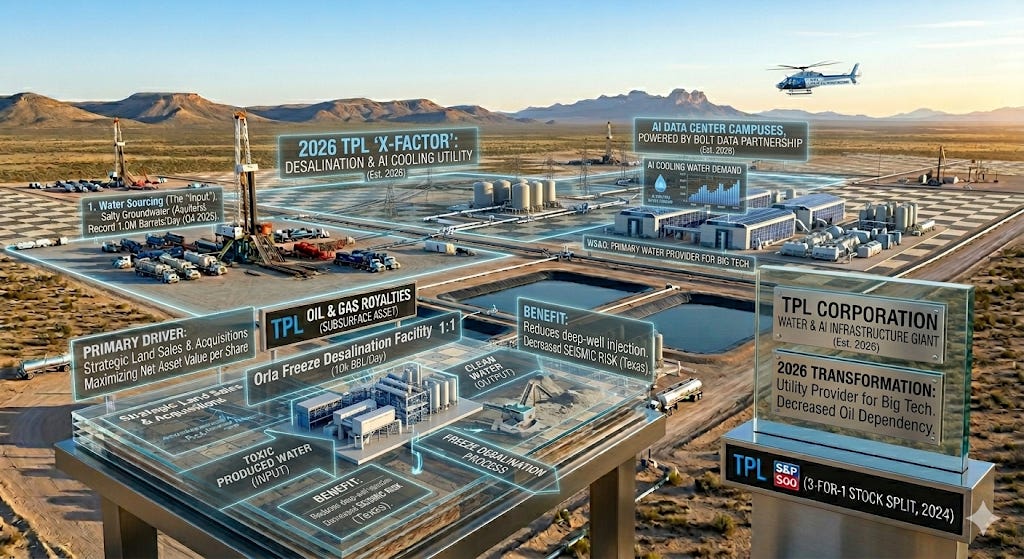
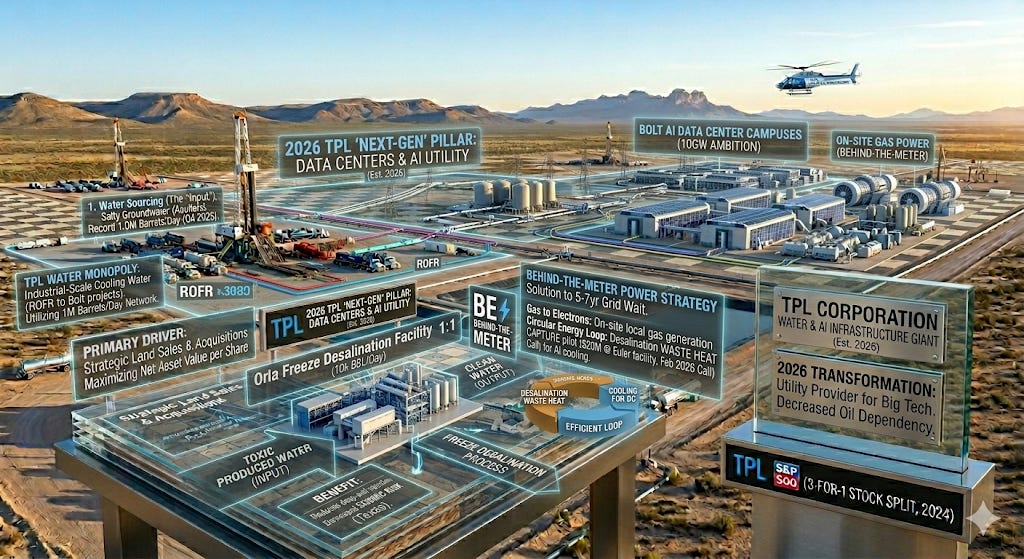
The Orla Desalination Project: TPL is commissioning a 10,000 barrel-per-day facility in Orla, Texas. Using “freeze desalination,” they can turn toxic produced water into clean water.
The Benefit: This reduces the need for deep-well injection (which has been linked to small earthquakes in Texas) and provides a sustainable water source for the desert.
The AI Connection: Data centers require millions of gallons of water for cooling. As TPL builds out its AI Data Center campuses (via the Bolt Data partnership), the WS&O segment will likely become the primary water provider for these facilities.
This transforms the segment from being 100% dependent on oil fracking to being a utility provider for Big Tech.
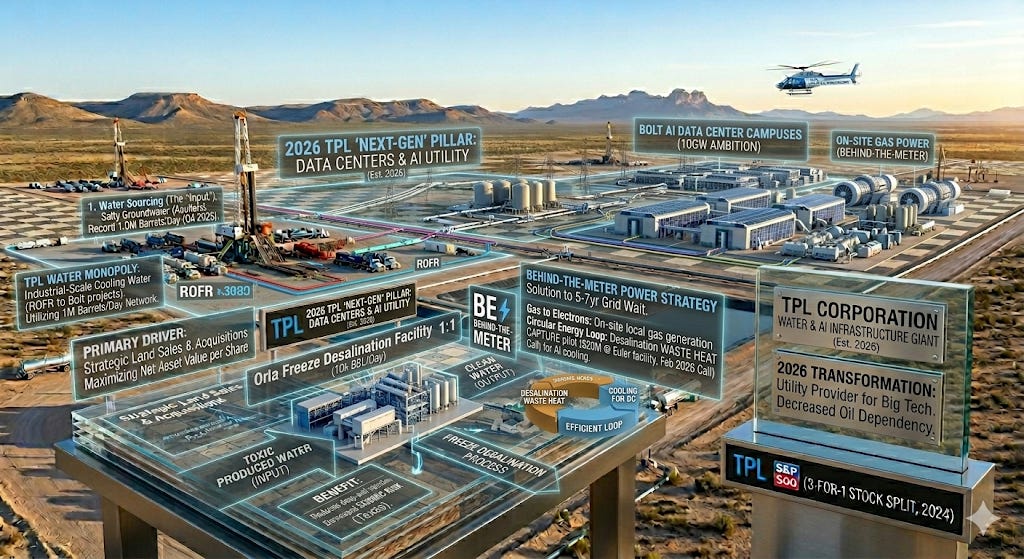
The “Next-Gen” Pillar: Data Centers & AI
As of March 2026, this is no longer just a theoretical project. TPL is actively moving to leverage its 880,000 acres to solve the #1 bottleneck for AI: Power Density.
The Bolt Data & Energy Partnership
In late 2025, TPL made a massive strategic pivot by investing $50 million into Bolt Data & Energy, an AI infrastructure startup chaired by former Google CEO Eric Schmidt.
The Vision: To build the “largest and most efficient data center network in the world” directly in West Texas.
The Scale: Bolt has publicly stated ambitions to develop up to 10 gigawatts of data center capacity on TPL land. For perspective, 1 gigawatt can power roughly 750,000 homes.
The Economics: TPL doesn’t just collect rent. Under this deal, TPL receives equity interests and warrants in Bolt, meaning they have a direct stake in the upside of the data center business itself.
The “Behind-the-Meter” Power Strategy
The biggest challenge for data centers today is waiting 5–7 years for a grid connection (ERCOT). TPL is bypassing this:
Natural Gas to Electrons: TPL land sits on top of enormous, low-cost natural gas reserves. By placing data centers “behind-the-meter,” they can use local gas to generate electricity on-site, bringing data centers online in a fraction of the time.
Waste Heat Capture: In their February 2026 earnings call, management announced a $20 million pilot project at their Euler facility. They are testing “waste heat capture” from their desalination process to cool data centers, creating a highly efficient, circular energy loop.
The Water Monopoly (Cooling)
Every AI chip generates heat that requires cooling. TPL has the Right of First Refusal (ROFR) to provide water to all Bolt-affiliated projects.
Because TPL already sells 1 million barrels of water per day, they have the existing pipe network to provide industrial-scale cooling water that other West Texas landowners simply cannot provide.
The Leadership: From Trustees to Operators
For over 130 years, TPL was managed by “Trustees” whose primary job was to not mess anything up. Today, it is run by a lean team of 114 employees led by executives who treat the land as an active capital allocation platform.
Tyler Glover: President and CEO
Tyler “Ty” Glover is the architect of the modern TPL. A native of Midland, Texas, he has over 17 years of experience in Permian Basin land management and energy services.
The “Water” Visionary: Before becoming CEO of the entire corporation, Glover was the founding CEO of Texas Pacific Water Resources. He essentially built TPL’s second-largest revenue stream from scratch starting in 2017.
Leadership Style: Glover is known for a “boots on the ground” pragmatic style. He moved the company away from the legacy trust mindset (which was essentially a liquidation vehicle) toward an “Active Management” model.
Compensation Alignment: His compensation is heavily weighted (roughly 88%) toward bonuses and stock options, aligning his personal net worth directly with share price performance. As of 2026, he remains one of the largest individual insiders, owning over $23 million in TPL stock.
Chris Steddum: Chief Financial Officer
If Glover is the operator, Steddum is the capital allocator. With a background in investment banking at Credit Suisse and Stifel, Steddum has brought “Wall Street discipline” to a company that used to keep its records in ledger books.
The “Fortress” Architect: Under Steddum, TPL has maintained a zero-debt balance sheet while simultaneously spending nearly $1 billion on acquisitions and special dividends over the last two years.
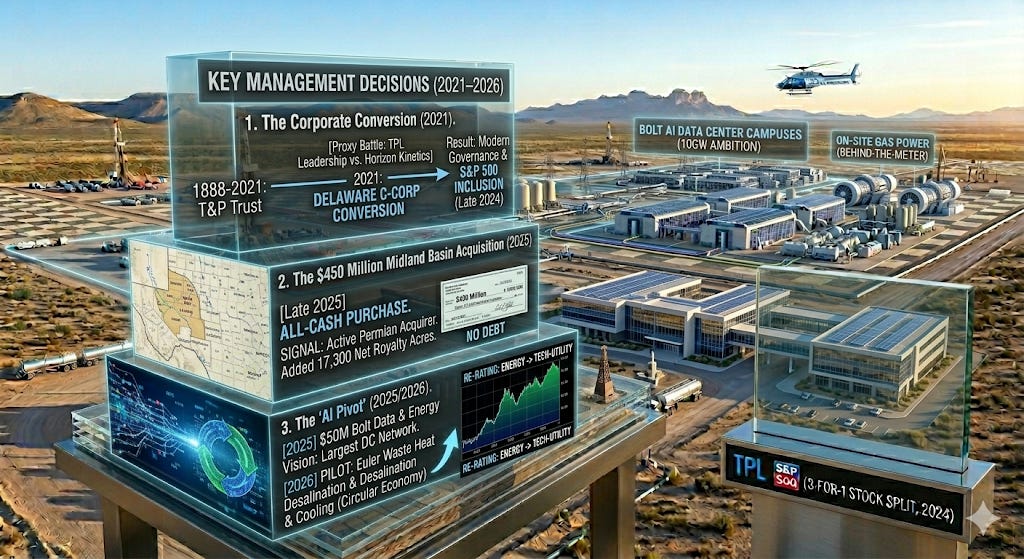
Key Management Decisions (2021–2026)
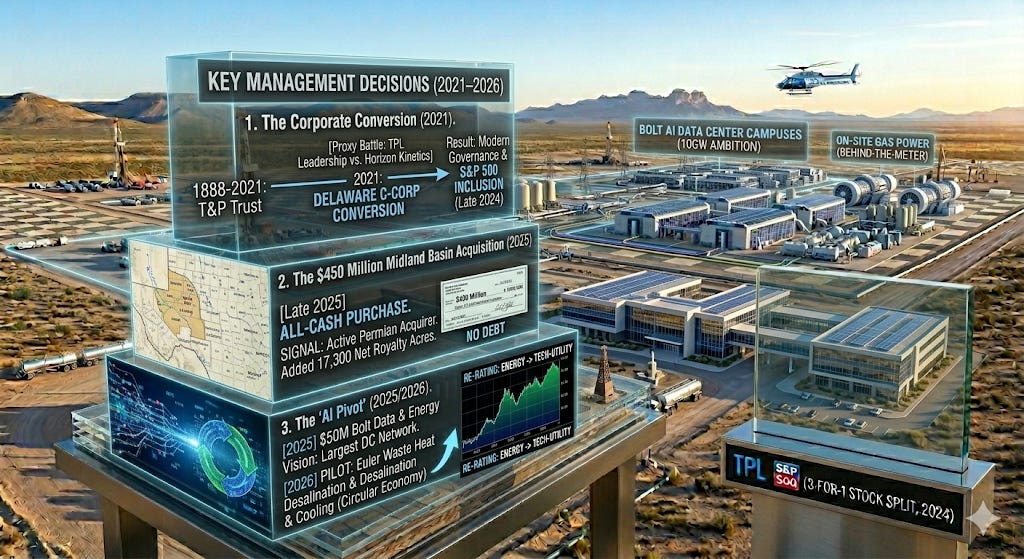
1. The Corporate Conversion (2021)
Perhaps the most significant decision in the company’s 130-year history. After a fierce proxy battle with activist investors (led by Horizon Kinetics), the leadership team agreed to convert from a Trust to a Delaware C-Corp.
The Impact: This allowed TPL to be included in major indices like the S&P 500 (joined in late 2024), which forced massive institutional buying and gave the company a modern governance structure.
2. The $450 Million Midland Basin Acquisition (2025)
In late 2025, management made their largest acquisition to date: an all-cash purchase of 17,300 net royalty acres in the Midland Basin.
The Big Move: By doing this in cash without taking on debt, they signaled to the market that TPL is no longer just “holding” its original 1888 land grant—it is an active acquirer of Permian acreage.
3. The “AI Pivot” (2025/2026)
The decision to invest $50 million in Bolt Data & Energy and pilot the Euler “Waste Heat” facility transformed the narrative of the company.
The Strategy: Leadership recognized that while oil is profitable, data infrastructure commands a much higher valuation multiple (P/E). They are successfully re-rating the stock from an “Energy” company to a “Tech-Utility.”
Governance & Investor Relations
TPL’s management team has historically been “quiet,” but as of 2026, they have significantly ramped up transparency.
Stockholder Engagement: Following years of friction, the board now includes activists like Eric Oliver and Murray Stahl, ensuring that shareholder interests (specifically regarding buybacks and dividends) are always at the forefront of the conversation.
The 3-for-1 Split (2024): A move widely seen as a “retail-friendly” decision to improve liquidity and accessibility for individual investors.
Note: The current team has successfully “unlocked the value” of a legacy asset. They are running a 130-year-old portfolio with the speed and capital efficiency of a modern private equity firm.