

In an equity market hyper-focused on software and sexier technology verticals, high-conviction alpha often hides in the unlikeliest of places—like the municipal bus depot. Blue Bird Corporation (NASDAQ: BLBD), a century-old industrial manufacturer born during the onset of the Great Depression, is undergoing a profound structural metamorphosis. Long dismissed as a cyclical, low-margin assembler of traditional diesel school buses, the company has quietly engineered a proprietary engineering moat that places it at the vanguard of the commercial clean-energy transition. Backed by massive regulatory tailwinds, a radically de-risked balance sheet, and a fresh leadership team hyper-focused on automated execution, Blue Bird is no longer just building student transport; it is scaling a high-margin, asset-right EV and alternative-fuel platform. This deep dive untangles Blue Bird’s historic operational turnaround, maps its modern product architecture against a consolidated competitive landscape, and breaks down the numbers to see if today’s market price offers a true margin of safety for compounding investors.
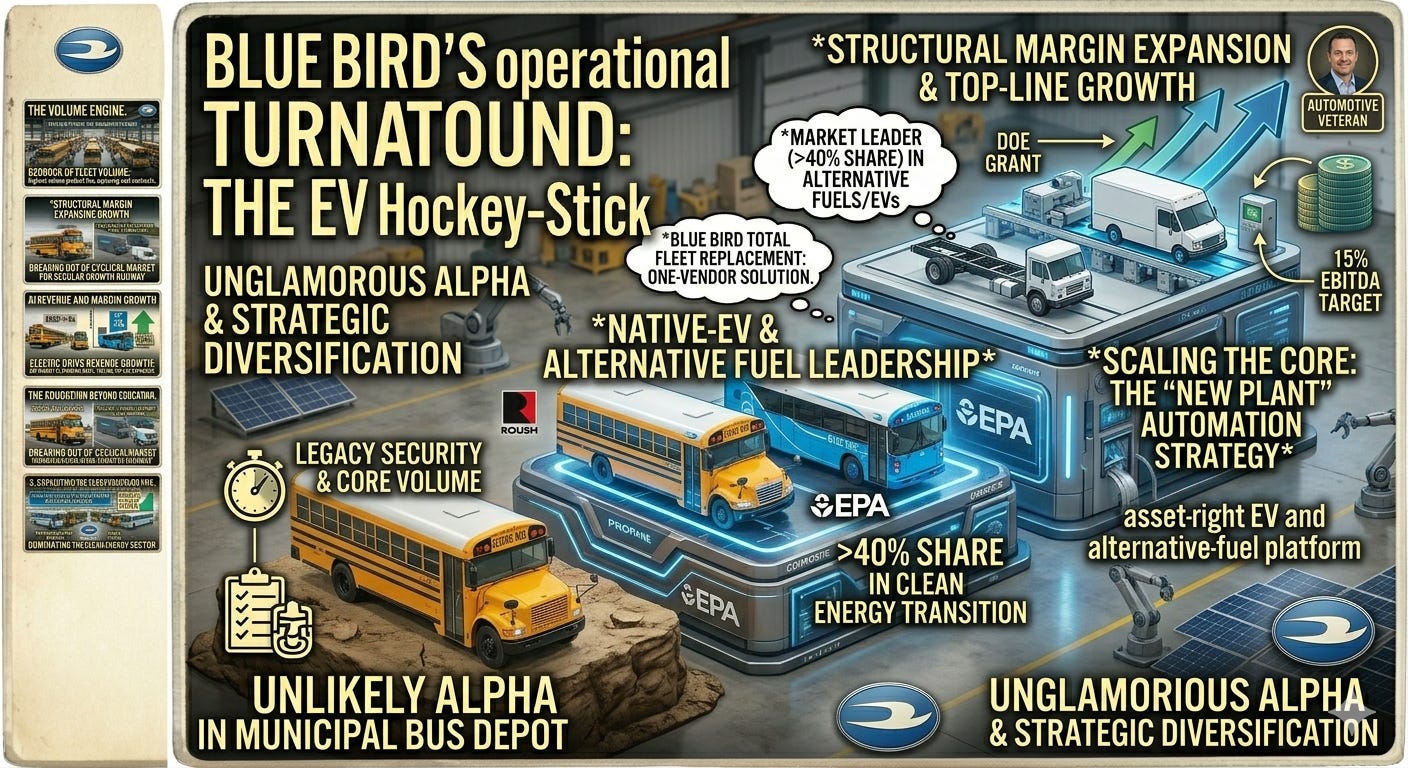
Table of Contents
📊 Base Case: Order Backlog Execution & Steady Alternative-Fuel Adoption
🐂 Bull Case: The EV Hockey-Stick & Commercial TAM Breakthrough
Blue Bird Corporation: Company History
Blue Bird’s history is a story of safety-driven innovation and structural evolution. Founded during the onset of the Great Depression, the company has grown from a regional operations workshop in rural Georgia into one of North America’s premier school bus manufacturers.
The Foundered Beginnings & The Safety Pivot (1927–1940s)
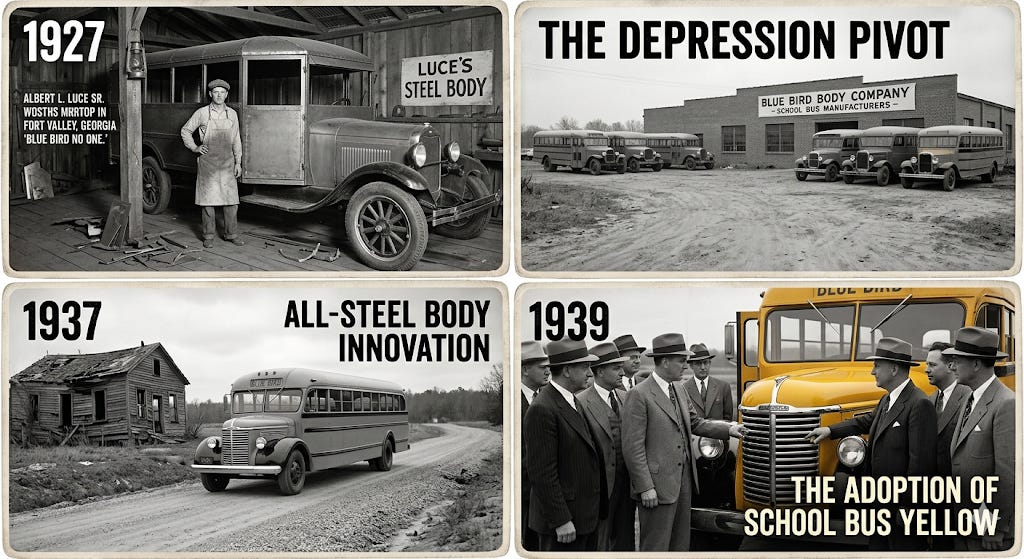
In 1925, Albert L. Luce Sr., a Ford dealership owner in Fort Valley, Georgia, sold a customer a Ford Model T adapted with a wooden bus body to transport workers. The rough, unimproved rural roads rapidly deteriorated the wooden frame before the customer even finished paying for it. Driven to engineer a more robust alternative, Luce constructed a bus body made of steel angles and sheet metal. Completed in 1927, this vehicle became retroactively known as “Blue Bird Number One.”
As car sales plummeted by 95% during the Great Depression, Luce sold his dealerships and invested his remaining $12,000 to pivot entirely into bus manufacturing. He correctly anticipated that the post-Depression era would bring school consolidations, requiring institutional student transportation.
The 1937 Safety Innovation: Blue Bird introduced the industry’s first all-steel bus body, a revolutionary upgrade that rendered wooden bodies obsolete and established safety as the core value proposition of the Blue Bird brand.
Standardizing the Industry (1939): Blue Bird engineers participated in the 1939 industry conference that established “School Bus Yellow” as the definitive safety standard across the United States.
Post-War Scaling & The Luce Family Era (1950s–1980s)
Following World War II, the nationwide consolidation of one-room schoolhouses into larger school districts created massive demand for high-capacity pupil transit. After attending the 1948 Paris Auto Show, Luce was inspired by European transit designs. This led to the 1952 commercial launch of the Blue Bird All American—a forward-control (transit-style) Type D bus that maximized passenger capacity and driver visibility. The All American would become the longest-surviving transit-style school bus model in American history.
The Luce family retained strict operational control until 1984, steering the company into geographic expansion (opening plants in Iowa, Canada, and Mexico) and product diversification, such as entering the luxury recreational vehicle market with the Wanderlodge motorhome in 1963.
Ownership Transitions & Alternative Fuel Pioneering (1990s–2010s)
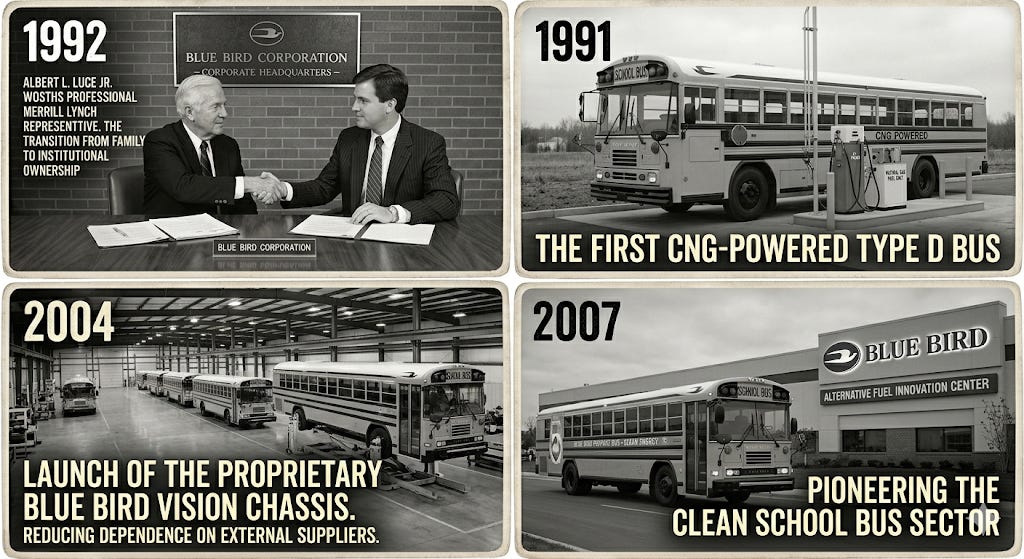
The 1990s marked the end of family control and the beginning of institutional ownership. In 1992, the family sold the company to Merrill Lynch Capital Partners for an estimated $397 million, changing the name from Blue Bird Body Company to Blue Bird Corporation.
Financially disciplined under corporate ownership, Blue Bird streamlined its manufacturing, closed legacy facilities, and focused heavily on proprietary engineering. Crucially, this era laid the groundwork for Blue Bird’s modern competitive moat: Alternative Fuels.
1991: Introduced the first Compressed Natural Gas (CNG) powered Type D school bus.
1994: Developed its first experimental battery-powered electric school bus in partnership with Westinghouse.
2004: Launched the Blue Bird Vision, a conventional Type C school bus built on a purpose-built, proprietary chassis rather than relying on commercial truck chassis suppliers like Navistar or Freightliner.
Institutional Consolidation, the SPAC IPO, and the EV Paradigm Shift (2004–Present)
The modern era of Blue Bird Corporation is defined by its transition away from traditional, low-margin diesel engines toward high-margin alternative fuels and electric vehicle (EV) powertrains. By establishing proprietary architecture early on, Blue Bird insulated itself from standard truck-chassis supply chains, enabling the company to capture massive federal and state clean-energy subsidies.
The Proprietary Chassis and Private Equity Carousel (2004–2014)
The launch of the Blue Bird Vision in 2004 fundamentally altered the company’s manufacturing economics. Rather than relying on third-party commercial chassis suppliers like Navistar or Freightliner—which compressed margins and subjected the company to external supply bottlenecks—Blue Bird began building its Type C buses on a proprietary, in-house chassis. This vertical integration drastically lowered production costs and gave Blue Bird full control over powertrain configuration.
This manufacturing edge caught the attention of institutional investors during a turbulent financial period. Following a brief Chapter 11 restructuring in 2006 to shed legacy debt, Cerberus Capital Management acquired the company. Cerberus implemented strict operational discipline, divesting non-core assets like the luxury Wanderlodge motorhome line to hyper-focus on the core pupil-transportation market. Under this regime, Blue Bird capitalized on a critical partnership with ROUSH CleanTech in 2012 to pioneer propane-autogas powered school buses, capturing an early lead in the alternative-fuel market.
The Public Markets and EV First-Mover Advantage (2015–2021)
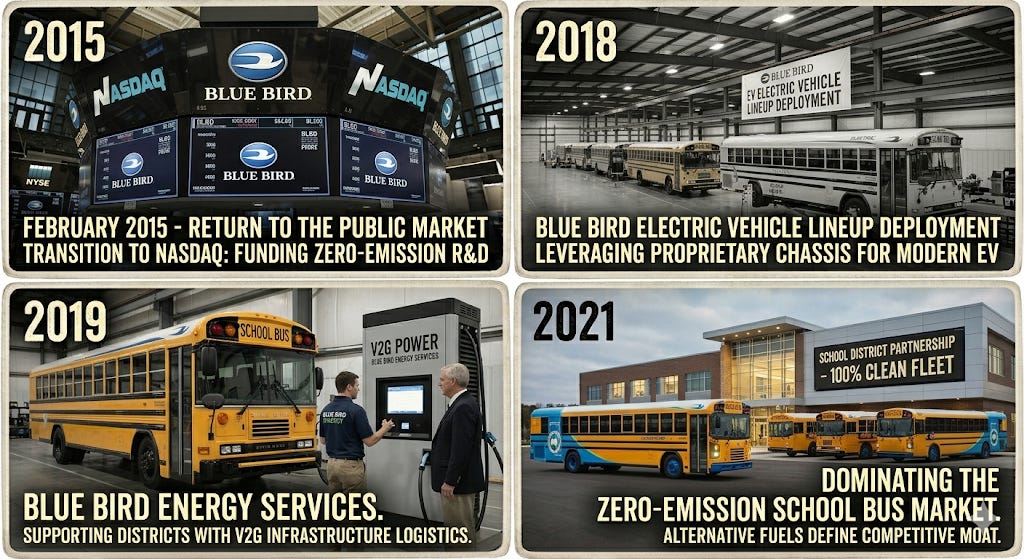
In February 2015, Blue Bird transitioned back to the public markets through a spin-off merger with Hennessy Capital Acquisition Corp., debuting on the NASDAQ under the ticker BLBD. Going public gave Blue Bird the liquidity and capital structure required to fund heavy R&D into zero-emission technologies.
While competitors continued to prioritize legacy diesel engines, Blue Bird leveraged its proprietary Vision and All American chassis to deploy its modern, commercial-grade electric vehicle (EV) lineup in 2018. The company built an ecosystem around its buses, establishing “Blue Bird Energy Services” to assist cash-strapped school districts with the daunting logistics of vehicle-to-grid (V2G) charging infrastructure. By 2021, alternative-fuel and electric options grew to represent a massive portion of the company’s order mix, establishing a distinct competitive moat.
The Macro Headwinds, Regulatory Tailwind, and Full Integration (2022–Present)
The post-pandemic era initially brought severe supply-chain constraints and raw-material inflation, but it also triggered the largest legislative tailwind in the history of student transportation: the EPA’s $5 billion Clean School Bus Program. As federal funding poured into school districts to replace aging diesel fleets, Blue Bird’s order backlog surged.
To streamline production and capture higher margins, the company underwent key structural and leadership evolutions:
EV Supply Chain Scaling: Blue Bird opened a dedicated Electric Vehicle Innovation Center in Fort Valley, Georgia, expanding its capacity to output up to 4,000 electric school buses annually.
Leadership Transition: In February 2025, automotive and manufacturing veteran John Wyskiel took over as President and CEO. Tasked with driving operational excellence, Wyskiel focused heavily on optimizing factory throughput, managing tariff-related cost pressures, and scaling up the company’s commercial vehicle footprint.
Full Integration of Micro Bird: In April 2026, Blue Bird closed a landmark $201.8 million acquisition to purchase the remaining 50% of its Micro Bird joint venture. This move fully consolidated Type A short-bus and commercial shuttle operations under one corporate umbrella, eliminating equity-method friction and widening their total addressable market (TAM) with Buy America-compliant vehicles.
Moving through 2026, Blue Bird routinely records alternative-fuel configurations (Propane, CNG, and EV) at over 60% of its total unit sales—a stark contrast to legacy peers whose mixes remain heavily weighted toward diesel. Backed by an active backlog of thousands of buses and record-high Adjusted EBITDA margins hovering around 15%, the century-old manufacturer operates as a highly specialized, clean-energy mobility company.
Blue Bird Product Portfolio
Blue Bird separates its product lines into three traditional school bus types alongside a newly launched commercial segment. For context on the overall business, over 60% of Blue Bird’s total unit sales are non-diesel (Propane, CNG, and Electric). This alternative-fuel dominance is Blue Bird’s core differentiator, as legacy competitors remain heavily dependent on low-margin diesel engines (which typically make up 80-90% of competitors’ sales volumes).
Type C (Conventional): The Blue Bird Vision
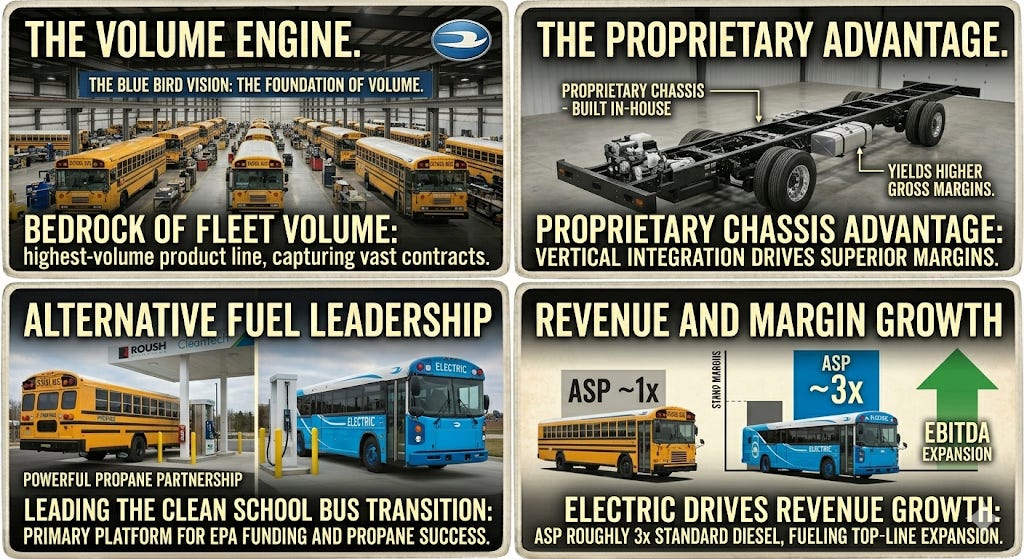
Overview: The “traditional” school bus with a prominent front hood. It accommodates 36 to 83 passengers and represents the absolute bedrock of Blue Bird’s fleet volume.
Powertrain Availability: Diesel, Propane, Gasoline, and Electric (EV).
Importance to Sales & Growth (The Volume Engine):
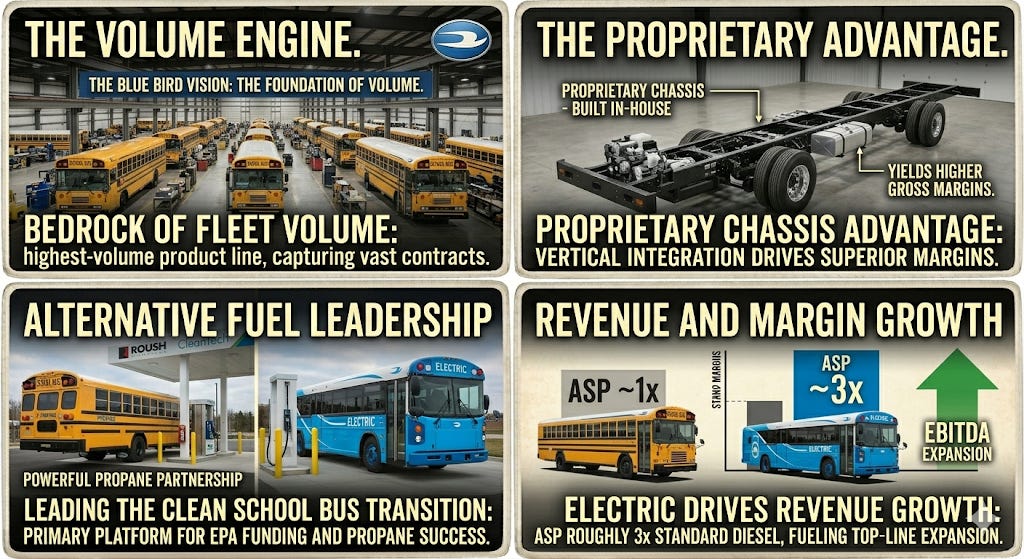
Core Volume: The Vision is the highest-volume product line for Blue Bird. It captures the vast majority of standard suburban and rural school district contracts across North America.
Alternative Fuel Leadership: This model is the primary vehicle for Blue Bird’s highly profitable partnership with ROUSH CleanTech for Propane-autogas configurations and acts as the primary platform for the EPA’s Clean School Bus Program funding.
Margin Profiles: Built on Blue Bird’s proprietary chassis, the Vision yields significantly higher gross margins than competitors’ conventional buses because Blue Bird doesn’t have to outsource the chassis. The Electric Vision commands an Average Selling Price (ASP) roughly 3x higher than a standard diesel bus, making it a powerful driver of top-line revenue growth and EBITDA expansion.
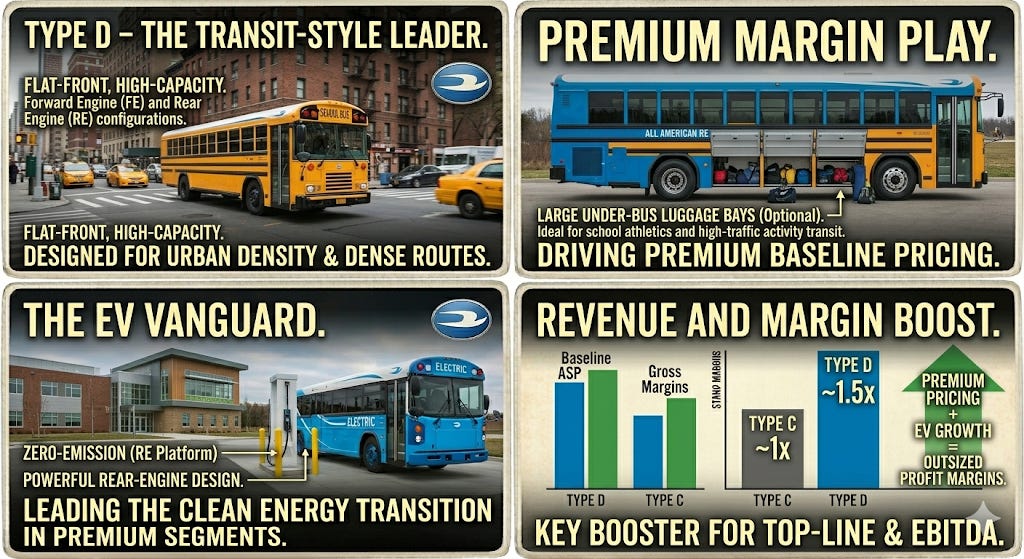
Type D (Transit-Style): The Blue Bird All American
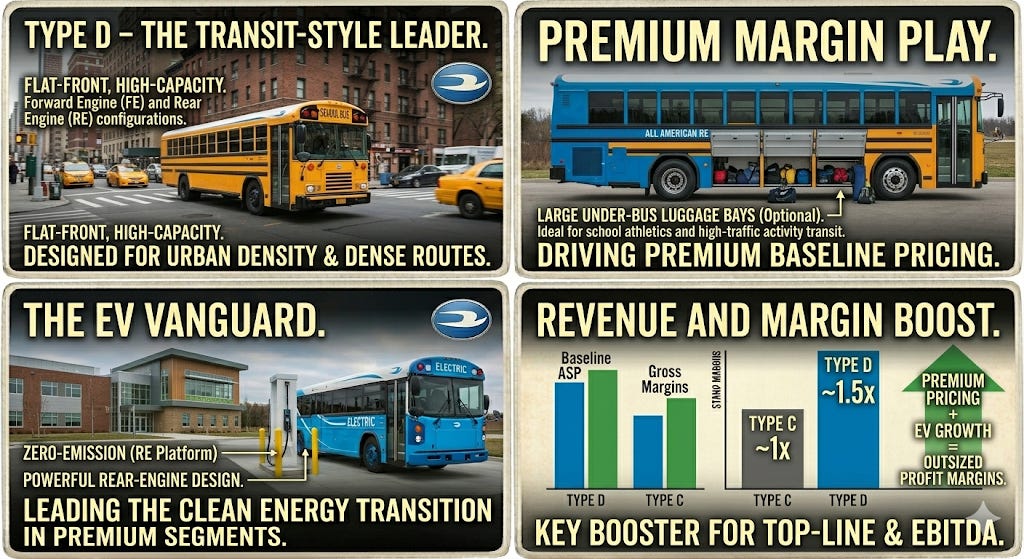
Overview: A flat-front, high-capacity bus designed like a public transit vehicle. It is offered in two configurations: Forward Engine (FE) (54–90 passengers) and Rear Engine (RE) (66–84 passengers).
Powertrain Availability: Diesel (FE/RE), CNG (RE), and Electric (RE).
Importance to Sales & Growth (The Premium Margin Play):
High-Density & Activity Routes: Type D buses are heavily utilized by dense urban school districts, high-traffic corridors, and for school athletics/activity transit due to their high passenger capacity and optional large under-bus luggage bays.
Premium Pricing (ASP Booster): Because they are larger and structurally more complex, Type D buses command premium baseline pricing over Type C buses.
The EV Vanguard: The Rear Engine (RE) Electric All American serves as a premium zero-emission vehicle. It is particularly popular with wealthy metropolitan school districts and states with strict climate mandates (e.g., California, New York), driving outsized profit margins due to the complex, heavy-duty nature of the platform.
Type A (Short Bus): The Micro Bird (by Girardin)
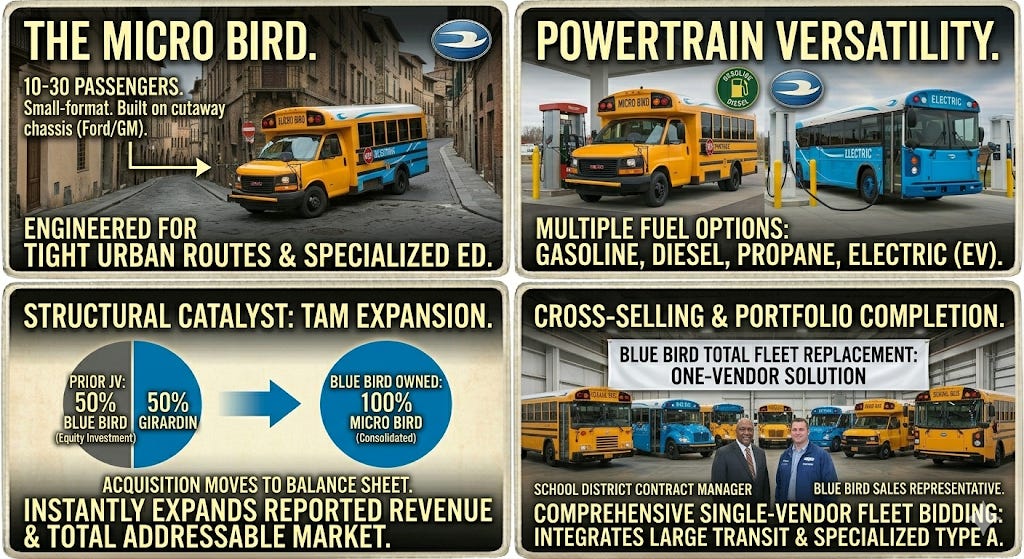
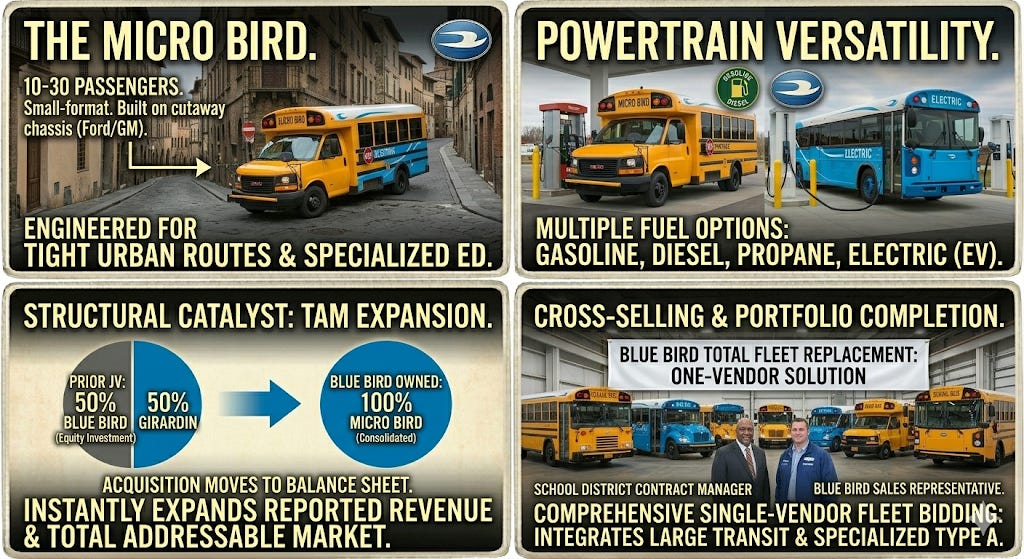
Overview: Small-format buses designed for 10 to 30 passengers, built upon cutaway commercial vehicle frames (such as Ford or GM chassis). They are engineered for specialized education, small-scale municipal transit, and tight urban routes.
Powertrain Availability: Gasoline, Diesel, Propane, and Electric.
Importance to Sales & Growth (The Total Addressable Market Expansion):
Recent Structural Catalyst: Previously operated as a 50/50 joint venture, Blue Bird closed a $201.8 million acquisition to buy out the remaining 50% of Micro Bird. This moves the unit from an “equity-method investment” directly onto the consolidated balance sheet, instantly expanding Blue Bird’s reported revenue and total addressable market (TAM).
Cross-Selling & Portfolio Completion: Having full control of the Micro Bird portfolio allows Blue Bird to bid on comprehensive, single-vendor fleet replacement contracts for major school districts that require a mix of large transit buses and specialized Type A special-education vehicles.
The Emerging Segment: Blue Bird Commercial EV Chassis
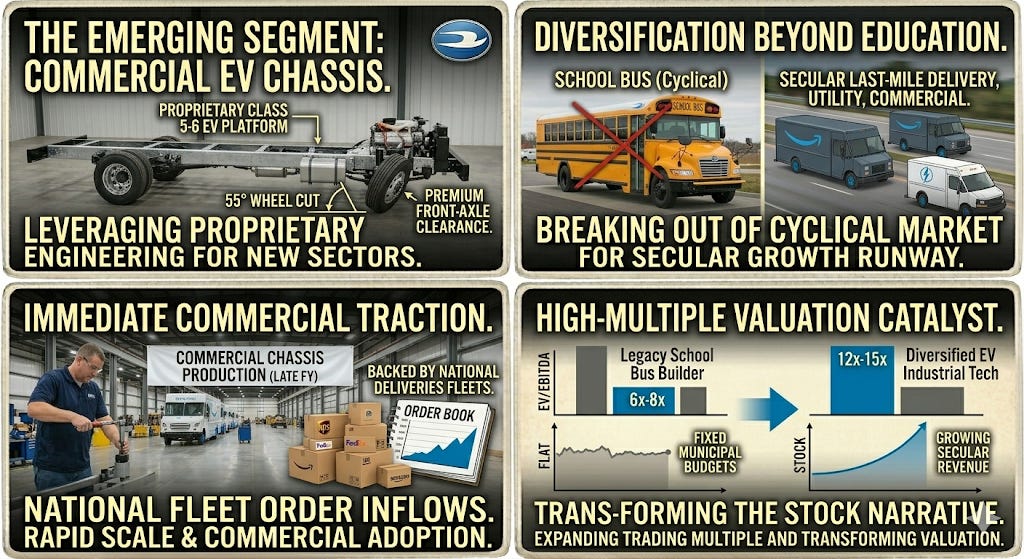
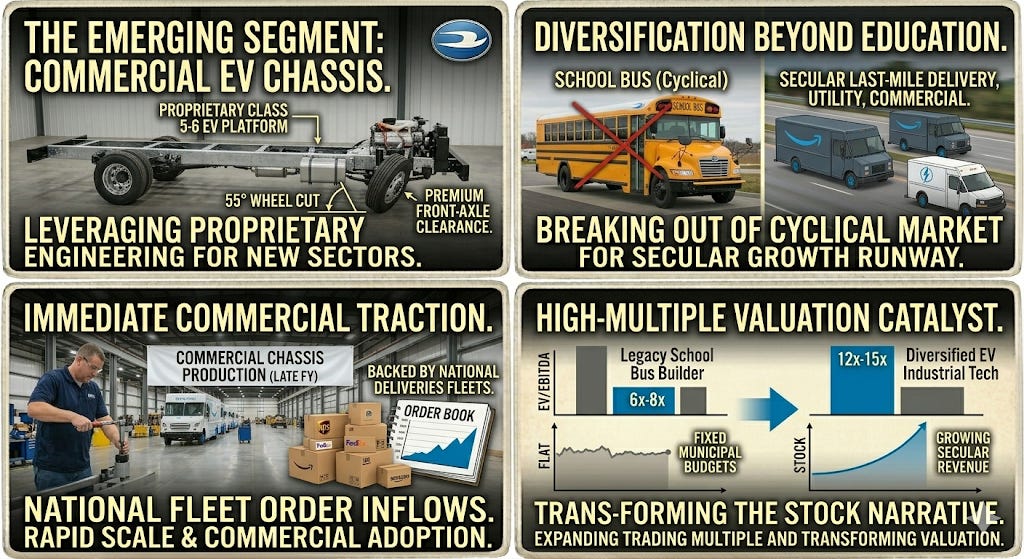
Overview: Leveraging their proprietary Class 5-6 electric vehicle platform, Blue Bird introduced a dedicated commercial chassis featuring a 55° wheel cut, galvanized frame rails, and premium front-axle clearance.
Powertrain Availability: Propane and Electric.
Importance to Sales & Growth (The Growth Runway Beyond Education):
Diversification Away from Pupil Transit: This represents Blue Bird’s play to break out of the highly cyclical school bus market and enter the secular last-mile delivery, utility, and commercial step-van industries.
Immediate Commercial Traction: Production begins late in the fiscal year, backed by order inflows from national commercial delivery fleets.
High-Multiple Valuation Catalyst: Wall Street historically values pure-play school bus manufacturers at lower EV/EBITDA multiples due to fixed municipal budgets. Successfully scaling this commercial chassis segment can expand Blue Bird’s trading multiple, transforming the stock’s narrative from a “legacy school bus builder” into a “diversified EV industrial tech provider.”
The Competitive Landscape & Market Share Dynamics
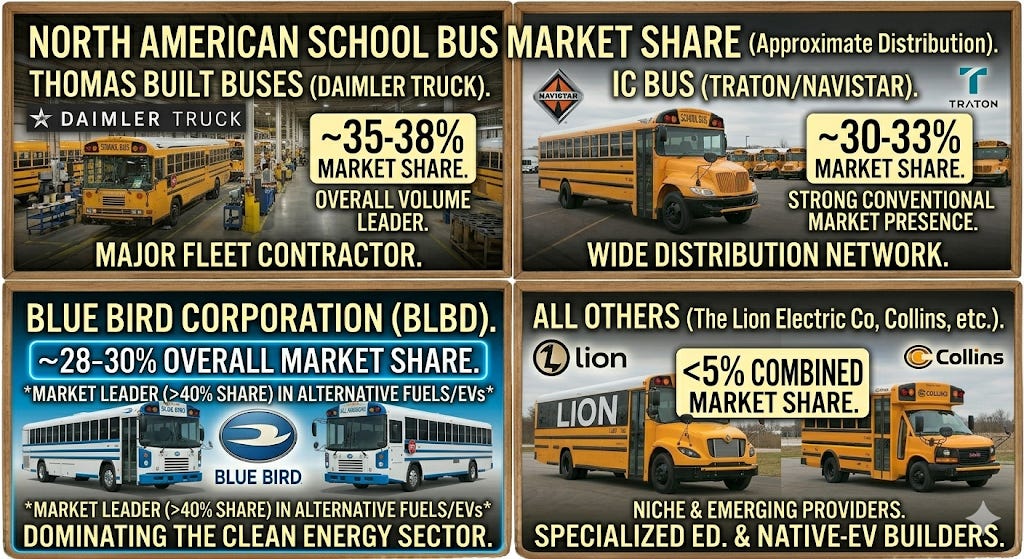
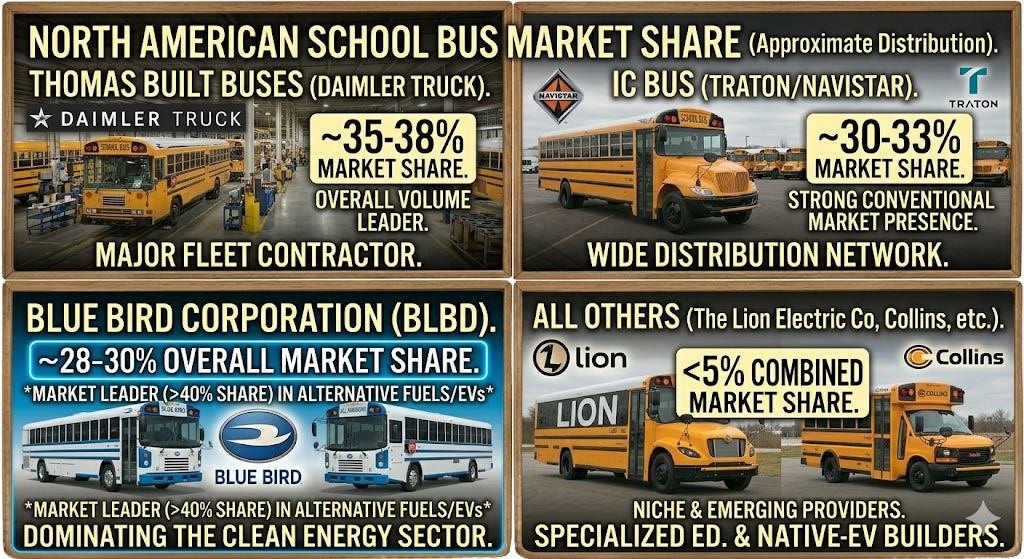
The North American school bus manufacturing industry is structured as a highly consolidated “Big Three” oligopoly. Blue Bird, Thomas Built Buses, and IC Bus collectively command over 90% of the total market share for Type C (conventional) and Type D (transit-style) school buses.
Historically, this industry operated as a low-margin, diesel-dependent commoditized market. However, the secular transition toward alternative fuels (Propane, CNG) and Electric Vehicles (EVs) has fractured this oligopoly, allowing Blue Bird to capture a commanding, high-margin lead in the clean-energy transition.
The “Big Three” Legacy Competitors
Thomas Built Buses (Subsidiary of Daimler Truck North America)
Market Position: Estimated overall market share leader at roughly 35–38%.
Core Strategy: Thomas Built relies heavily on the massive corporate backing and supply chain scale of its parent company, Daimler (the world’s largest commercial vehicle manufacturer). Their flagship Type C bus, the Saf-T-Liner C2, is built on a Freightliner chassis.
EV Competitive Stance: Thomas fields the Jouley electric school bus, utilizing Proterra battery technology. While formidable due to Daimler’s deep pockets, Thomas Built has lagged behind Blue Bird in alternative-fuel volume, primarily focusing on traditional diesel and electric while largely bypassing the highly profitable propane middle-market.
IC Bus (Subsidiary of Navistar / Traton Group)
Market Position: Holds approximately 30–33% of the total market.
Core Strategy: IC Bus is the school bus manufacturing arm of Navistar, which was fully acquired by Volkswagen’s truck division, Traton Group. Their buses are fully integrated with International truck chassis and Cummins/Navistar proprietary engines.
EV Competitive Stance: IC Bus manufactures the CE Series Electric. Backed by Traton’s global electrification modular platform, they pose a long-term threat. However, corporate restructuring post-acquisition and historical supply chain dependencies on their own legacy diesel engines have slowed their agile deployment of clean-energy fleets compared to Blue Bird.
Pure-Play EV Entrants & Niche Competitors
The Lion Electric Company (NYSE: LEV)
Market Position: Minor volume player (<3% market share), operating as a pure-play EV manufacturer.
Core Strategy: Lion built its purpose-built electric school buses (LionC and LionD) from the ground up, utilizing composite body panels to prevent corrosion.
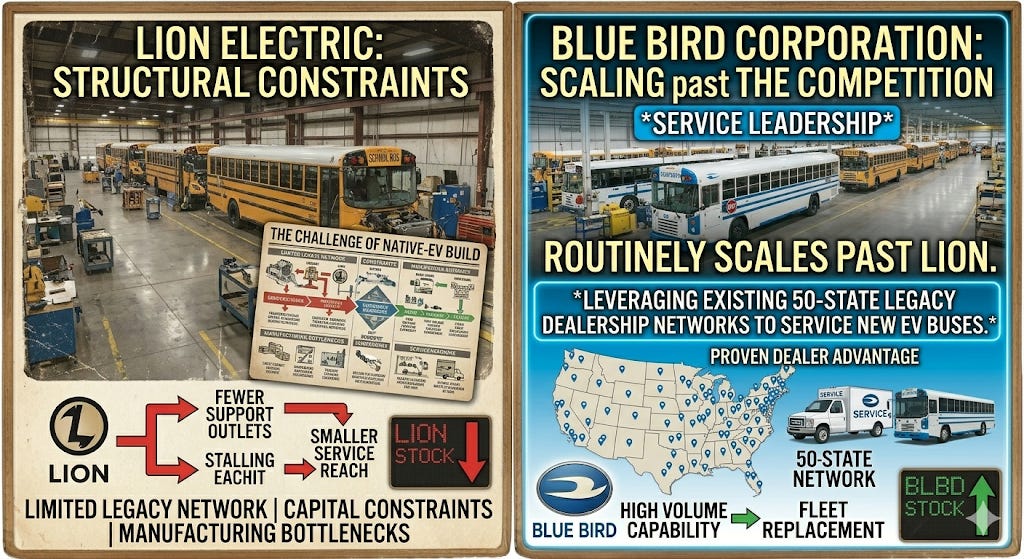
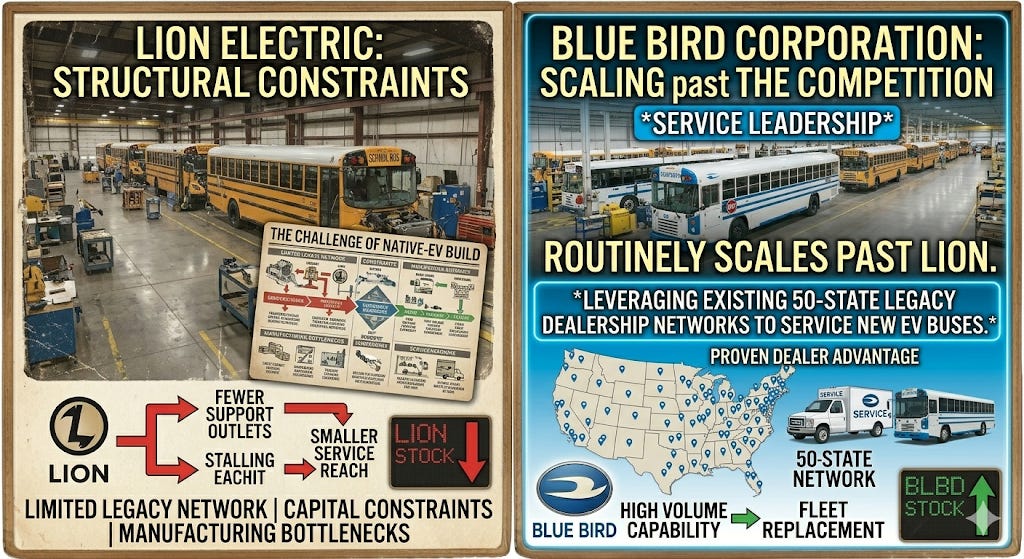
The Competitive Reality: While structurally innovative, Lion Electric lacks the massive dealer and service network built by the Big Three over the last century. Lion has faced severe capital constraints, manufacturing bottlenecks, and negative gross margins. Blue Bird routinely scales past Lion by leveraging its existing 50-state legacy dealership networks to service new EV buses.
Blue Bird’s Market Share Moat & Structural Advantages
While Blue Bird sits in third place for total legacy unit volumes (fluctuating between 28% and 30% of total industry market share), it holds an undisputed market share of over 40% in alternative-fuel and electric school buses.
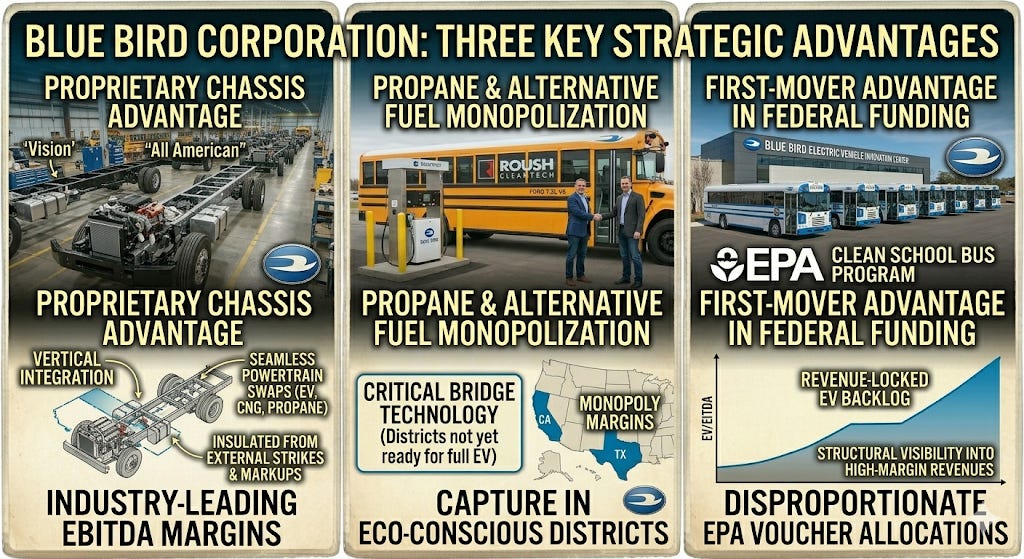
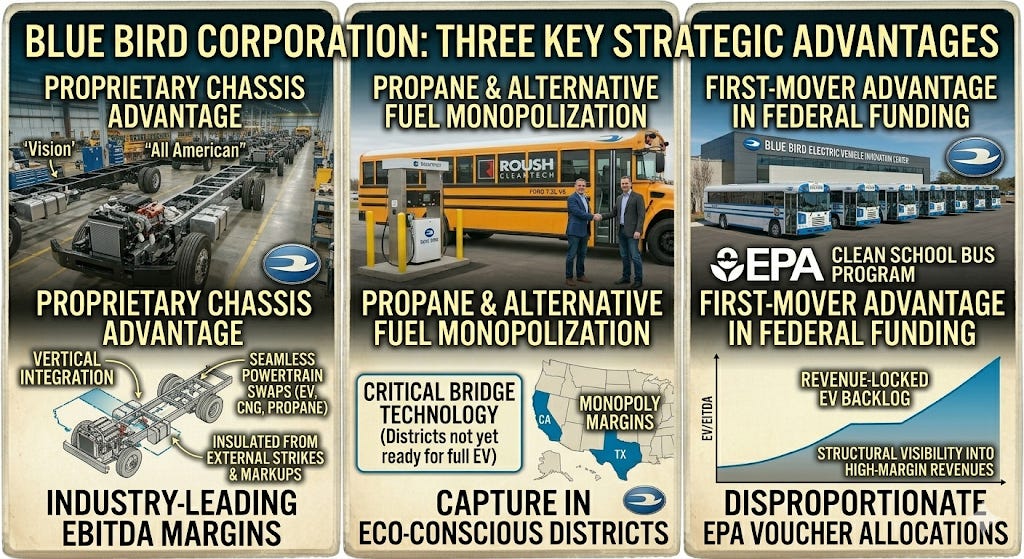
1. The Proprietary Chassis Advantage (The Margin Moat)
Unlike Thomas (dependent on Freightliner/Daimler) and IC Bus (dependent on Navistar/Traton), Blue Bird engineers and builds its own proprietary chassis for the Vision and All American lines.
Strategic Value: When diesel component prices spike, or third-party chassis builders face labor strikes, Blue Bird is insulated. Furthermore, building their own chassis allows Blue Bird to seamlessly swap in Propane, CNG, or EV powertrains without paying a markup to an external chassis provider, yielding industry-leading EBITDA margins.
2. The Propane & Alternative Fuel Monopolization
Blue Bird made a highly successful strategic bet on Propane-Autogas via an exclusive partnership with ROUSH CleanTech and Ford (using the 7.3L V8 engine).
Strategic Value: Propane buses serve as the critical “bridge technology” for school districts that want lower emissions but cannot yet afford the steep upfront costs or infrastructure requirements of full EV setups. Neither Thomas nor IC Bus has an equivalent, vertically integrated propane offering. This allows Blue Bird to capture near-monopoly margins in eco-conscious school districts across states like Texas and California.
3. First-Mover Advantage in Federal Funding (EPA Clean School Bus Program)
The EPA’s $5 billion Clean School Bus Program distributes massive grants to incentivize zero-emission student transit.
Strategic Value: Because Blue Bird already had an active, commercially viable EV production line running out of its dedicated Electric Vehicle Innovation Center, they captured a disproportionate share of early EPA voucher allocations. Blue Bird has an active, revenue-locked EV backlog that outpaces its peers relative to corporate size, giving them structural visibility into high-margin revenues for the next 3–5 fiscal years.
Management Team & Strategic Growth Plans
Blue Bird is undergoing an aggressive operational transformation. While the company was historically steered by sales-focused executives to capture early public market share, its leadership structure has been completely re-engineered around automotive supply chain veterans to aggressively scale manufacturing margins and volume.
Executive Leadership Profile
John Wyskiel — President & Chief Executive Officer (Appointed Feb 2025)
Background: Wyskiel is an automotive manufacturing heavyweight with over 35 years of global operations and supply chain experience. Crucially, he is not a stranger to Blue Bird; he served as General Manager of Blue Bird Coach in Canada from 2002 to 2004.
The Magna Pedigree: Before returning to lead Blue Bird, Wyskiel spent 20 years at Magna International, one of the largest automotive suppliers in the world. He most recently served as President of Magna Seating, where he managed a $6 billion business unit with 33,000 employees spanning more than 60 manufacturing plants across 15 countries.
Investment Significance: Wyskiel’s appointment signals a shift from “incubation” to “industrial execution.” His expertise lies in scaling highly automated production lines, managing complex global supply chains, and driving strict manufacturing cost-downs. This background is vital as the company balances component tariff volatility and builds out its new manufacturing capacity.
Razvan Radulescu — Chief Financial Officer
Background: Radulescu brings deep heavy-duty truck industry finance expertise to Blue Bird. Before joining BLBD, he spent over 20 years in senior financial and procurement roles at Daimler Trucks North America.
Investment Significance: Radulescu has driven rigorous capital allocation across the business, engineering a consecutive 14-quarter streak of beating consensus financial guidance. Under his eye, gross margins have climbed to ~20%, and the company maintains a record cash position of $276 million with zero restrictive debt constraints.
Blue Bird’s Multi-Pronged Growth Plan
Blue Bird’s growth strategy centers on expanding total volume capacity, integrating its high-margin acquisitions, and diversifying outside of its core municipal client base. Management raised its long-term corporate outlook to target $2.5 billion in annual revenue and $325 million to $375+ million in Adjusted EBITDA.
Scaling the Core: The “New Plant” Automation Strategy
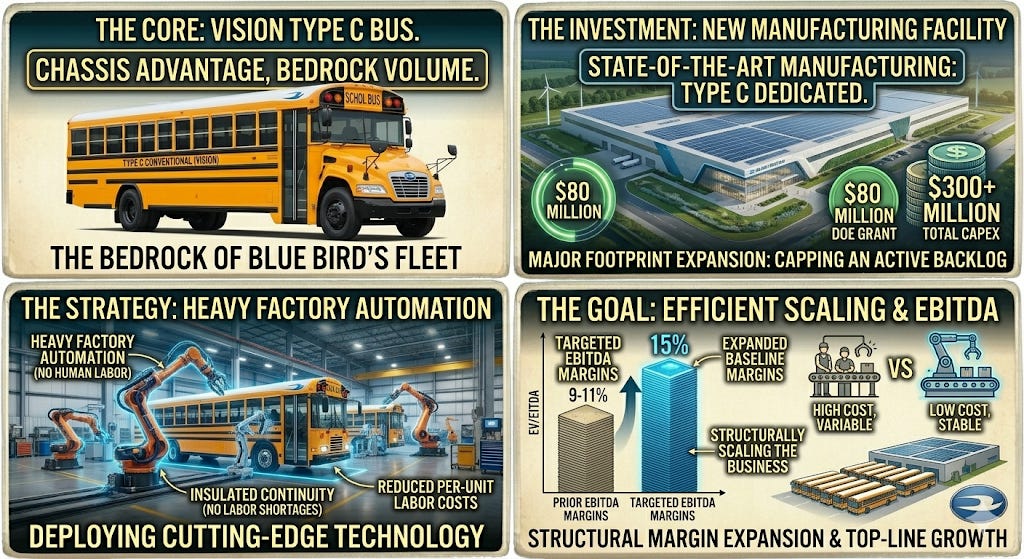
To chew through an active backlog of nearly 3,600 units, Blue Bird is executing a major manufacturing footprint expansion:
The Facility: Backed by an $80 million grant from the Department of Energy (DOE), Blue Bird is deploying over $300 million in total capital expenditures to construct a state-of-the-art manufacturing plant dedicated to Type C conventional buses.
Automation Focus: This facility—slated for production start in late calendar year 2028—is engineered from the ground up to utilize heavy factory automation. This will drastically reduce per-unit labor costs, insulate production continuity from regional labor shortages, and structurally expand baseline EBITDA margins to a targeted 15%.
2. Full Consolidation of the Micro Bird Segment
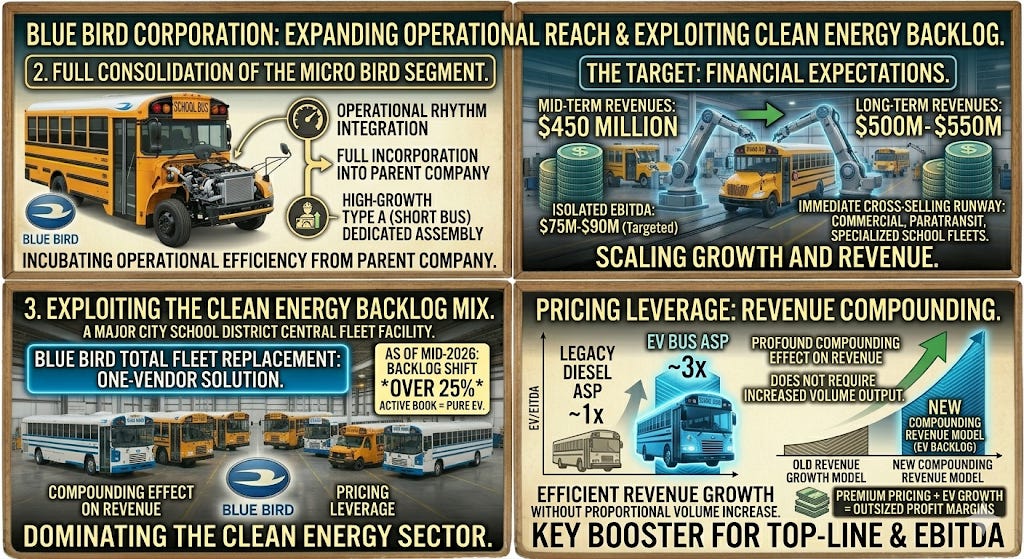
Following the complete buy-out of the Micro Bird joint venture for $201.8 million, management is fully incorporating this high-growth Type A (short bus) and commercial shuttle manufacturer into the parent company’s operational rhythm.
The Target: Management has outlined clear financial expectations for this segment, projecting mid-term revenues of $450 million and long-term revenues scale-up to $500 million–$550 million (yielding $75 million–$90 million in isolated EBITDA). This provides Blue Bird an immediate cross-selling runway into commercial, paratransit, and specialized school fleets.
3. Exploiting the Clean Energy Backlog Mix
As of mid-2026, Blue Bird’s backlog reveals an unprecedented shift in consumer demand: over 25% of the company’s active order book consists of pure electric vehicles (EVs).
Pricing Leverage: Since EV buses command an Average Selling Price (ASP) nearly three times higher than legacy diesel units, processing this backlog creates a profound compounding effect on top-line revenue without requiring a proportional increase in physical volume output.
4. Non-Cyclical Diversification: The Commercial EV Chassis
Historically, pure-play school bus manufacturers trade at lower valuation multiples due to the rigid, highly cyclical budgeting periods of school districts. To disrupt this narrative, Wyskiel is aggressively launching Blue Bird’s Class 5-6 electric commercial vehicle chassis.
The Timeline: Following initial order bookings from national delivery fleets in early 2026, commercial production is locked to begin in FY26-Q4.
The Goal: This program thrusts Blue Bird directly into the high-growth, secular tailwinds of last-mile logistics, utility vehicles, and commercial step-vans. Success here re-prices the equity from a legacy municipal manufacturer to a multi-channel industrial EV technology powerhouse.
Blue Bird Corporation: Financial Profile & Analysis
Analyzing Blue Bird’s (NASDAQ: BLBD) financial metrics over the last decade reveals a text-book operational turnaround story. The company has transformed from a cyclical, low-margin vehicle manufacturer struggling with a debt-heavy capital structure into a highly profitable, cash-generative leader in the clean-energy transition.
