

Few companies in modern corporate history have navigated as many existential pivots as Netflix. From shipping DVDs in red envelopes to pioneering the streaming revolution, and from burning billions to build an original content library to aggressively cracking down on password sharing, Netflix has essentially cannibalized its own business model four distinct times to preempt technological shifts.
Today, in mid-2026, Netflix sits at another critical inflection point. The narrative has fundamentally shifted. It is no longer a “growth-at-all-costs” tech darling priced on pure subscriber additions. Instead, it has matured into a highly profitable, cash-gushing media utility characterized by expanding operating margins, aggressive capital returns, and a dominant hold on global television screen time.
The Catalyst & The Cautionary Tale
As we delve into this analysis, we must immediately address a massive, one-time anomaly that is currently distorting the headline numbers. Earlier this year, Netflix walked away from highly publicized merger talks with Warner Bros. Discovery (WBD). As a result, Netflix pocketed a staggering $2.8 billion termination fee.
While this massive cash injection is an undeniable boon for the balance sheet and supercharges the company’s share buyback program, it creates a dangerous trap for superficial analysis. Throughout this deep dive—particularly in our financial breakdown and DCF valuations—we have explicitly normalized earnings, stripping out this WBD windfall to evaluate the true, recurring compounding power of the underlying business.
What This Deep Dive Covers:
In this comprehensive report, we will deconstruct the Netflix engine to determine if it still offers the requisite margin of safety for a 15% annualized return. We will explore:
Strategic Evolution: A timeline of the four major pivots that built the moat.
Product & Growth Vectors: How the ad-tier, live sports, and gaming are driving the next phase of Average Revenue per Member (ARM) expansion.
Production Economics: Why Netflix’s “cost-plus” model gives it insurmountable operating leverage over legacy Hollywood.
Leadership & Vision: The dual-CEO structure and the brilliant (yet risky) strategy to build an “always-on” linear TV experience.
The Bear Case: Stress-testing the thesis against TAM saturation, fierce ad-market competition, and valuation multiples priced for perfection.
Financials & Scenario Analysis: A rigorous DCF valuation (Base, Bull, and Bear) based on normalized earnings to determine our ideal entry point.
Netflix has undeniably won the streaming wars. But in investing, identifying a great company is only half the battle; the other half is paying a great price. Let’s dive in to see if the math still works.
Table of Contents
Deep dives are only half the equation. Join me as we put this research into practice and build a high-conviction allocation strategy from the ground up in the CompoundingAlpha Tracking Portfolio.

Check the Scorecards Want to see how our research grades out? View our 1-page fundamental breakdowns—scoring every company on Growth Potential, Profitability, Balance Sheet, Return on Capital, Shareholder Yield, Management, Moat, and Execution Certainty

Corporate Timeline
Netflix is arguably modern corporate history’s premier case study in successful business model pivots. From a $152 million DVD-by-mail operation in 2002 to a highly profitable global streaming giant generating over $50 billion in projected 2026 revenue, Netflix’s compounding engine has been driven by visionary management, high-risk capital allocation, and an obsession with customer retention.
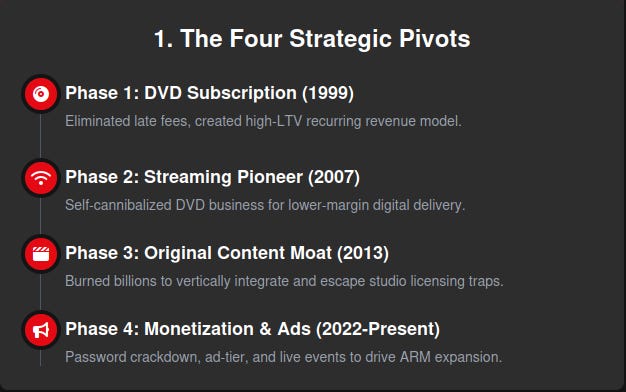
The company’s history can be categorized into four distinct strategic eras:
Phase 1: The DVD Disruptor (1997 – 2006)
The core innovation in this era was not just shipping DVDs, but the invention of the subscription model that eliminated friction (late fees) and created high customer lifetime value (LTV).
August 1997: Netflix is founded by Reed Hastings and Marc Randolph in Scotts Valley, California. The initial model is a direct clone of Blockbuster but delivered via mail (pay-per-rental).
April 1998: Netflix.com launches with 925 titles available for rent.
September 1999 (The First Pivot): Netflix introduces the subscription model. For a flat monthly fee, customers can rent unlimited DVDs without due dates, late fees, or shipping charges. This recurring-revenue pivot dramatically improves repeat rental rates and user retention.
2000: The “All-You-Can-Watch” subscription tier is introduced at $19.95/month. During this time, Hastings famously attempts to sell Netflix to Blockbuster for $50 million. Blockbuster declines.
May 2002: Netflix goes public (IPO) at $15 per share ($1.07 adjusted for stock splits). The company ends the year with 857,000 subscribers and $152 million in revenue.
2006: Netflix hits 5 million subscribers. The business is highly profitable, generating significant free cash flow (FCF), which provides the war chest for its next massive pivot.
Phase 2: The Streaming Pioneer & “The Valley of Death” (2007 – 2012)
Management recognizes broadband adoption is reaching a tipping point. They use cash from the legacy DVD business to fund a structurally lower-margin (initially) digital distribution model.
January 2007 (The Second Pivot): “Watch Instantly” launches as a free add-on for DVD subscribers. It initially features only 1,000 titles. Netflix begins aggressively licensing streaming rights from major studios at what are later revealed to be artificially depressed rates.
2008 – 2010: The platform shift accelerates. Netflix partners with consumer electronics brands to embed the app on Xbox, PlayStation, smart TVs, and Blu-ray players.
2010: International expansion begins with a launch in Canada. Blockbuster officially files for bankruptcy.
July 2011 (The Qwikster Crisis): In an effort to force the transition to streaming, Hastings announces a 60% price increase for customers wanting both DVDs and streaming, and attempts to spin off the DVD business into a separate brand called “Qwikster.”
Market Reaction: Subscriber growth reverses (losing 800k US subs). The stock drops over 75% in the following months. Hastings quickly abandons the Qwikster name but keeps the price increase, demonstrating a willingness to endure short-term pain for long-term strategic positioning.
2012: Netflix reaches 25 million subscribers globally. The foundation for a global streaming monopoly is set, but licensing costs from studios are beginning to skyrocket as media conglomerates wake up to the threat.
Phase 3: The Original Content Moat (2013 – 2021)
Realizing that suppliers (studios) would eventually become competitors, Netflix pivots to vertical integration. The company burns billions in negative FCF to build a proprietary content library that cannot be licensed away.
February 2013 (The Third Pivot): House of Cards premieres. Netflix commits an unprecedented $100 million for two seasons upfront, outbidding traditional networks. This marks the transition from content distributor to content creator.
2015: Netflix launches its first original feature film, Beasts of No Nation.
January 2016: A massive global rollout: Netflix launches in 130 new countries simultaneously, bringing its total to 190+.
2017 – 2019: The “Cash Burn” era. Netflix aggressively issues junk-rated debt to fund a massive content pipeline (spending $10B–$15B annually). Wall Street bears repeatedly short the stock based on negative FCF, fundamentally misunderstanding that content spend was a customer acquisition/retention cost with a multi-year shelf life.
2020 – 2021 (The Pandemic Pull-Forward): Lockdowns drive extraordinary subscriber growth. In 2021, paid memberships cross 220 million. Operating margins expand past 20%, and management signals that the company no longer needs to rely on external financing for day-to-day operations.
Phase 4: Monetization & Capital Allocation Discipline (2022 – 2026)
With subscriber growth maturing in core markets, Netflix pivots from a “growth-at-all-costs” tech valuation model to a highly profitable, cash-gushing media utility.
April 2022: The stock takes a massive hit after the company reports its first net subscriber loss in a decade. Management announces major shifts: cracking down on password sharing and introducing an advertising tier.
November 2022 (The Fourth Pivot): “Basic with Ads” launches, fundamentally altering the business model from pure subscription to a hybrid model, massively expanding the Total Addressable Market (TAM) and Average Revenue Per Member (ARM).
2023: The password-sharing crackdown (”Paid Sharing”) rolls out globally, forcing millions of “borrowers” into paying subscribers or ad-tier users. Free cash flow jumps to nearly $7 billion.
2024: Netflix scales its ad-supported tier to over 70 million monthly active users. Total revenue hits $39 billion with operating margins expanding to 26.7%. The company leans heavily into live sports/entertainment (e.g., WWE Raw multi-year deal, NFL on Christmas).
Q1 2026 (Current State):
Financials: The compounding engine is mature. Q1 2026 revenue hits $12.5 billion (up 16% YoY). Operating margins top 32%.
Capital Allocation Shift: Netflix firmly establishes itself as a cash generator, heavily engaging in stock buybacks.
M&A Discipline: Despite heavy rumors of a mega-merger with Warner Bros. Discovery early in 2026, Netflix walks away, pocketing a massive $2.8 billion termination fee and signaling to Wall Street that they remain highly disciplined “builders, not buyers” with their capital.
Product Ecosystem, Monetization & Growth Vectors
As Netflix transitions from its “growth-at-all-costs” phase into a mature, cash-generating media utility, the equity narrative relies heavily on its ability to expand Average Revenue per Member (ARM) and monopolize total screen time.
1. Market Position & Total TV Share
Netflix’s scale in 2026 is unprecedented. As of Q1 2026, the company boasts over 325 million global paid subscribers, towering over competitors like Amazon Prime Video (~200M), Disney+ (~131M), and Max (~117M).
More importantly for investors, Netflix is dominating the attention economy. According to Nielsen’s Gauge report from late 2025/early 2026, streaming now commands a record 47.5% of total U.S. TV viewing.
Netflix single-handedly captures roughly 9.0% of all U.S. TV screen time, pacing neck-and-neck with YouTube as the default entertainment platform for the modern household.
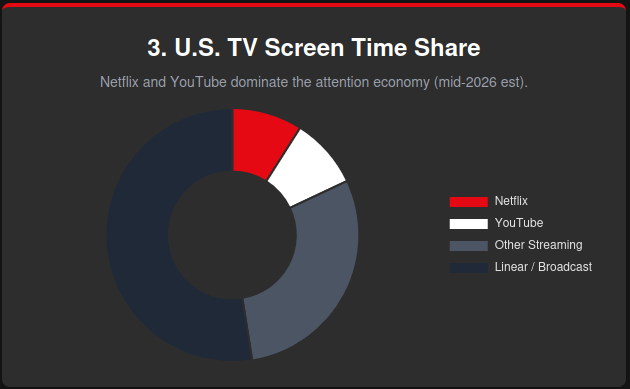
The average Netflix subscriber spends over an hour per day on the platform, contributing to industry-low churn rates (consistently hovering around 2%).
2. Content Offerings & The IP Flywheel
Netflix’s content strategy has evolved into the “Everything Store” of video. While competitors rely on specific niches, Netflix’s sheer volume, global production footprint, and algorithmic targeting create a formidable engagement moat.
The Heavy Hitters: Top Shows Driving the Moat
To understand Netflix’s pricing power, one must look at the unprecedented viewership scale of its top-tier intellectual property. Netflix doesn’t just launch shows; it creates global cultural events that lower Customer Acquisition Cost (CAC) and drive massive retention.
The Global Juggernauts (Squid Game & Stranger Things): Squid Game remains the blueprint for Netflix’s “local-for-global” strategy, with its first season generating over 1.6 billion hours viewed in 28 days—a metric no traditional competitor has ever touched. By executing successful sequel seasons and reality spin-offs (Squid Game: The Challenge), Netflix proved it can turn high-margin, foreign-language IP into a sustained franchise. Similarly, the multi-part conclusion of Stranger Things (Season 5) acted as an anchor for subscriber retention across 2025 and 2026.
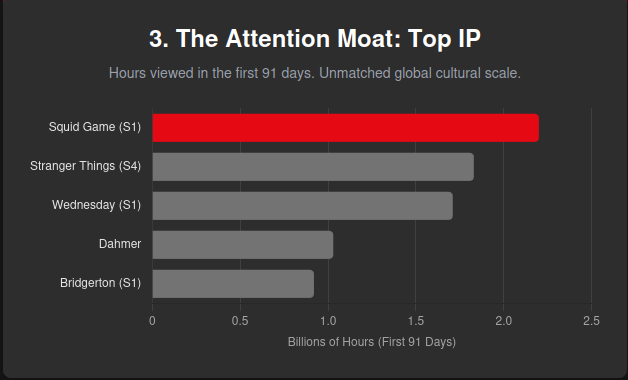
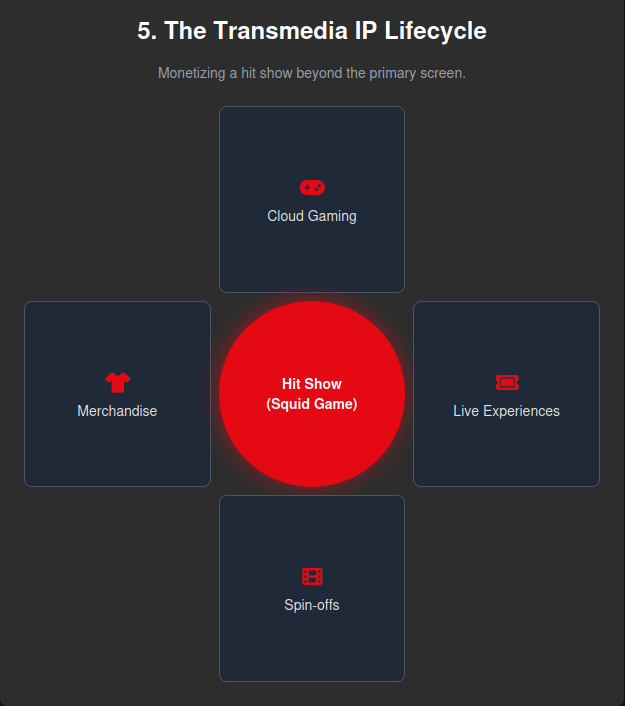
The Gen Z & Millennial Engine (Wednesday & Bridgerton): Properties like Wednesday (which also crossed 1 billion hours viewed) and the Bridgerton universe demonstrate Netflix’s grip on younger, highly engaged demographics. These shows form the basis of a “transmedia flywheel,” efficiently spinning off into merchandise, live experiences, and video games.
The Unscripted Profit Machine (Love is Blind, Drive to Survive): Not all hits require $20 million-per-episode budgets. Netflix has mastered low-cost, high-engagement unscripted television. Love is Blind commands massive recurring viewership and serves as a testing ground for live-streamed reunions. Meanwhile, sports docuseries like Formula 1: Drive to Survive and Quarterback prove Netflix’s immense power as a “kingmaker” for sports leagues, directly paving the way for their current live sports deals.
Competitor Comparison
Disney+: Heavily reliant on massive, expensive IP (Marvel, Star Wars, Pixar, Family). While they enjoy high brand loyalty, their content release cadence is slower, resulting in lower overall daily engagement hours compared to Netflix’s continuous content hose.
Max (Warner Bros. Discovery): The leader in “Prestige TV” (HBO’s The Last of Us, House of the Dragon) and reality TV (Discovery), but struggling with higher churn as viewers often subscribe for a 10-week prestige run and then cancel.
Amazon Prime Video: A massive library tied to a retail bundle. Strong in franchise IP (The Boys, Fallout, Rings of Power) and live sports (Thursday Night Football), but primarily viewed by consumers as a shipping add-on rather than a standalone media necessity.
3. Subscription Tiers & Unit Economics (ARM)
In March 2026, Netflix executed its latest flex of pricing power, cementing a tiered strategy designed to maximize ARM and push price-sensitive consumers into its highly lucrative ad ecosystem.
Current U.S. Pricing Structure (as of Mid-2026):
Standard with Ads: $8.99/month
Standard (Ad-Free): $19.99/month
Premium (4K, 4 screens): $26.99/month
The Ad-Tier Trojan Horse:
The “Standard with Ads” tier is arguably Netflix’s most important financial vehicle today. As of mid-2026, this tier boasts over 90 million Monthly Active Users (MAUs) and accounts for roughly 60% of all new sign-ups in available markets.
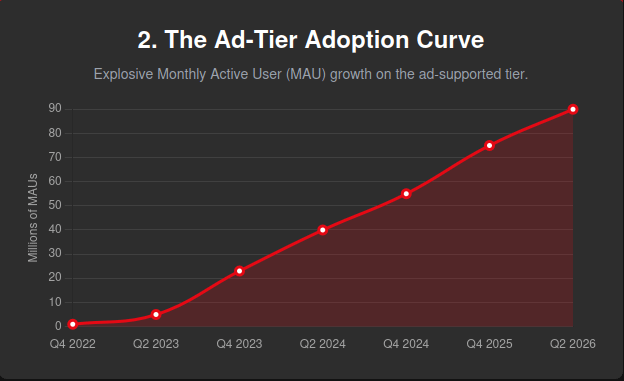
Why is this bullish? The ad tier is frequently the most profitable on a per-user basis. By collecting an $8.99 subscription fee plus high-CPM programmatic ad revenue, the blended ARM often exceeds the $19.99 Standard tier. Furthermore, Netflix has transitioned away from relying entirely on Microsoft for its ad-tech, launching its own proprietary ad server to capture higher margins. Advertising revenue is projected to hit $3 billion in 2026, fundamentally transforming Netflix into a digital advertising juggernaut.
4. The Next Growth Frontiers: Live, Gaming, and Comedy
To justify its premium valuation multiple and drive the next decade of growth, Netflix is aggressively expanding its Total Addressable Market (TAM) beyond traditional on-demand video.
A. Live Events & Sports
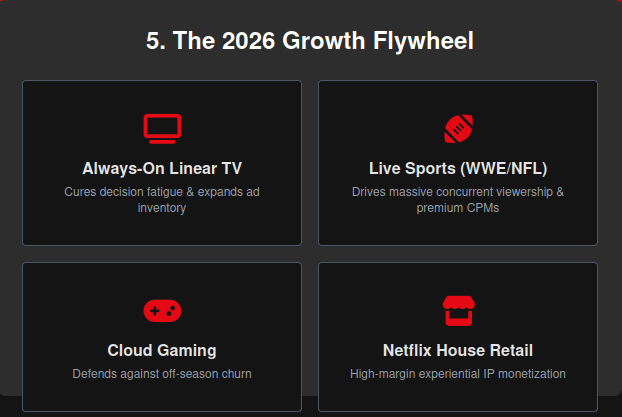
Live programming is the final frontier in cannibalizing traditional linear television (and its associated premium ad dollars).
The WWE Deal: In January 2025, Netflix took over WWE Raw in a 10-year, $5 billion mega-deal. This guarantees 52 weeks a year of high-engagement, live, ad-friendly inventory that actively prevents subscribers from churning during slow months.
NFL on Netflix: Netflix successfully streamed NFL games on Christmas Day 2025 and is expanding this footprint in 2026. This drives massive concurrent global viewership and allows Netflix to sell ultra-premium, Super Bowl-style ad packages.
Strategic Takeaway: Netflix is not buying broad regional sports networks; they are buying eventized sports that feed their new in-house ad-tech platform while maintaining global appeal.
B. Stand-Up Comedy
Netflix has essentially monopolized modern stand-up comedy, turning it into a high-margin retention tool.
Favorable Unit Economics: A comedy special costs a fraction of a scripted drama to produce but generates massive social media virality and repeat viewing (acting as evergreen content).
Live Integration: Through events like the Netflix Is a Joke Fest and live-streamed roasts, Netflix is training its user base to tune in concurrently, further boosting its live ad-inventory and solidifying its status as the cultural town square.
C. Video Games (The Sleeper Catalyst)
Netflix is quietly building a massive gaming ecosystem, operating on the premise that gaming and video are converging into a single “entertainment” category.
Cloud Gaming: In 2026, Netflix expanded its cloud-streaming video game service. Users can now play high-fidelity games directly on their smart TVs, using their smartphones as controllers—completely bypassing the need for an Xbox or PlayStation console.
IP Synergy: By tying games directly to hit shows (e.g., Stranger Things, Squid Game universes, Queen’s Gambit chess) and securing mobile hits like the GTA trilogy, Netflix increases daily app opens. If a user is playing a Netflix game between seasons of their favorite show, they are statistically far less likely to churn.
Production Economics & Ancillary Monetization
To fully grasp Netflix’s structural advantages, investors must look beneath the consumer-facing app and analyze its supply chain: how it finances, produces, and scales content compared to legacy Hollywood, as well as how it monetizes its IP beyond the screen.
1. The Production Engine: Silicon Valley Meets Hollywood
Netflix didn’t just disrupt distribution; it fundamentally rewired the economics of television and film production. While legacy media companies are tethered to century-old operational habits, Netflix operates its production arm with the efficiency of a global tech platform.
The “Cost-Plus” Financing Model (The Buyout)
Historically, television was a deficit-financed business. A studio would produce a show at a loss, license it to a network, and hope to make a profit years later through syndication (reruns) and global licensing. Talent and creators accepted lower upfront pay in exchange for “back-end points” (a percentage of those future profits).
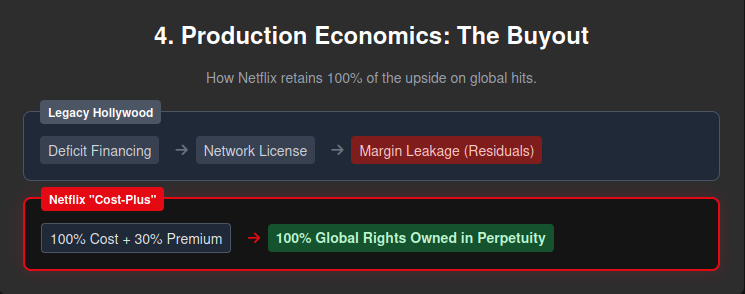
Netflix pioneered the Cost-Plus Model:
The Mechanism: Netflix pays the production studio 100% of the production costs plus an upfront premium (usually 20% to 30%).
The Strategic Advantage: In exchange for this guaranteed profit, the creators and studios sign away all back-end rights. Netflix owns the global distribution rights in perpetuity.
The Equity Narrative: While this requires massive upfront cash burn (which drove the bear thesis from 2017–2021), it creates immense operating leverage. When a show like Squid Game becomes a multi-billion-dollar global phenomenon, Netflix captures 100% of the upside. There are no massive residual checks or profit-sharing agreements that dilute margins. (Note: Post-2023 Hollywood strikes, a small performance-based bonus structure was implemented, but the core buyout model remains intact).
“Straight-to-Series” vs. The Pilot Model
Legacy TV relies on the expensive, inefficient “Pilot Season,” where dozens of pilot episodes are shot, focus-grouped, and mostly discarded, with only a few ordered to series.
Netflix uses its massive data lake of viewing habits to bypass pilots entirely, ordering straight-to-series (usually 8 to 10 episodes).
By guaranteeing a full season, Netflix attracts top-tier creators who detest the uncertainty of the pilot process, locking in premium talent faster and more efficiently than linear networks.
“Local-for-Global” Arbitrage
A core driver of Netflix’s recent free cash flow generation is its geographic production shift.
Producing a prestige drama in Los Angeles can cost $10M–$15M per episode. Producing a similar tier of content in South Korea, Spain, or Latin America costs a fraction of that.
Because Netflix has perfected dubbing, subtitling, and algorithmic recommendation, a high-quality Korean thriller or Spanish heist show (Money Heist) can perform like a massive US blockbuster but with vastly superior unit economics and Return on Invested Capital (ROIC).
2. Competitive Contrast: Netflix vs. Legacy Studios
Disney & Warner Bros. Discovery (WBD): These legacy studios are bogged down by theatrical release windows and complex licensing deals. When they make a movie, it goes to theaters, then premium video-on-demand (PVOD), then linear TV, and finally streaming. Netflix bypasses the theater entirely, funneling all that cultural momentum directly into subscriber acquisition and retention on a single platform.
The Agility Gap: Traditional studios are heavily siloed (film division vs. TV division vs. consumer products). Netflix’s centralized, tech-first infrastructure allows it to pivot resources globally. If a show pops in India, the platform instantly localizes it and pushes it to European and North American home screens within hours.
3. Ancillary Monetization: Beyond the Screen
As subscriber growth in North America and Western Europe matures, Netflix is aggressively monetizing its captive audience through non-media physical products, live experiences, and interactive entertainment. This shifts Netflix from a pure software subscription to a holistic lifestyle brand.
A. Experiential Retail: “Netflix House”
Launched in 2025, Netflix House represents the company’s boldest move into physical retail. Located in massive footprints (often taking over vacant department stores in premium malls), these are permanent, immersive entertainment venues.
The Offering: Fans can eat food inspired by Netflix food shows, buy exclusive merchandise, and participate in immersive experiences (e.g., navigating a Squid Game obstacle course or attending a Bridgerton ball).
Financial Impact: While highly capital intensive initially, these venues operate as massive, self-funding marketing engines. They deepen brand loyalty, reduce churn, and create a high-margin revenue stream through premium food, beverage, and ticket sales.
B. Consumer Products and Merchandising
Historically, Disney was the undisputed king of merchandise. Netflix has spent the last five years building a formidable consumer products division from scratch.
E-Commerce & Retail: Through its proprietary Netflix.shop and massive retail partnerships (Walmart, Target, H&M), Netflix is monetizing its IP rapidly.
The Moat: Unlike legacy studios that plan merchandise years in advance around theatrical releases, Netflix uses rapid-response manufacturing. When a show unexpectedly goes viral, Netflix can have licensed apparel and products on shelves in a matter of weeks, capitalizing on the cultural zeitgeist.
C. The Evolving Gaming Ecosystem
Netflix doesn’t view video games as a side project; they view it as a core pillar of their “Attention Economy” moat.
In-House Studio Acquisitions: Rather than just licensing IP to third-party developers, Netflix has been acquiring independent game studios (like Night School Studio and Spry Fox) to build games natively.
Transmedia Flywheel: The ultimate goal is seamless cross-pollination. A user finishes a season of a fantasy show, and the app immediately prompts them to play the canonical video game sequel on their phone or smart TV, keeping them inside the Netflix walled garden instead of switching over to a PlayStation, TikTok, or YouTube.
Leadership & The Next Evolution of Viewing
A key pillar of any “compounding alpha” thesis is the management team’s ability to execute complex strategic pivots and allocate capital efficiently. For Netflix, the leadership structure has evolved perfectly to match the company’s transition from a high-growth tech disruptor to a highly profitable, mature media utility.
Furthermore, looking ahead, management is laying the groundwork for the next evolution in streaming: merging the on-demand library with a traditional “always-on” linear television experience.
1. The Management Engine: The Dual-CEO Structure
In January 2023, visionary founder Reed Hastings stepped down as co-CEO, transitioning to Executive Chairman. This marked the end of Netflix’s hyper-growth builder phase and ushered in the era of optimization, led by a highly complementary dual-CEO structure.
Ted Sarandos (Co-CEO) – The Hollywood Bridge
Sarandos has been with Netflix since 2000 and is the architect of its original content strategy.
The Moat Builder: He is responsible for taking Netflix from a distributor of other people’s content to the most powerful studio in the world. He championed the massive upfront investments in shows like House of Cards and spearheaded the push into global, local-language content.
Industry Clout: While legacy Hollywood executives initially scoffed at Netflix, Sarandos built deep relationships with elite showrunners (Shonda Rhimes, Ryan Murphy), proving Netflix could offer both creative freedom and massive global reach.
Greg Peters (Co-CEO) – The Product & Monetization Architect
If Sarandos handles the art, Peters handles the science. Previously the Chief Operating Officer and Chief Product Officer, Peters is the driving force behind Netflix’s recent financial inflection points.
The Revenue Optimizer: Peters successfully executed the two most difficult pivots in recent company history: the password-sharing crackdown (Paid Sharing) and the launch of the advertising tier. Both required flawless technical execution and careful consumer messaging to avoid mass churn.
New Frontiers: He is also leading Netflix’s expansion into cloud gaming and proprietary ad-tech, transforming Netflix’s underlying software infrastructure to support diverse revenue streams.
Key C-Suite Lieutenants
Spencer Neumann (CFO): Recruited from Activision Blizzard, Neumann brought rigorous financial discipline to Netflix. He oversaw the end of the debt-fueled content binge, guiding the company to consistent, massive Free Cash Flow (FCF) generation and initiating aggressive share buyback programs.
Bela Bajaria (Chief Content Officer): Bajaria oversees all of Netflix’s film and television output globally. She is the mastermind behind the “local-for-global” strategy, greenlighting massive, cost-efficient international hits that drive the company’s high ROI on content spend.
2. Future Plans: The “Always-On” Linear TV Pivot
As Netflix looks toward the end of the 2020s, one of the most exciting strategic developments is the convergence of streaming and traditional linear television. Management recognizes that on-demand streaming has a flaw: decision fatigue.
To combat the endless “Netflix scroll” and increase daily viewing hours, Netflix is actively building towards an “Always-On” Live TV experience natively within its app.
The “Lean-Back” Experience
Rather than forcing users to actively choose a specific episode of a specific show, Netflix is exploring continuous, pre-programmed channels.
How it Works: Imagine logging in and seeing a “Netflix Comedy” channel continuously broadcasting stand-up specials and sitcoms, or a “True Crime” channel playing documentaries 24/7. The user simply clicks a button and the content starts rolling, mimicking the effortless “lean-back” experience of legacy cable.
The FAST Channel Strategy: This borrows from the Free Ad-Supported Streaming TV (FAST) model popularized by Pluto TV and Tubi, but leverages Netflix’s premium, proprietary IP rather than licensed B-tier movies.
The Strategic & Financial Rationale
Adding always-on linear feeds is not a step backward; it is a highly calculated monetization tool.
Solving Decision Fatigue: By removing the friction of choosing what to watch, Netflix instantly increases total screen time, preventing users from closing the app out of frustration to scroll TikTok or YouTube instead.
Massive Ad-Inventory Expansion: Continuous programming is the holy grail for digital advertising. Always-on channels allow Netflix to seamlessly insert commercial breaks at regular intervals, vastly scaling their ad-inventory without needing to produce a single new show.
Live Event Integration: These linear channels provide the perfect real estate to seamlessly transition users into live events, such as a pre-game show leading directly into a live NFL broadcast or a WWE Raw match, maximizing concurrent live viewership.
Resurrecting Back-Catalog ROI: Netflix has thousands of original shows that are no longer actively promoted by the algorithm. Pre-programmed linear channels allow the company to monetize this dormant “long tail” content by feeding it directly to viewers, squeezing extra margin out of sunk production costs.
The Bear Case & Key Risks
While the bull thesis for Netflix centers on its unassailable scale, pricing power, and expanding margins, a prudent “compounding alpha” investor must actively seek out the friction points. The stock has been a massive outperformer over the last few years, meaning it is currently priced for near-perfect execution.
If Netflix’s compounding engine is going to stall in the late 2020s, it will likely be driven by one (or a combination) of the following structural risks.
1. TAM Saturation & The “Pull-Forward” Hangover
The most potent arrow in the bear quiver is the argument that Netflix’s recent subscriber surge was largely a one-time event.
The Paid Sharing Mirage: The 2023–2025 crackdown on password sharing forced tens of millions of “borrowers” to finally pay for the service. Bears argue this essentially pulled forward years of organic subscriber growth. With the crackdown now fully implemented globally, the catalyst is exhausted.
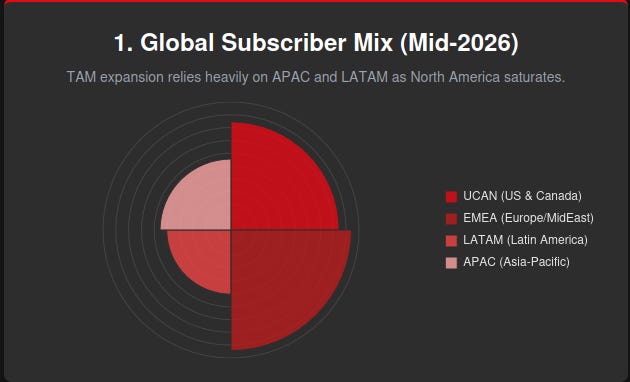
Geographic Mix Shift & Lower ARM: North America (UCAN) and Western Europe are heavily saturated. To reach 400 million subscribers, Netflix must rely heavily on growth in the Asia-Pacific (APAC) and Latin America (LATAM) regions. However, the Average Revenue per Member (ARM) in countries like India and Indonesia is a fraction of the U.S. ARM. Even if they add millions of subscribers in these regions, top-line revenue growth will inherently decelerate.
2. The Ad-Market Battlefield: Competing with Tech, Not Media
Netflix’s pivot to advertising was a masterstroke for subscriber retention, but scaling ad revenues to justify its valuation is an entirely different challenge.
The YouTube Threat: Netflix is no longer just competing with Disney and Warner Bros. Discovery; in the ad-tier space, they are competing directly with YouTube, Amazon, and Meta. YouTube dominates the “living room TV” ad space and has a structurally zero-cost content model (User-Generated Content).
CPM Pressure: As streaming competitors (Disney+, Prime Video, Max, Peacock) all shove ad-inventory into the market simultaneously, supply is vastly outpacing demand. This creates downward pressure on Cost Per Mille (CPMs). Netflix has historically demanded a premium for its ads, but buyers may balk and shift budgets to cheaper programmatic inventory elsewhere if Netflix cannot prove superior return on ad spend (ROAS).
3. Margin Dilution from Live Sports & Events
Netflix spent a decade avoiding live sports, arguing that it was a low-margin rental business rather than a high-margin owned-IP business. Their recent pivot (WWE, NFL) introduces significant margin risk.
The Bidding Wars: Legacy sports rights are astronomically expensive. By entering this arena, Netflix is stepping into a bidding war against Apple (MLS, MLB) and Amazon (NFL, NBA), both of which have balance sheets that dwarf Netflix’s and can afford to view sports as a loss-leader for their broader tech ecosystems.
Renting vs. Owning: Unlike Stranger Things, which Netflix owns forever and can monetize globally for decades, an NFL game has a shelf life of about four hours. If Netflix becomes addicted to live sports to drive ad-tier engagement, they will be forced to repeatedly renew these licenses at higher and higher prices, eroding the massive operating leverage they just spent a decade building.
4. Capital Misallocation in Unproven Frontiers
As core streaming growth slows, management is looking for new TAMs, which introduces severe execution risk and capital intensity.
The Gaming Cash Burn: Despite years of investment and studio acquisitions, Netflix Games has yet to prove it can move the needle financially. Developing AAA games is notoriously difficult, expensive, and hit-driven. If the “transmedia flywheel” fails to resonate with casual viewers, gaming becomes a multi-billion dollar black hole for free cash flow.
Experiential Retail Risks: The rollout of “Netflix House” and permanent physical retail locations introduces physical real estate liabilities, massive CapEx, and operational complexities that a software/media company is ill-equipped to handle. A failure in physical retail would be a highly visible embarrassment and a drag on Return on Invested Capital (ROIC).
🔒 Unlock the Full Financial Analysis & DCF Model
You’ve reached the preview threshold for this deep dive.
So far, we’ve broken down Netflix’s four historical pivots, its dominant TV engagement metrics, the monetization potential of the ad tier and live sports, and the primary strategic risks threatening its moat.
Up next for paid subscribers of Compounding Alpha:
The Normalized Financial Breakdown: We strip out the massive one-time $2.8 billion WBD merger breakup fee to reveal Netflix’s true underlying operating margins, GAAP distortion, and recurring earnings baseline.
Capital Return & FCF Acceleration: How much cash Netflix is actually generating—and how aggressively management is returning it through share buybacks.
3-Scenario DCF Valuation Models: Full access to our Base, Bear, and Bull valuation scenarios—complete with explicit entry points, terminal multiples, and projected 5-year annualized returns (IRR) targeting our 15% hurdle rate.
The Final Investment Verdict: The final actionable thesis on whether NFLX is a Buy, Hold, or Pass at current price levels.
