
The AI Gold Standard: A Deep Dive into Palantir ($PLTR)
How a secretive defense contractor became the most important operating system for the modern enterprise, and what it means for investors.

If you want to understand Palantir Technologies ($PLTR), you have to understand its contradictions. For over a decade, it was Silicon Valley’s most secretive outcast—a company that eschewed consumer advertising, embraced the U.S. defense apparatus, and was run by a self-described socialist philosopher, Alex Karp, backed by libertarian billionaire Peter Thiel.
Wall Street misunderstood Palantir for years. When they went public in 2020, analysts dismissed them as a low-margin, glorified government consulting firm disguised as a SaaS company.
Fast forward to 2026, and the narrative has violently inverted. Palantir is now recognized as a premier AI infrastructure necessity, sitting comfortably alongside hardware giants like NVIDIA. In early 2026, they shattered the SaaS “Rule of 40” by posting an astronomical score of 145%, driven by U.S. commercial revenue growth that has consistently topped 130% year-over-year.
Table of Contents
Check the Scorecards Want to see how my research grades out? View the 1-page fundamental breakdowns—scoring every company on Growth Potential, Profitability, Balance Sheet, Return on Capital, Shareholder Yield, Management, Moat, and Execution Certainty

Deep dives are only half the equation. Join me as we put this research into practice and build a high-conviction allocation strategy from the ground up in the CompoundingAlpha Tracking Portfolio.

How did a company that started out hunting terrorists become the operating system for the modern enterprise? Lets map out their timeline.
The Complete History of Palantir: A Timeline
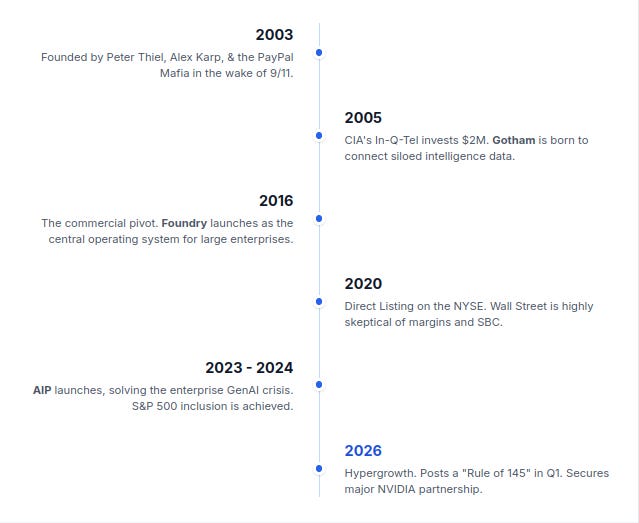
2003–2004: The PayPal Mafia and the Post-9/11 World
The origins of Palantir stem from the ashes of 9/11 and the success of PayPal. Peter Thiel, fresh off the sale of PayPal to eBay, recognized that the fraud-detection algorithms they used to stop Russian cybercriminals could be repurposed for counter-terrorism.
Thiel co-founded the company with Joe Lonsdale, Stephen Cohen, Nathan Gettings, and his former Stanford law school classmate, Alex Karp—who stepped in as CEO. Karp, a PhD in neoclassical social theory with no technical background, proved to be the eccentric but visionary leader the company needed to navigate the intersection of Silicon Valley and Washington D.C.
2005–2008: In-Q-Tel and the Birth of Gotham
Palantir struggled initially to secure venture capital, largely because its target customer base (the intelligence community) was notoriously difficult to penetrate. The breakthrough came when In-Q-Tel, the venture capital arm of the CIA, invested $2 million.
This partnership allowed Palantir to develop Palantir Gotham. Gotham was built as a data integration and analytics platform specifically designed for defense and intelligence agencies. It didn’t replace human analysts; it gave them a “single pane of glass” to connect disparate data points—cell phone records, bank transfers, and flight logs—uncovering networks that were previously invisible.
2010–2015: The Mythos and the Moat
During this era, Palantir became the stuff of legend. While the company rarely commented on specific operations, it was widely reported (and heavily rumored) that Gotham played a pivotal role in tracking down Osama bin Laden in 2011.
Palantir systematically built an impenetrable economic moat within the U.S. government. They secured massive contracts across the DoD, the SEC, and ICE. By 2015, Palantir’s private valuation soared past $15 billion, making it one of the most valuable “unicorns” in the world.
2016–2019: The Commercial Pivot and Palantir Foundry
Realizing that government budgets, while sticky, were slow to grow, Palantir aggressively pivoted to the commercial sector. They launched Palantir Foundry.
While Gotham was built for finding a needle in a haystack, Foundry was built to rethink the haystack entirely. It was designed to become the central operating system for massive enterprises, helping companies like Airbus and BP integrate their supply chains, manufacturing data, and logistics.
Despite Foundry’s success, critics argued the software was too complex, required too many forward-deployed engineers (FDEs), and wasn’t truly scalable.
2020–2022: The Direct Listing and The Profitability Struggle
On September 30, 2020, Palantir bypassed the traditional IPO process and went public via a Direct Listing on the NYSE. The stock debuted at $10 a share.
The early public years were volatile. While retail investors (the “Palantirians”) loved the stock, Wall Street remained deeply skeptical. Bears pointed to heavy stock-based compensation (SBC), lumpy government contracts, and a lack of GAAP profitability. The company had to prove it could scale its commercial product without scaling its headcount at the same rate.
2023–2024: The AIP Inflection Point and S&P 500 Inclusion
This was the turning point. As the generative AI boom kicked off, enterprises rushed to implement Large Language Models (LLMs). However, most companies realized quickly that plugging ChatGPT into their proprietary data was a security nightmare and often resulted in useless hallucinations.
Palantir introduced AIP (Artificial Intelligence Platform). AIP allowed companies to deploy LLMs securely on top of their private networks, governed by Palantir’s robust ontology and security permissions.
To sell it, Palantir threw out the traditional enterprise sales playbook. They launched “AIP Bootcamps,” inviting prospective clients to sit down with engineers and build a functional AI use-case in five days or less. The strategy was a masterclass in product-led growth. Conversions skyrocketed.
By late 2024, Palantir reached a major milestone: inclusion in the S&P 500. They had achieved consistent GAAP profitability, silencing the Wall Street bears once and for all. Following the U.S. elections in late 2024, renewed optimism around defense tech spending sent the stock into a sustained, multi-year rally.
2025–2026: Hypergrowth and The Rule of 145
If 2024 was the breakout year, 2025 and 2026 have been the era of market dominance.
In 2025, the stock rallied to fresh all-time highs (crossing $200 at one point) as U.S. commercial revenue surged by a staggering 109% for the full year.
By Q1 2026, Palantir posted an 85% year-over-year total revenue growth rate, pulling in $1.63 billion in a single quarter. U.S. Commercial growth hit 133% year-over-year.
Today, Palantir is no longer viewed as a consultancy; it is a high-margin software juggernaut. With an adjusted operating margin hovering around 60% and a massive war chest of cash, Palantir has cemented itself as the connective tissue between raw data and the AI-driven future.
The Core Product Suite: Solving the Enterprise “Meaning” Crisis
To understand why Palantir is seeing this unprecedented growth, you have to understand the fundamental problem they solve.
Most companies believe they have a data storage problem. They don’t. Moving your data from an on-premise Oracle server to a cloud-based Snowflake data warehouse doesn’t actually make the data useful. What companies actually suffer from is a crisis of meaning.
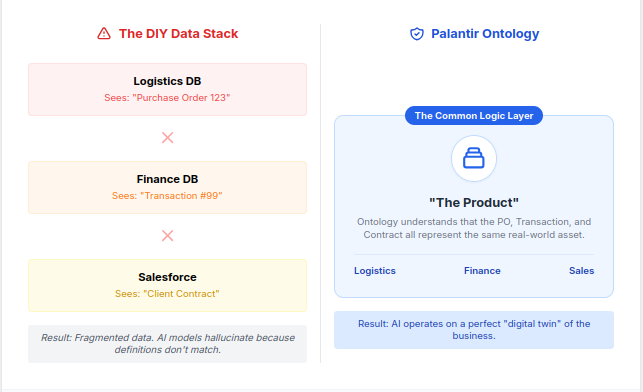
A logistics database might call a shipment a “Purchase Order,” while the finance database calls it a “Transaction.” If the systems can’t communicate what these terms mean in the real world, human analysts have to manually stitch them together.
Palantir’s entire product suite is built to solve this. They don’t just store data; they map it into what they call an Ontology—a digital twin of an organization that natively understands the relationships between objects (assets, people, inventory) and verbs (actions, shipments, approvals).
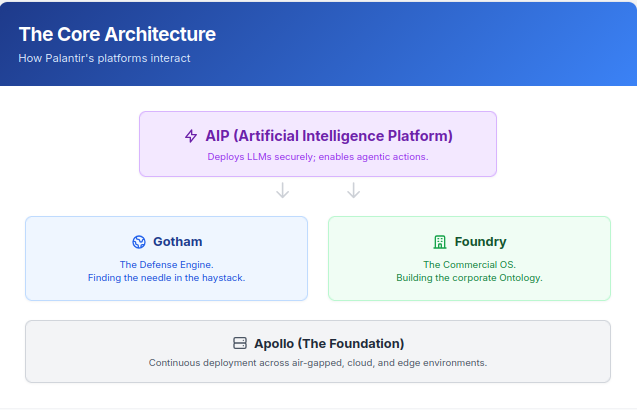
Here is how Palantir’s four core products work together to achieve this.
1. Palantir Gotham: The Defense Engine
What it is: The original software platform, built primarily for defense, intelligence, and government agencies.
The Problem it Solves: In the intelligence community, data is dangerously siloed. You might have SIGINT (signals intelligence), HUMINT (human intelligence), drone telemetry, and cell phone records all sitting in different, highly classified databases. A human cannot physically cross-reference all of this in real-time to find a terrorist network or coordinate battlefield logistics.
How it Works: Gotham acts as a singular “pane of glass.” It integrates these massive, unstructured datasets and creates visual networks. If you are looking for a needle in a haystack, Gotham doesn’t just find the needle; it shows you everyone who touched the needle, where the needle was manufactured, and who paid for it.
2. Palantir Foundry: The Commercial Operating System
What it is: The commercial evolution of Gotham, designed for the world’s largest enterprises (Airbus, BP, hospitals, banks).
The Problem it Solves: Massive corporations operate in disconnected silos. A hospital’s patient record system doesn’t talk to its bed-allocation system, which doesn’t talk to its nursing schedule. This fragmentation causes supply chain shocks, inefficiencies, and wasted billions.
How it Works: Foundry creates the corporate Ontology. It connects data, analytics, and operational workflows into a common logic layer. Instead of just creating “dashboards” that tell executives what happened yesterday, Foundry allows operators to make decisions that write back into the system today. When the UK NHS needed to manage COVID-19 vaccine distribution and PPE supply chains across thousands of fragmented locations, they used Foundry.
3. Palantir Apollo: The Silent Enabler
What it is: Palantir’s autonomous software deployment and continuous delivery platform.
The Problem it Solves: Traditional SaaS products (like Salesforce or Slack) run on the public cloud. But Palantir’s customers operate in extreme environments—classified air-gapped government servers, submarines, or ruggedized Humvees in combat zones. You can’t just push a standard cloud update to a submarine.
How it Works: Apollo is the unsung hero of Palantir’s margins. It allows developers to “write code once, deploy anywhere.” Apollo autonomously manages software updates, dependency resolutions, and vulnerability patches across cloud, on-premise, and disconnected environments without human intervention. It is the engine that allowed Palantir to scale from a manual consulting model into a high-margin software juggernaut.
4. Palantir AIP: The AI Rocket Ship
What it is: The Artificial Intelligence Platform. This is the product driving Palantir’s explosive 2025/2026 growth.
The Problem it Solves: In the post-ChatGPT world, every Fortune 500 board demanded AI integration. But companies quickly realized that feeding raw corporate data into a generic LLM is a disaster. It causes massive security leaks, hallucinations, and produces chatbots that are functionally useless for actual business operations.
How it Works: AIP anchors Large Language Models (like GPT-4, Claude, or Llama) directly into a company’s Foundry Ontology. Because the Ontology already maps out the rules, physics, and security permissions of the business, the AI can operate safely.
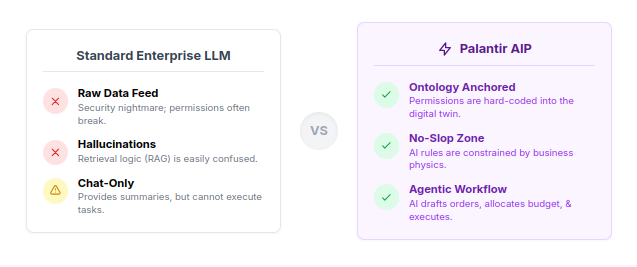
More importantly, AIP moves AI from a “chat” function to an agentic function. Because the AI understands the business context, you can allow it to take action. An AI agent inside AIP can evaluate a supply chain disruption, draft a re-order ticket, check the budget, and route it to a human manager for a single-click approval. It is a “no-slop zone” for enterprise AI, turning potential AI chaos into compounding, real-world value.
Beyond the Core Four: The Growth Multipliers
While the core platforms establish Palantir’s moat, the company has recently rolled out several adjacent initiatives that are drastically expanding their Total Addressable Market (TAM) and accelerating revenue.
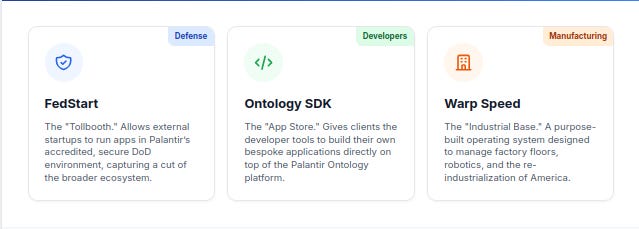
5. Palantir FedStart: The Defense Tech Tollbooth
What it is: A program that allows commercial and defense startups to run their software within Palantir’s secure, accredited environment.
Why it matters to investors: Selling software to the U.S. Department of Defense requires incredibly rigorous security accreditations (like IL5, IL6, and FedRAMP). This process can take startups years and millions of dollars. Through FedStart, startups can bypass this barrier by running their apps on Palantir Apollo. In exchange, Palantir acts as a “tollbooth,” capturing a cut of the broader defense tech ecosystem’s growth without having to build every solution themselves.
6. The Ontology SDK (OSDK): The “App Store” Evolution
What it is: A suite of developer tools that allows external software engineers to build bespoke applications on top of Palantir.
Why it matters to investors: Historically, the biggest bear thesis against Palantir was that it required too many internal engineers to deploy. OSDK changes the paradigm. By giving client developers the tools to build their own apps directly on top of the Ontology, Palantir has officially transitioned from a monolithic software provider into a true platform—similar to how thousands of developers build apps for Apple’s iOS or Amazon’s AWS.
7. Palantir Warp Speed: Re-Industrializing America
What it is: An end-to-end operating system specifically designed for modern American manufacturing.
Why it matters to investors: Capitalizing on the macro trend of “American Dynamism” and the reshoring of supply chains, Warp Speed is built to manage everything from factory floor robotics to complex inventory logistics. By offering a purpose-built solution for the manufacturing renaissance, Palantir is positioning itself at the center of the hardware and defense-industrial base revival.
The Architects: A Management Team of Contradictions
You cannot understand Palantir without understanding the uniquely unconventional leadership team steering the ship. They have consistently rejected the standard Silicon Valley playbook, cultivating a corporate culture that is unapologetically pro-Western, highly intellectual, and uniquely intense.
Alex Karp (Co-Founder & CEO)
Alex Karp is not your typical tech CEO. Holding a PhD in neoclassical social theory from Frankfurt University, Karp has no formal background in computer science. Instead, he operates as Palantir’s philosophical engine and primary strategist.
Karp has spent years fiercely defending Palantir’s choice to prioritize the U.S. and its allies, frequently criticizing other Silicon Valley firms for refusing defense contracts. In 2026, he remains the outspoken voice of the company, recently making headlines for calling out AI labs for selling models that “steal” enterprise value, positioning Palantir’s software as the only way companies can securely own the “means of production” for their own AI.
Peter Thiel (Co-Founder & Chairman)
The billionaire libertarian venture capitalist and former PayPal founder is the structural architect behind Palantir. Thiel provided the initial seed capital and the core thesis: that the anti-fraud algorithms used in finance could be deployed for national security. While he does not run the day-to-day operations, his influence as Chairman is profound. Thiel’s macro-level thinking on the stagnation of tech innovation and the need for American industrial revival deeply informs Palantir’s strategic bets, like Warp Speed and FedStart.
Shyam Sankar (Chief Technology Officer)
If Karp is the philosopher and Thiel is the architect, Shyam Sankar is the tactical builder. Sankar has been instrumental in creating Palantir’s “Forward Deployed Engineer” (FDE) model, which embeds engineers directly alongside clients to solve real-world problems. Recently, Sankar has become a vocal public advocate for rapidly accelerating defense tech adoption, warning that failing to embrace AI innovation would be a generational mistake for the U.S. military.
The Path Through 2026: Hypergrowth and The Rule of 145
If the years leading up to 2024 were about proving profitability, 2025 and 2026 have been about cementing market dominance. The financial narrative surrounding Palantir has fundamentally shifted from a “story stock” to a high-leverage growth compounder.
The Financial Inflection and Q1 2026 Earnings
The most critical metric demonstrating Palantir’s maturity is its expanding operating margins. For years, bears argued that Palantir’s consulting-heavy model would prevent it from achieving true SaaS profitability.
They were wrong.
In their blockbuster Q1 2026 earnings report, Palantir posted an 85% year-over-year total revenue growth rate. Even more staggering, they posted an incredible “Rule of 40” score of 145% (a metric combining revenue growth rate and profit margin). In the software world, a score of 40 is considered elite; a score of 145% places Palantir in a rarefied atmosphere matched only by AI infrastructure giants like NVIDIA or Micron.
This profitability is translating directly to the bottom line. Q1 2026 GAAP net income hit $871 million, and they raised full-year 2026 revenue guidance to over $7.65 billion.
The $10 Billion Army Enterprise Agreement
While the U.S. commercial sector is the primary growth engine (surging 133% YoY in Q1 2026), Palantir has effectively locked up the U.S. Department of Defense. In 2025, they secured a monumental Enterprise Agreement (EA) with the U.S. Army worth up to $10 billion over a decade.
This agreement consolidates over 75 separate procurement actions into a single vehicle, making Palantir the undeniable backbone of the Army’s data infrastructure and cementing their role in the Pentagon’s shift toward “data-centric warfare.”
The Sovereign AI Playbook and the NVIDIA Partnership
As enterprises and governments realize the danger of funneling their proprietary data into third-party AI models (like OpenAI or Anthropic), Palantir has positioned itself as the solution for “Sovereign AI.”
In late June 2026, Palantir doubled down on this strategy by announcing a major partnership with NVIDIA. This strategic initiative created an “intelligent engine” that allows Palantir to deploy NVIDIA’s Nemotron open models directly into sovereign environments (like U.S. government agencies and critical infrastructure). Because these organizations often cannot use outside or foreign open models for security reasons, the combination of NVIDIA’s Nemotron models running securely on Palantir’s AIP platform is a massive strategic move. It transitions Palantir from just an application layer into a foundational AI necessity.
The Competitive Landscape: Who is Palantir Fighting?
To understand Palantir’s moat, you have to understand that there is no “Palantir clone.” They rarely face a single competitor in bake-offs. Instead, Palantir’s biggest competition is the “Do-It-Yourself” patchwork.
When a Fortune 500 company decides they want an AI enterprise system, their IT department often tries to build it themselves using existing hyperscaler tools.
The DIY Data Stack: Companies will use AWS, Azure, or Google Cloud for compute, Snowflake or Databricks for data storage, and bolt on LangChain and OpenAI to build chatbots. The problem? This creates RAG (Retrieval-Augmented Generation) systems that are brittle, lack strict access controls, and cannot safely execute actions. Palantir’s pitch is that cobbling these tools together takes years and often fails, whereas AIP works out of the box in five days.
The App Layer Giants: In certain operational silos, Palantir bumps up against giants like ServiceNow, Salesforce, and SAP. However, these are fundamentally system-of-record applications. Palantir prefers to sit on top of them, integrating their data rather than replacing them entirely.
The Defense Rivals: On the government side, Palantir competes with legacy prime contractors like Booz Allen Hamilton and Lockheed Martin, who traditionally survive on cost-plus government consulting contracts. More recently, aggressive defense tech upstarts like Anduril have entered the fray, though Palantir and Anduril often find themselves as complementary players (with Anduril providing the hardware/weapons systems and Palantir providing the data integration).
The Bear Case: What Could Break the Palantir Machine?
Despite the euphoria surrounding their 2026 hypergrowth, Palantir is not immune to risk. For investors, the bear case largely hinges on valuation, complexity, and the rapid pace of AI evolution.
1. Priced for Absolute Perfection (The Valuation Risk)
This is the single biggest risk for PLTR stock. With a Rule of 145 and U.S. commercial growth topping 130%, Wall Street has slapped a massive premium on the stock. Palantir is trading at software multiples historically reserved for the absolute peak of the ZIRP (Zero Interest-Rate Policy) era. If their commercial growth decelerates even slightly—say, from 130% down to 60%—the stock multiple could violently compress, leading to a massive haircut for investors, even if the underlying business is still doing well.
2. The Commoditization of AI Agents
Palantir’s current moat is built on the fact that general LLMs (like GPT-4) are too dumb and hallucinate too much to be trusted with enterprise workflows without Palantir’s Ontology holding their hand. But what happens if foundational models get so good at reasoning that they no longer need complex semantic layers? If companies like OpenAI or Anthropic release models that can autonomously map corporate data and execute actions natively, Palantir’s high-margin AIP platform could face severe pricing pressure.
3. The Mid-Market Growth Wall
Historically, Palantir only hunted “elephants”—massive global organizations like BP, Airbus, and the U.S. Army. To justify its current valuation, Palantir must successfully penetrate the mid-market. While AIP bootcamps and the OSDK have lowered the barrier to entry, Foundry and AIP are still incredibly complex software ecosystems. If mid-market companies find the software too expensive or too difficult to maintain without hiring expensive specialized engineers, Palantir’s Total Addressable Market (TAM) will be capped.
4. Lumpy Government Revenues & Political Risk
While the commercial sector is the star of the show right now, government revenue is still Palantir’s bedrock. Government budgets are notoriously lumpy, and procurement cycles can be delayed by congressional gridlock or shifting administrations. Furthermore, Palantir’s aggressive, unapologetically pro-Western stance makes them highly reliant on U.S. and allied defense budgets. Any macro shift in defense spending immediately impacts their baseline revenue.
🛑 The Line in the Sand: Narratives vs. Numbers 🛑
I’ve covered the narrative—how Palantir went from a CIA black box to the most important operating system for the modern enterprise. I’ve mapped out their impenetrable “Ontology” moat, and I’ve stared down the bear case risks.
But for investors, narratives don’t compound wealth; cash flows do.
In the second half of this deep dive—exclusive to Premium CompoundingAlpha members—we are lifting the hood on the Palantir machine. I will break down their explosive Q1 2026 earnings, dissect how they achieved an unheard-of “Rule of 145,” and finally put the “Stock-Based Compensation” ghost to rest.
Most importantly, I am going to walk you through three detailed CompoundingAlpha DCF Valuation Models (Bear, Base, and Bull) to pinpoint the exact price where Palantir transitions from a “great company” to a “great buy.”
Upgrade your subscription below to unlock the full financial breakdown, the proprietary DCF models, and our final investment thesis on $PLTR.
